Home > Uncategorized > What Are ESD Gloves? Static Control Explained
What Are ESD Gloves? Static Control Explained
17 May, 2026
By arafatshuvo509
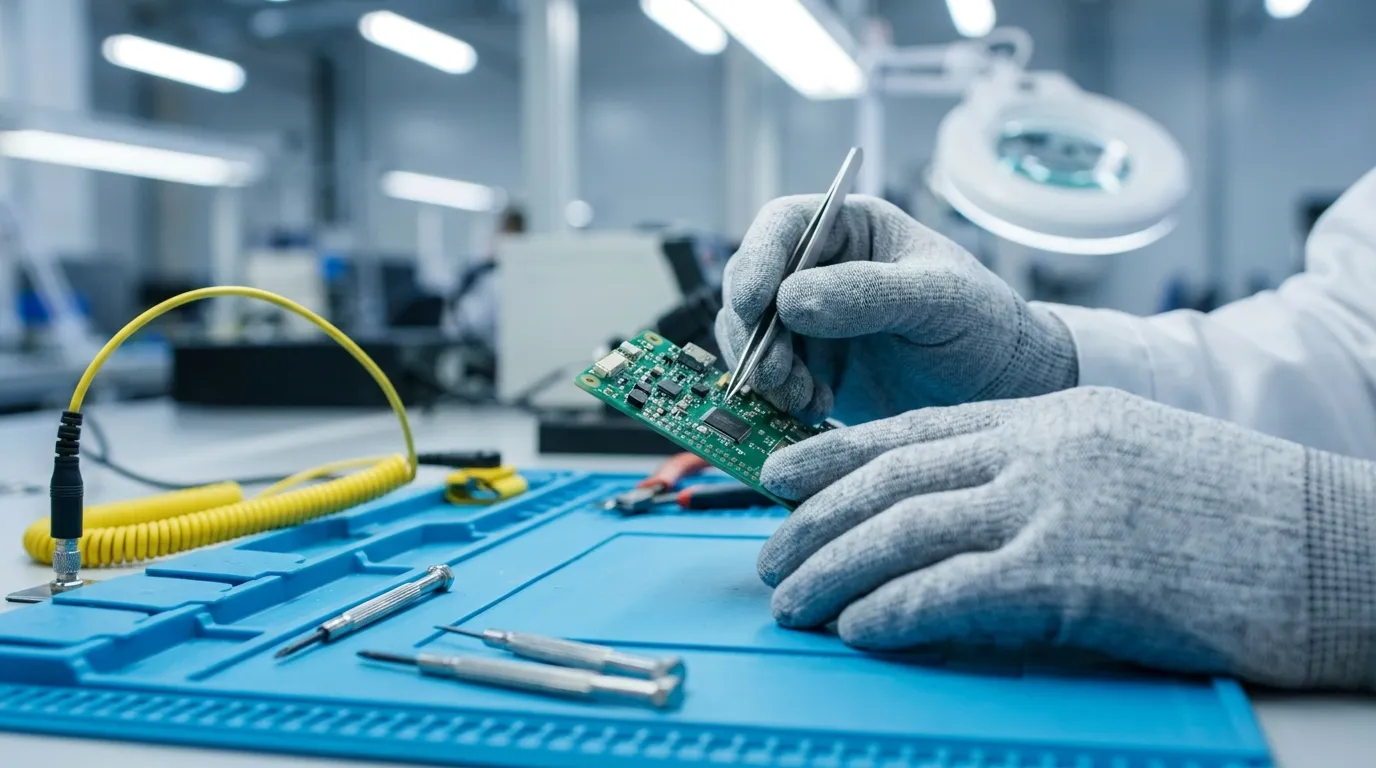
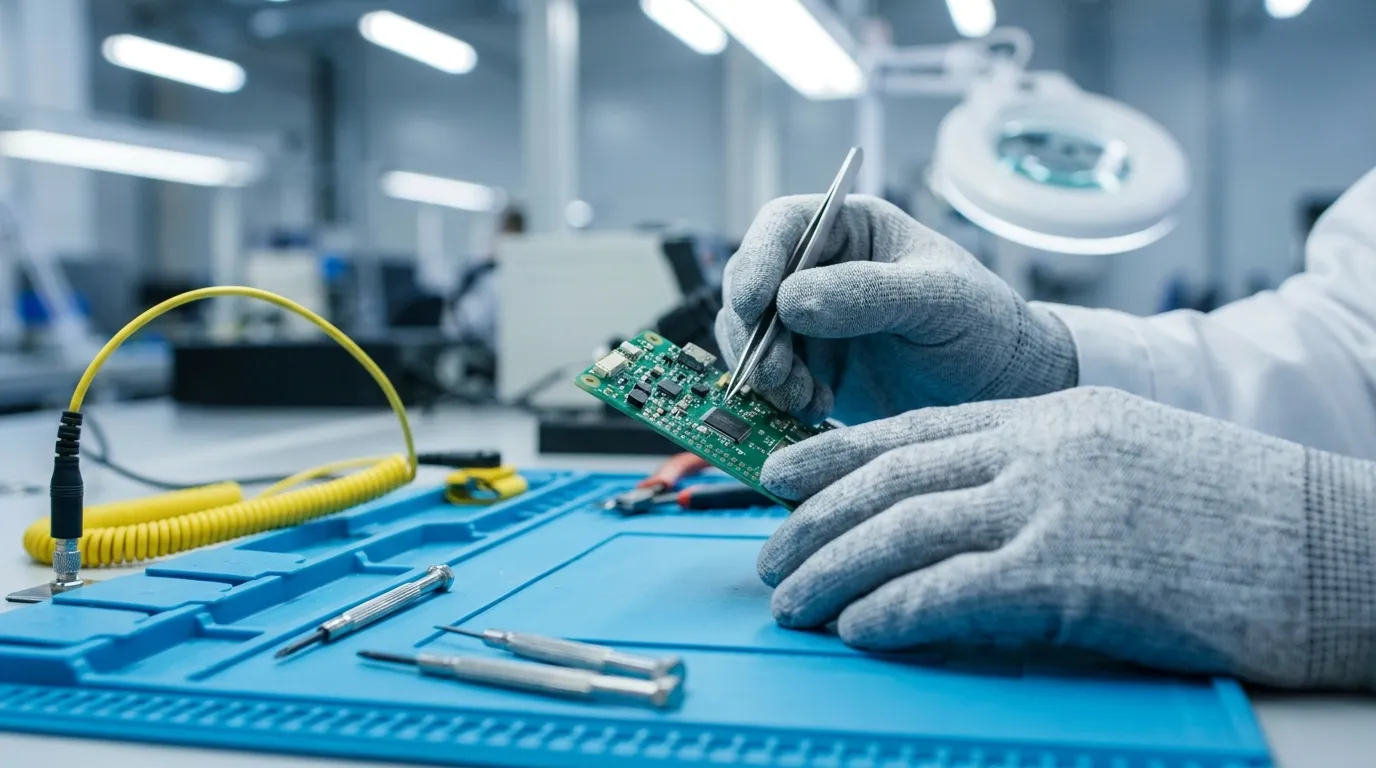
What are ESD gloves? They are conductive or static-dissipative gloves used to control electrostatic discharge when handling sensitive electronics. They help route static charge away from the hands so it is less likely to jump into PCBs, chips, sensors, or wafers. They work best with a grounded ESD setup, not alone.
Static damage is easy to miss because you may not feel it happen. A technician can touch a board, connector, or chip and still pass the part along, even if the part was weakened. That is why ESD gloves matter in electronics work. They give your hands a safer way to handle sensitive parts, but only when the glove fits the task and the workstation supports static control.
ESD gloves are gloves made with conductive or static-dissipative materials that help control electrostatic discharge while handling sensitive electronics. Their main job is to reduce static transfer from the worker’s hands to components, not to insulate against live electricity.
ESD means electrostatic discharge. It happens when stored static charge moves suddenly from one object to another. In electronics work, that object might be a circuit board, microchip, sensor, or wafer. The glove’s job is to reduce that risk during direct handling.
Do not confuse ESD gloves with electrical insulation gloves. ESD gloves are mainly for product protection. They are used to protect static-sensitive devices from damage during assembly, repair, inspection, packaging, and cleanroom handling. They are not designed for working on energized electrical systems.
What is electrostatic discharge and why does it damage electronics?
Electrostatic discharge is a fast movement of stored static charge between objects at different electrical potentials. Sensitive electronics can fail because the discharge may damage semiconductor structures, degrade parameters, or create defects that appear later.
The ESD Association explains electrostatic discharge as a rapid transfer of electrostatic charge. You may think of static as the small shock from a door handle, but electronics can be damaged by a discharge that is too small for a person to feel.
A microchip or PCB trace is much more sensitive than human skin. Analog Devices notes that ESD can damage ICs and may create cumulative damage. That means a part may not fail right away. It may pass inspection, then fail later in the field.
Think about a phone repair station. A technician opens a device, touches a connector, and replaces a board. If the workstation has no static control, a hidden discharge can weaken that board before the repair is finished. That is why gloves, mats, straps, packaging, and training all matter.
How do ESD gloves route static charge away from your hands?
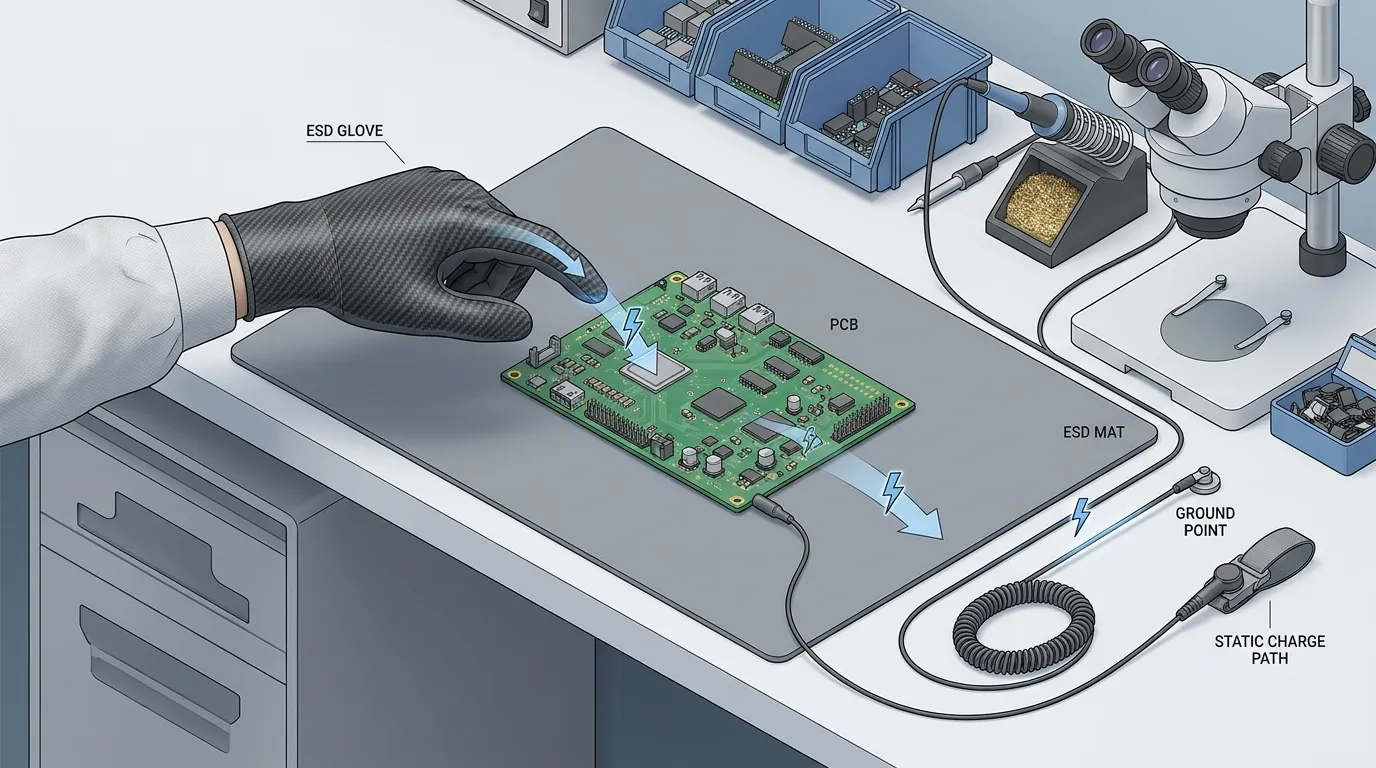
ESD gloves work by giving static charge a safer path through conductive fibers or dissipative coatings instead of letting charge jump into a component. They work best as part of a grounded ESD setup, not as a standalone fix.
The basic idea is simple. Your hand can carry static charge. An ESD glove uses conductive fibers, carbon yarns, metal threads, or static-dissipative coatings to help control that charge. Instead of allowing a sudden jump into a component, the glove supports a slower and more controlled path.
Simple charge path: hand, glove, work system, ground
A practical charge path looks like this:
Static charge builds on the worker or nearby material.
The hand contacts the inside of the glove.
Conductive yarns or coatings help move charge across the glove.
The charge enters the controlled ESD workstation.
The grounded system helps remove the charge safely.
This is why gloves work better with a mat, wrist strap, ESD-safe bench, and trained handling process. Ansell also warns that gloves reduce risk but may need to be used with grounding equipment. For board-level handling, a deeper guide on PCB assembly gloves can help match gloves to the work area.
Are ESD gloves the same as anti-static gloves?
Anti-static gloves and ESD gloves overlap, but they are not always equal. For sensitive electronics, choose gloves sold and tested for ESD control instead of assuming any “anti-static” glove gives enough protection.
In product listings, the terms often appear together. Anti-static usually means the glove helps reduce static buildup. ESD-safe should mean the glove helps control discharge in a static-sensitive work area. For low-risk handling, the difference may feel small. For PCB or semiconductor work, that difference matters.
Term
What it usually means
Main risk if misunderstood
Anti-static gloves
Help reduce static buildup
May not control discharge well enough for sensitive electronics
ESD gloves
Designed for electrostatic discharge control
Still need a grounded ESD process
Conductive gloves
Move charge more easily
May be too specialized for simple handling
Static-dissipative gloves
Slow and control charge movement
Performance depends on material, coating, and use
A buyer should check the glove’s material, resistance claim, coating type, and intended use. A general anti-static glove may be fine for light inspection, but sensitive electronics need a glove built for ESD control.
What are the main ESD glove constructions?
The three common ESD glove constructions are carbon fiber yarn, copper-thread yarn, and static-dissipative topcoat or coated designs. Each one controls static in a different way, and each one fits a different type of work.
What makes gloves ESD-safe?
A glove becomes ESD-safe when its material and construction help control static charge in the intended work environment. The control may come from conductive carbon fibers, copper or metal threads, dissipative coatings, or a mix of these features.
Construction
How it works
Best use
Watch out for
Carbon fiber yarn
Conductive carbon fibers are blended into the liner
General electronics assembly, inspection, repair
Grip may be limited if the glove is uncoated
Copper-thread yarn
Copper or metal thread helps move charge
More controlled or sensitive ESD tasks
Higher cost and may be more specialized than needed
Static-dissipative topcoat
A coating helps control surface charge and improve grip
Handling small parts, boards, tools, or packages
Coating quality and wear affect performance
PU palm or fingertip coating
Adds grip while keeping dexterity
PCB assembly and fine parts handling
Choose carefully if lint or cleanroom needs are strict
Nitrile ESD coating
Adds grip and surface protection
Packaging, inspection, or some oily handling tasks
Regular nitrile is not automatically ESD-safe
A semiconductor line may need stricter glove control than a simple repair bench. For wafer or cleanroom-related work, semiconductor ESD gloves need closer attention to lint, contamination, and process rules.
Which ESD glove gives the best cost-vs-effectiveness balance?
The best value is usually not the most conductive glove. For general electronics assembly, a carbon-fiber ESD knit or PU-coated ESD glove often balances control, dexterity, and cost. Use higher-end constructions when the process is more sensitive or tightly controlled.
A low-cost glove can be the right choice for light inspection. It becomes the wrong choice when poor grip causes dropped parts, rework, or slow handling. A coated fingertip or palm glove can cost more, but it may reduce handling mistakes.
Glove option
Relative cost
Static-control role
Grip and dexterity
Best fit
Avoid when
Carbon fiber knit
Low to medium
Good starter ESD control
High dexterity, lower grip
PCB inspection, light assembly
Parts are slippery or sharp
PU fingertip ESD glove
Medium
ESD control with better touch
Strong fingertip control
Small components, connectors, repair
Full-palm grip is needed
PU palm ESD glove
Medium
ESD control plus handling grip
Good grip, slightly less breathability
PCB assembly, packaging, tool handling
Cleanroom lint limits are strict
Copper-thread knit
Medium to high
Stronger conductive path
Depends on liner design
Sensitive or controlled processes
General assembly does not need it
ESD nitrile coating
Medium to high
ESD plus coating protection
Better grip and surface coverage
Packaging, inspection, some oily handling
The glove lacks verified ESD performance
Copper-thread gloves are not automatically the smart upgrade. They work when the process needs stronger conductive performance, but carbon-fiber ESD knit is often enough for general electronics assembly. If the task also needs device control, touch input, or small-button handling, touchscreen work gloves may be the next comparison point.
Are ESD gloves enough by themselves?
ESD gloves are not enough by themselves for high-risk static-sensitive work. They should be used with the required ESD controls for the workstation, such as grounding, mats, wrist straps, ionization, process training, and regular checks.
Gloves reduce risk, but they cannot fix a broken ESD process. If the worker is not grounded, the bench is not controlled, or parts are placed on unsafe packaging, the glove may only solve one small part of the problem. Analog Devices lists wrist straps and static-dissipative work areas as part of prevention.
For medical and electronics-related quality systems, the FDA recognizes ANSI/ESD S20.20 as a standard for ESD control programs. That matters because serious ESD control is treated as a process, not a single product purchase.
A good first check looks like this:
Use the glove required by the work instruction.
Confirm the mat, bench, or floor is part of the ESD setup.
Wear the wrist strap when the process requires it.
Keep static-sensitive parts in approved packaging.
Replace worn, dirty, or damaged gloves.
Train new workers before they handle sensitive devices.
For a PCB line, anti-static PCB gloves should match the workstation process, not replace it.
Where are ESD gloves used?
ESD gloves are used anywhere hands may contact static-sensitive electronics or clean parts. The most common areas include PCB assembly, device repair, semiconductor handling, electronics inspection, and packaging lines.
Work area
Typical task
Glove need
PCB assembly bench
Handling boards, connectors, and small components
ESD control with good dexterity
Phone repair station
Opening devices and touching internal boards
ESD glove plus wrist strap and mat
Semiconductor inspection
Handling wafers or sensitive parts
Stricter lint, cleanliness, and ESD control
Electronics packaging
Packing static-sensitive devices
ESD control with repeatable handling grip
Cleanroom or lab
Handling precision parts
Low contamination and process-approved materials
A wafer handling area has different risks than a general electronics bench. Lint, contamination, and static control may all matter at the same time. For that use case, wafer handling gloves need more careful selection than a basic inspection glove.
What should a new technician check before using ESD gloves?
A new technician should check the task, glove type, workstation controls, and glove condition before touching sensitive parts. The right glove used in the wrong setup can still leave components exposed.
The cheapest uncoated ESD glove is not always the best value. It works for light inspection, but a coated fingertip or palm glove is safer when dropped parts or poor grip can damage components. Regular nitrile gloves can also be a problem if they are clean-looking but not ESD-safe.
Step
What to check
Why it matters
1
Is the part ESD-sensitive?
Confirms whether ESD control is required
2
Is the glove ESD-rated for this task?
Prevents use of ordinary nitrile or fabric gloves
3
Does the glove fit well?
Loose gloves reduce control and dexterity
4
Is the workstation grounded?
Gloves need a working ESD system
5
Is grip enough for the part?
Poor grip can cause drops and rework
6
Is the glove clean and intact?
Dirt, coating wear, or damage can affect performance
7
Is the glove allowed by the process?
Some lines have lint or contamination rules
NASA JPL’s ESD control language also shows how strict programs may restrict unsafe materials or contamination sources. If the main hazard is not electronics, such as cold, oil, or heavy outdoor work, oil and gas gloves belong in a different selection path.
What to Do Next
Start with the task, not the glove name. If the work involves PCBs, chips, sensors, or wafers, choose ESD gloves that match the sensitivity of the process and the workstation controls. For light inspection, carbon fiber knit may be enough. For small parts or slick surfaces, a coated ESD glove is often the safer choice.
If the job also needs cut protection, coating performance, or wider hand safety planning, compare the ESD requirement with the broader coated glove selection. Static control matters, but it should fit the full work environment.
Frequently Asked Questions
What are ESD gloves?
ESD gloves are gloves made with conductive or static-dissipative materials to reduce electrostatic discharge during electronics handling. They help protect sensitive components such as PCBs, chips, sensors, and wafers from static transfer.
How do ESD gloves work?
ESD gloves work by letting static charge move through conductive yarns, fibers, or coatings instead of jumping suddenly into a component. They are most effective when used with a grounded ESD workstation.
Are nitrile gloves ESD-safe?
Regular nitrile gloves are not automatically ESD-safe. A nitrile glove should be treated as ESD-safe only when it is designed or tested for static control, such as through conductive additives or ESD-rated construction.
Are ESD gloves enough?
ESD gloves are not enough for a complete static-control process. Sensitive electronics usually need workstation controls too, such as grounding, mats, wrist straps, safe handling rules, and regular checks.
What makes gloves ESD-safe?
A glove becomes ESD-safe when its materials and construction can control static charge in the intended work environment. Common design features include conductive carbon fibers, copper or metal threads, dissipative coatings, and verified resistance performance.
Do I need ESD gloves if I wear an anti-static wrist strap?
Yes, you may still need ESD gloves if your process requires product protection, cleanliness, grip, or direct handling control. A wrist strap helps ground the worker, and gloves reduce direct transfer, contamination, and handling risk at the fingers.