Home > BLOG > Industry Blog > Eco Friendly Gloves Factory in China: 2026 Sustainable Materials and PPE Trends
Eco Friendly Gloves Factory in China: 2026 Sustainable Materials and PPE Trends
11 Aug, 2026
By hqt
The sustainability discussion around work gloves is becoming more technical in 2026. Buyers evaluating an Eco Friendly Gloves Factory in China are no longer satisfied with a "recycled yarn" label. They want to know where the fiber comes from, how much renewable or recycled content is actually present, whether it can be traced, and whether the final glove still delivers the required grip, abrasion resistance, cut protection and service life.
This change reflects a broader textile-material transition. Global recycled polyester production increased from about 8.9 million tonnes in 2023 to 9.3 million tonnes in 2024, although its market share fell to 12% because virgin polyester production grew faster. The data shows both growing supply and the continuing challenge of replacing fossil-based fibers at scale.
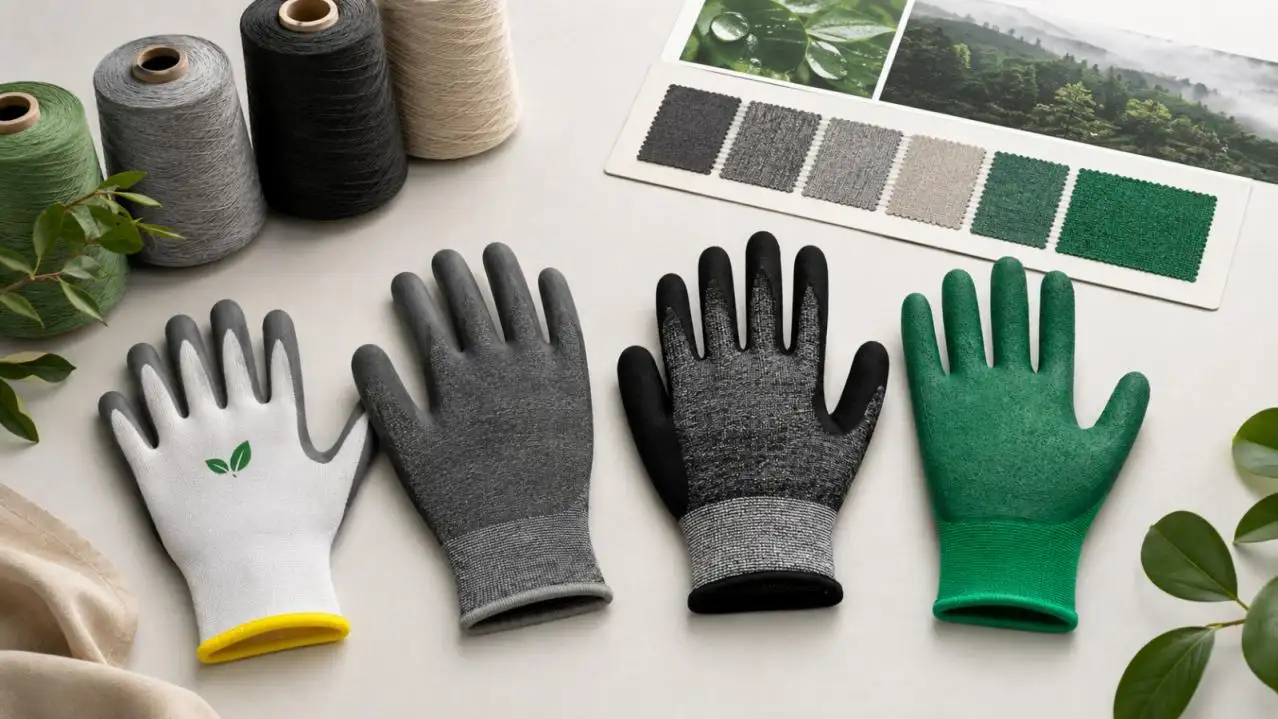
Three material routes are becoming particularly relevant to industrial gloves: recycled polyester, bio-based synthetics and cellulose-derived fibers. A fourth route—hybrid yarn engineering—is used when these materials alone cannot provide the required protection.
For an Eco Friendly Gloves Factory in China, the engineering question is therefore not "Which material is greenest?" but:
Which material can reduce dependence on virgin fossil feedstock while maintaining the required glove performance?
Eco-Friendly Glove Materials Compared
Material Strategy
Typical Origin
Sustainability Route
Technical Strength
Main Limitation
Suitable Glove Direction
Virgin Polyester
Petroleum-derived PET
Conventional baseline
Stable, economical, widely available
Fossil feedstock
General handling
RPET Polyester
Recycled PET, often bottles or textile waste
Replaces part of virgin polymer demand
Familiar polyester processing and good versatility
Quality depends on recycled feedstock and yarn control
General coated gloves
Bio-Based Nylon
Renewable biological feedstocks
Replaces part or all fossil-derived carbon
Nylon-like flexibility and durability depending on polymer
Cost, polymer type and bio-content vary
Fine-gauge flexible gloves
Bamboo-Derived Fiber
Bamboo cellulose
Renewable plant feedstock
Soft hand feel and moisture management potential
Often viscose/rayon rather than natural bamboo fiber
The table also shows why comparing materials only by recycled percentage gives an incomplete result.
RPET Polyester: The Most Scalable Recycled Route
RPET has gained attention because polyester already has an established global spinning and knitting infrastructure. Textile Exchange reports that recycled polyester production continues to grow, while initiatives across the textile sector have pushed brands toward greater use of recycled synthetics.
In gloves, recycled PET can be processed into polyester yarn and knitted into liners that are subsequently coated.
An Eco Friendly Gloves Factory has to control:
•Yarn count and uniformity
•Knitting density
•Liner dimensional stability
•Coating penetration
•Hand feel and flexibility
•Mechanical performance after coating
RPET also does not mean that the whole glove is recycled. Nitrile, latex, PU, elastane and cut-resistant reinforcement may still be conventional materials.
For sourcing verification, GRS and RCS provide third-party systems for recycled input and chain of custody. Textile Exchange states that GRS additionally includes environmental, social and chemical-processing requirements.
Bio-Based Nylon: Renewable Feedstock Without Giving Up Polymer Performance
Bio-based nylon addresses a different problem. Instead of recycling an existing polymer, it substitutes renewable feedstock for fossil raw material.
One established example is PA11 produced from castor oil. Arkema describes its PA11 as being produced from renewable castor oil and reports properties including flexibility, dimensional stability, low moisture absorption and abrasion resistance.
Growth is also supported by expanding industrial capacity: Arkema's Singapore bio-factory was developed for PA11 monomer and polymer production to address increasing Asian demand.
This does not mean every "bio-based nylon glove" uses PA11. Buyers should ask an Eco Friendly Gloves Factory in China for:
•Exact nylon chemistry
•Percentage of bio-based carbon
•Feedstock source
•Supporting certification or supplier documentation
•Comparison with conventional nylon performance
That distinction prevents "bio-based" from becoming an undefined marketing term.
Bamboo-Based Liners Require More Careful Material Claims
Bamboo appears attractive because it is plant-derived, but textile terminology matters.
The U.S. Federal Trade Commission states that a textile can be called bamboo only when it is made directly from bamboo fiber. When bamboo is used as the cellulose source for rayon or viscose, it should be described as rayon or viscose made from bamboo.
For PPE buyers, the relevant questions are therefore:
•Is the liner mechanically processed bamboo fiber or regenerated cellulose?
•Which chemical process produces the fiber?
•What percentage of the liner uses it?
•How does abrasion and dimensional stability compare with polyester or nylon?
This makes bamboo-derived yarn more suitable for evaluating comfort and renewable feedstock than for making unsupported claims such as "biodegradable industrial glove."
Why Hybrid Yarns Matter for Cut-Resistant Gloves
Sustainable fibers alone may not deliver the required cut resistance. A cut-resistant construction can combine recycled or alternative fibers with HPPE, glass fiber, steel fiber or other reinforcement.
This creates an important trade-off:
Priority
Material Response
Lower virgin-polyester use
Increase RPET content
Renewable feedstock
Consider bio-based nylon
Comfort-oriented liner
Evaluate bamboo-derived fiber
Higher cut protection
Use engineered hybrid yarn
Longer service life
Optimize liner + coating together
Hybrid construction is particularly relevant because environmental improvement has little value if a glove fails prematurely and needs frequent replacement.
Coating Choice Changes the Final Environmental and Functional Profile
The liner is only one part of a coated glove. Different coatings change grip, durability, flexibility and process requirements.
• Water-based PU: lightweight and flexible; process chemistry is a key sustainability consideration.
• Microfoam nitrile: useful where dexterity, breathability and controlled grip are important.
• Sandy nitrile: selected when stronger grip is needed in oily or wet handling.
• Latex: high elasticity and grip, but manufacturing chemistry and end-use requirements must be considered.
An Eco Friendly Gloves Factory in China should therefore optimize the liner and coating as one system rather than marketing the recycled yarn separately.
Sustainable Materials Still Need PPE Validation
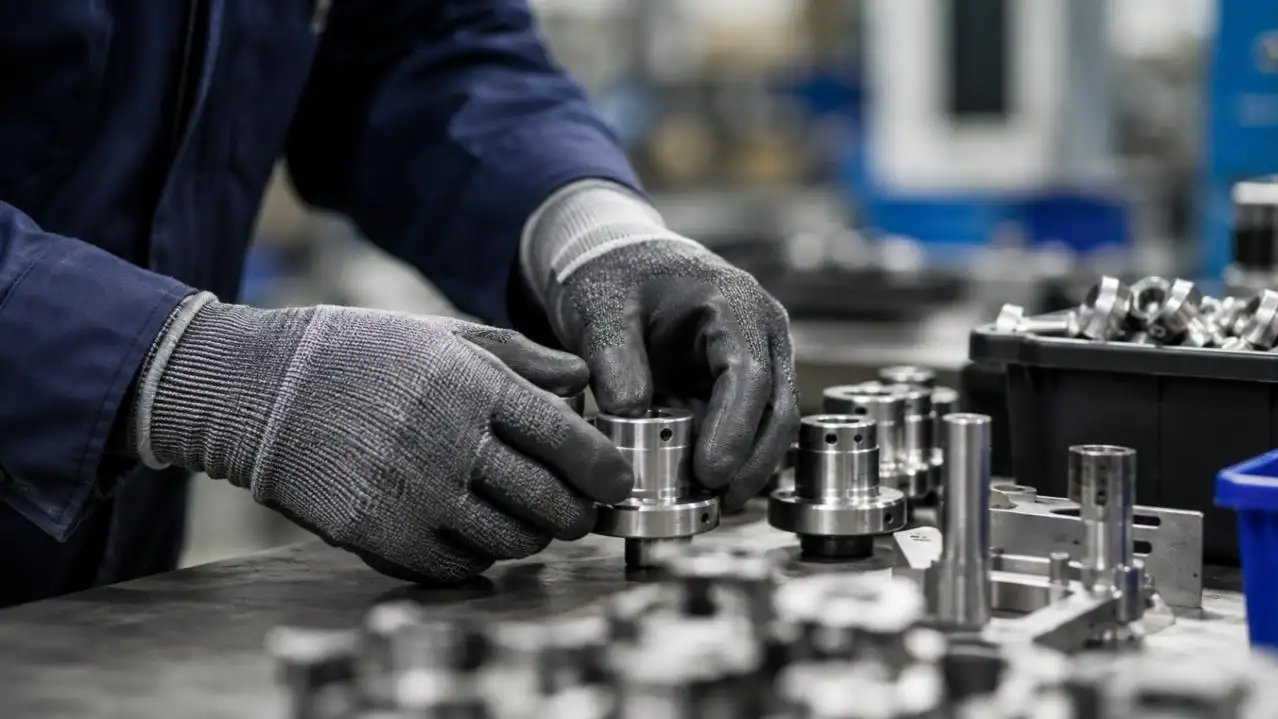
Material origin does not determine safety performance. Protective gloves still require application-specific verification.
ISO 21420 covers general glove design, construction, innocuousness, comfort and efficiency, while ISO 13997 provides a method for determining resistance to cutting by sharp edges.
For industrial procurement, useful comparisons include:
• Abrasion and tear performance
• ISO 13997 cut resistance where applicable
• Grip under dry, wet or oily conditions
• Dexterity
• Coating adhesion
• Wear life
• Replacement frequency
A higher recycled-content percentage is therefore only useful when the finished glove remains suitable for the actual hazard.
How NMSafety Applies Different Sustainable Material Routes
NMSafety currently offers multiple eco-friendly glove constructions rather than relying on one material concept. Its range includes RPET polyester liners, bio-based nylon constructions, bamboo liners, thermal hybrid structures, and several nitrile, latex and other coating options.
This gives buyers different starting points depending on whether the priority is recycled content, renewable feedstock, fine-gauge dexterity, cut protection or cold-weather performance.
When selecting an Eco Friendly Gloves Factory in China, the better approach is to define the hazard, required EN/ANSI performance, working environment, material target and documentation requirements first.
For an eco-friendly glove development project, NMSafety can review these requirements and help compare liner materials and coating structures before samples are submitted for performance evaluation.
FAQs
Q1. What types of sustainable glove materials does NMSafety provide?
NMSafety employs a number of eco-friendly material strategies to develop sustainable work gloves, including RPET recycled polyester, bioplastic nylon, and bamboo with hybrid yarns. Based on the balance of protection, comfort, durability, and sustainability needs, the final material combination can be selected.
Q2. Can NMSafety make work gloves with RPET recycled polyester?
Yes. NMSafety has glove designs with RPET polyester liners. For B2B sourcing, the buyers need to set the targets for the recycled content, the type of coating, the gauge of the glove and its performance, as well as the required supporting evidence for sample development.
Q3. Does NMSafety provide bio-based nylon gloves?
Yes. NMSafety provides bio-based nylon as one of the eco-friendly glove materials. Since the bioplastic nylon can have different chemistry and renewable content from different suppliers, the buyers should specify the exact material and the required supporting evidence for their project.
Q4. Are all the materials used to make NMSafety's gloves eco-friendly?
Not necessarily. A glove may use recycled materials in the knitted liner while still using traditional polymers in the coating, elastic yarns, and protective reinforcement. When sourcing, buyers should evaluate recycled content on a component basis, and not assume that the entire glove is eco-friendly.
Q5. What are the options for sustainable liners and coatings offered by NMSafety?
Depending on the use, NMSafety can develop eco-friendly glove constructions using coatings such as water-based PU, microfoam nitrile, sandy nitrile, and latex, among others. The selection of coatings depends on the required balance of grip, abrasion, flexibility, and breathability for the given working conditions.