Home > Uncategorized > Anti-Static Gloves for PCB Assembly & Soldering
Anti-Static Gloves for PCB Assembly & Soldering
11 May, 2026
By arafatshuvo509
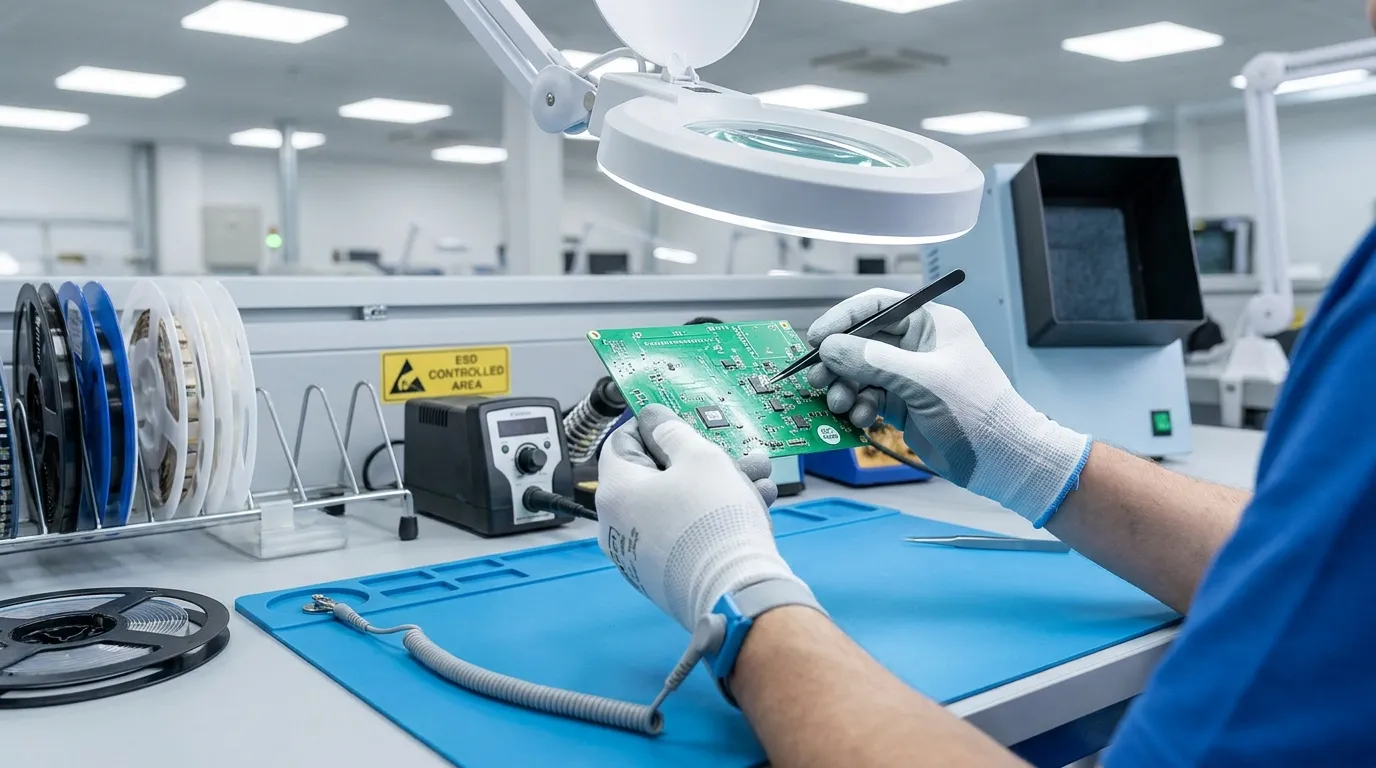
Anti static gloves for PCB assembly should protect boards from both ESD and contamination. Specify gloves with verified resistance testing, low-lint construction, suitable PU or ESD coating for the task, and a laundering rule that retires gloves when resistance, fit, lint, or coating condition drifts. For soldering and rework cells, gloves must support grounding and handling discipline, not replace them.
A PCB glove is a small item with a big quality impact. One poor glove choice can add charge risk, fingerprints, fibers, or coating wear into a line that already has tight process controls. Production engineers need more than a product label. They need a glove spec that operators can wear all shift, QA can inspect, and the ESD program can defend.
What should anti-static gloves do on a PCB assembly line?
Anti-static gloves for PCB assembly should reduce static discharge risk while blocking skin oils, salts, and fingerprints from reaching boards. They are part of an ESD control system, not a replacement for grounding or handling discipline.
The glove has two jobs on a PCB line. It should help control electrostatic discharge, or ESD, when operators handle sensitive boards and components. It should also reduce direct skin contact with solderable surfaces, pads, leads, and assemblies.
This matters in SMT placement, soldering, inspection, rework, and final handling. A good glove supports the wider ESD protected area, also called an EPA. It works with wrist straps, grounded benches, ESD flooring, packaging, and operator training under an ESD control program such as ANSI/ESD S20.20.
For a production engineer, the best glove is not the one with the biggest claim on the package. It is the one that controls charge, limits contamination, fits the task, and keeps working after real use.
Why does bare-hand contact destroy PCB yield?
Bare hands hurt PCB yield because oils, salts, dirt, and fingerprints can transfer to soldering surfaces. That contamination can cause poor wetting, weaker solder joints, voids, corrosion risk, and coating adhesion problems.
Bare-hand contact looks harmless during normal handling, but PCB surfaces are not forgiving. Fingers can leave oils, salts, sweat, and fine dirt on pads, leads, and board surfaces. Those residues can create soldering defects or later reliability issues.
Yield callout: If an operator touches a bare board before soldering, the issue may not show up right away. It may appear later as poor wetting, weak solder joints, voiding, corrosion risk, or conformal coating adhesion trouble.
Circuitnet’s PCB handling guidance links bare fingers with contamination that can affect wetting and solder quality during assembly. A related SMTA contamination paper also notes that gloves and finger cots reduce skin oil and salt transfer, but dirty gloves can become a new contamination source if they are reused badly.
That is why the glove rule must include replacement behavior. A clean ESD glove protects the board. A dirty glove stored in a pocket, worn across multiple wet processes, or used past its service limit can move contamination from one board to the next.
Which surface resistance specs should production engineers ask for?
Production engineers should request glove or finger-cot resistance test data, preferably tied to ANSI/ESD STM15.1, plus proof that the glove works in the facility’s ESD control system. A generic “anti-static” claim is not enough.
The first buying rule is simple: ask for test evidence. A supplier should provide resistance data for the glove or finger cot, not only a broad statement about anti-static material. ANSI/ESD STM15.1 is a key reference because it covers electrical resistance measurement for gloves and finger cots with personnel as a system.
Ask for glove test data, not just material marketing
A useful request for quotation should ask for these items:
Spec item
What to ask the supplier
Why it matters
Glove resistance data
Test method, result range, sample size
Confirms the glove was measured
Finger or palm coating data
Coating type and tested area
Checks the contact surface operators use
Lot traceability
Lot number and production date
Helps QA isolate problems
Laundering limit
Wash method and retest guidance
Prevents uncontrolled reuse
Cleanliness notes
Lint, powder, residue, packaging
Supports contamination control
Resistance is still only one part of the decision. ESDA guidance explains that low charging behavior is not always predicted by resistance or resistivity alone. That means a glove can look good on one data point and still need real process validation.
Match the glove to the EPA control plan
The glove should fit the plant’s full ESD program. ANSI/ESD S20.20 applies to organizations handling electronic parts and assemblies that can be damaged by ESD. It is a program standard, not a simple product label.
Use one link to broader coated glove selection when the writer needs to explain grip, coating coverage, and wear in general terms. Keep this article focused on PCB assembly and rework decisions.
PU coating, ESD topcoat, or uncoated knit: which is safer for soldering and rework?
PU-coated ESD gloves usually fit PCB assembly best when operators need grip, tactility, and low mark transfer. Uncoated knit works for light handling, and disposable ESD nitrile may fit contamination-sensitive rework when validated.
PU fingertip coating is often the best starting point for SMT and PCB handling. It gives controlled grip without covering the whole hand. That helps operators place parts, hold boards, and inspect assemblies without losing too much feel.
PU palm coating is not always the best choice. It works when operators need stronger grip, but PU fingertip coating is often safer for fine SMT handling where tactile control matters more than full-palm coverage. An ESD topcoat or conductive liner can help, but it still needs test evidence.
PCB task
Preferred glove style
Coating choice
Main risk to control
When not to use
SMT placement
Nylon or carbon ESD knit
PU fingertips
Slips, fingerprints, static
If coating leaves marks
Manual soldering
ESD knit or finger cots
Light PU fingertip
Heat proximity and tactility
If operators cut fingertips
Rework bench
ESD glove or ESD nitrile
Task validated
Solvent and flux residue
If glove swells or sheds
Inspection
Low-lint ESD knit
Minimal coating
Fibers and fingerprints
If grip is too weak
Conformal coating
Low-lint clean glove
Smooth surface
Fibers and residues
If knit sheds near coating
Final packaging
ESD handling glove
Palm or fingertip grip
Dropped boards and charge
If gloves are dirty
The decision should match the cell. A feeder setup operator may need PU fingertips. A conformal coating operator may need lower lint first. A rework tech using IPA needs a glove rule that covers chemical exposure and replacement.
How should you judge lint, particles, and contamination risk?
Judge lint risk by what the glove releases during real work, not only by how clean it looks in a catalog. A PCB glove should not shed loose fibers, leave powder, transfer coating marks, or carry residue from one process to another.
For fine-pitch PCB work, lint can create rework headaches. It can sit near solder joints, stick around coating areas, or move into inspection zones. Gloves should be checked after bending, gripping, cleaning contact, and repeated board handling.
Use this checklist during sampling:
Rub the fingertips on a clean dark and light surface to check visible shedding.
Inspect the coating after repeated board handling.
Check whether the glove leaves marks on boards, fixtures, or trays.
Keep gloves away from flux, solder paste, and wet chemistry unless approved.
Ban pocket storage of used gloves.
Replace gloves that look dirty, stretched, cracked, or fuzzy.
A conformal coating line needs stricter control than a final packaging bench. In that scenario, loose cotton gloves are a poor choice because fibers can affect surface cleanliness before coating. Low-lint ESD gloves are safer when the board surface must stay clean.
How many washes before anti-static gloves should be retired?
Reusable ESD gloves should be retired by test result, not by habit. Set a launder-cycle chart that checks resistance, fit, lint, coating wear, and cleanliness at defined intervals based on supplier data and internal validation.
There is no safe universal wash number for every glove and every process. The right limit depends on the glove material, coating, wash method, chemicals used on the line, and the plant’s own ESD and cleanliness checks.
Reusable ESD gloves are not automatically cheaper. They only save money when laundering, inspection, and retirement rules are controlled. Dirty reusable gloves can become a contamination source, especially when operators move between soldering, rework, cleaning, and inspection.
Launder stage
Resistance check
Fit and shrinkage
Lint check
Coating wear
QA action
New lot
Record baseline
Confirm size fit
Inspect sample
Check fingertips and palm
Release if all pass
After first wash
Retest sample
Compare to baseline
Check shedding
Look for cracks or peeling
Release or hold
Mid-cycle sample
Retest by plan
Check stretch and cuff
Inspect used surface
Check grip zones
Keep, repair rule, or retire
Pre-retirement sample
Retest higher-risk sizes
Check operator complaints
Check fibers and residue
Inspect coating loss
Retire if any limit fails
Fail condition
Out of range or unknown
Poor fit
Visible lint
Cracks, peeling, sticky surface
Remove from line
For an IPA rework station, add a stricter rule. Gloves exposed to wet cleaning, flux residue, or dirty benches should be replaced instead of returned to storage. That one rule prevents many hidden contamination loops.
What incoming QA checks should go into the glove specification?
Incoming QA should check documents, samples, packaging, and line fit before gloves reach production. A glove specification should make pass and fail rules clear enough for purchasing, QA, and supervisors to apply the same way.
A glove labeled anti-static is not enough for a PCB line. The buyer should ask for glove resistance data and validate the glove inside the ESD control program. The same lot should also be checked for lint behavior, coating quality, and operator fit.
Use this release checklist:
Confirm supplier name, model, size range, lot number, and production date.
Match the glove to the approved material and coating description.
Review resistance test data and test method.
Inspect packaging for dust, damage, or mixed lots.
Check fingertip and palm coating for cracks, peeling, or sticky areas.
Confirm sizes with actual operators from the target cell.
Test sample gloves after the first approved wash cycle.
Keep one new sample as a visual baseline.
Define when supervisors must remove gloves from use.
In a manual soldering bench, add one more rule: operators must not cut off fingertips to improve feel. If they do, the glove spec has failed in practice. Choose a better size, thinner liner, or fingertip coating instead.
How should a soldering or rework cell roll out the glove change?
Roll out the glove change in one cell first, then expand after operators and QA agree it works. A pilot prevents a good specification from failing because of poor fit, weak training, or unclear replacement rules.
Start with a real cell, such as manual soldering or SMT feeder setup. Give operators two or three approved sizes, then watch how they handle boards, tweezers, trays, and fixtures. Check whether they remove gloves for fine work or store used pairs in pockets.
Use this rollout process:
Pick one soldering or rework cell for a two-week trial.
Train operators on ESD risk and bare-hand contamination.
Set glove bins for clean, used, and rejected gloves.
Ban cut fingertips, shared dirty gloves, and pocket storage.
Review defects, handling complaints, and contamination findings.
Adjust glove size or coating before full release.
Add the final glove rule to work instructions.
For an SMT feeder and placement cell, PU fingertips may solve grip and dexterity problems. For a rework bench using solvent, the same glove may fail faster. Treat those as two different use cases, even if both handle PCBs.
When are anti-static gloves not enough by themselves?
Anti-static gloves are not enough when the rest of the ESD control system is weak. They cannot replace wrist straps, grounded benches, ESD flooring, ionization, safe packaging, training, or process audits.
The glove controls one contact point: the operator’s hand. It does not solve charged tools, insulating trays, ordinary plastic bags, dry air, poor grounding, or uncontrolled movement in and out of the EPA. Those problems still need normal ESD controls.
Use gloves as one layer in the process. ESDA guidance explains that ESD control depends on more than one material property. The glove must fit the larger control plan, and QA should confirm that the plan works on the floor.
What to Do Next
The right anti static gloves for PCB assembly come from a controlled specification, not a quick product search. Start with the cell that has the highest handling risk, such as solder touch-up, SMT feeder setup, or conformal coating prep. Ask suppliers for test data, sample the gloves on real operators, and build a wash and retirement rule before full rollout. If the glove protects boards but slows operators down, keep testing. The best choice protects yield and still gets worn correctly.
Frequently Asked Questions
What are antistatic gloves or ESD gloves?
Anti-static or ESD gloves are gloves designed to reduce harmful electrostatic discharge when handling sensitive electronics. For PCB assembly, they also help reduce direct skin contact with boards, components, and solderable surfaces.
Do rubber gloves work as anti-static?
Standard rubber gloves should not be assumed to be anti-static. A PCB line should use gloves with verified ESD performance, because ordinary insulating gloves may trap charge or fail the facility’s ESD control requirements.
Are PU coated ESD gloves reusable and washable?
Some PU coated ESD gloves are reusable and washable, but the buyer must verify this with supplier data and internal checks. Laundering should not be unlimited, because fit, coating, lint, and resistance can drift over time.
What is the difference between PU coated and PVC dotted ESD gloves?
PU coated ESD gloves usually give smoother, more continuous grip for small PCB parts. PVC dotted gloves can help with larger or slippery items, but they may offer less fine-touch control for SMT and inspection tasks.
Do these gloves meet ANSI/ESD S20.20 requirements?
A glove does not meet S20.20 by label alone. Ask for glove resistance testing, product qualification records, and proof that the glove works inside your facility’s ESD control program.
Should operators wear gloves before soldering or reflow?
Operators handling boards before soldering or reflow should use approved gloves or finger cots when the process requires contamination control. The glove must be clean, ESD-safe, and changed before it becomes a contamination source.