Home > BLOG > Industry Blog > Anti Static Gloves OEM in China for ESD Performance Consistency
Anti Static Gloves OEM in China for ESD Performance Consistency
13 Aug, 2026
By hqt
For electronics manufacturers, the difficult part of sourcing anti-static gloves is not obtaining one sample with an acceptable resistance reading. The real challenge is reproducing that electrical behavior across yarn lots, knitting batches, coating runs, washing cycles, and changing workplace conditions.
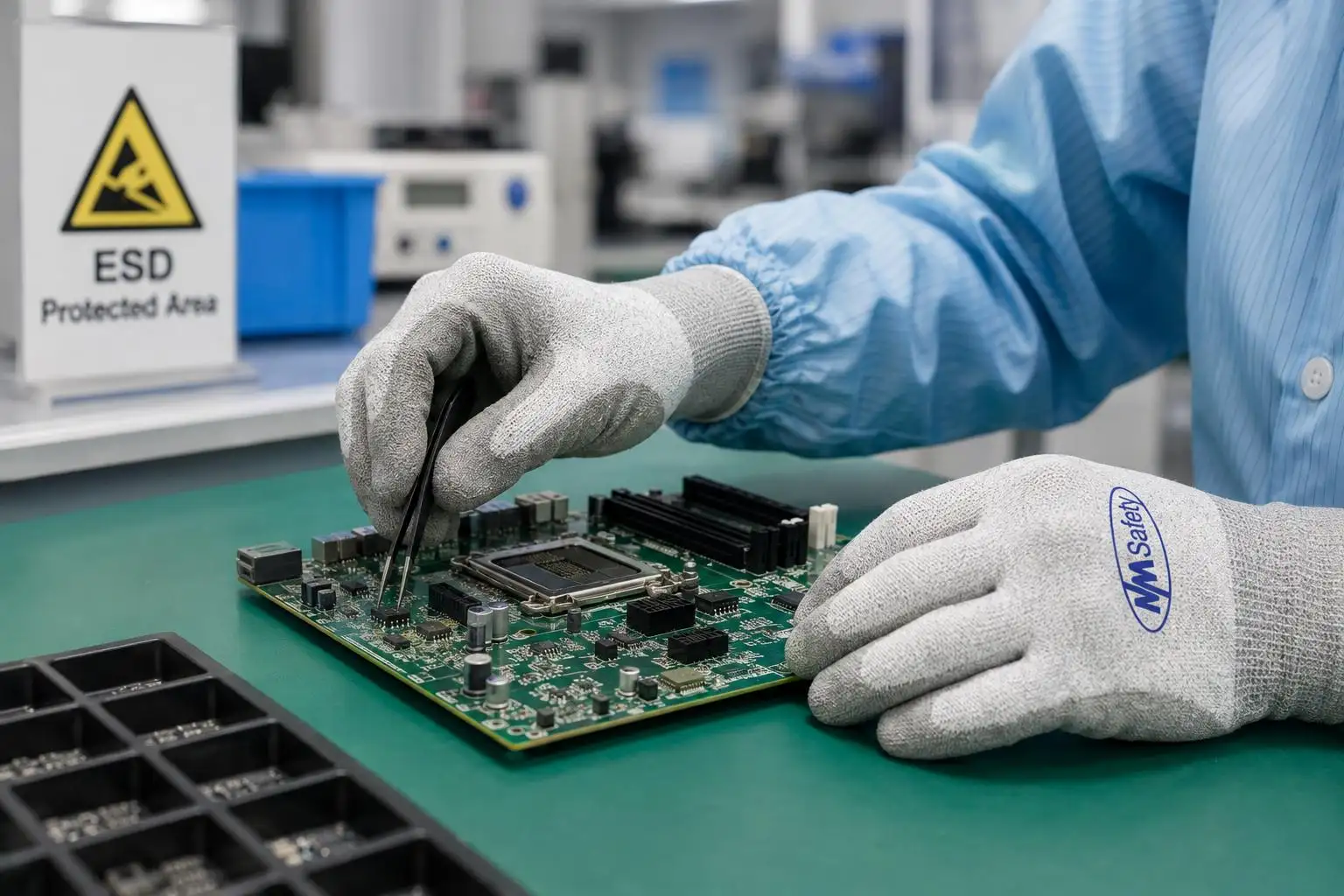
A capable Anti Static Gloves OEM in China, therefore, needs to control the glove as an electrical and mechanical system—not simply add carbon fiber to a nylon liner. For PCB assembly, semiconductor handling, component inspection, and precision electronics, the critical question is repeatability under defined conditions.
Carbon fiber, nylon, and some other synthetic fibers form either conductive or dissipative yarns and create paths of charge dissipation in anti-static gloves.
The selection of fibers is only part of what influences the entire glove:
Conductive yarn → spacing of yarn → density of knit → coating → contact area → surrounding conditions → wear → testing method
This standard is relevant because IEC 61340-5-1:2024 addresses the protection of ESD-sensitive components in the ESD control program, considering the provision of a single ESD-related PPE item as insufficient.
Key Construction Variables
• Variable ESD Relevance Manufacturing Risk
• Conductive yarn forms charge-dissipation paths Lot-to-lot variation
• Yarn spacing Affects network continuity Uneven distribution
• Knitting gauge Affects thickness and contact geometry Variation in tension/stitch
• PU coverage Affects grip and exposed liner area Variable coating thickness
• Fit Affects hand/glove contact Size variation
• Wear Affects pathways Abrasion and fiber damage
For an Anti Static Gloves OEM in China, addressing these variables is more important than quoting a resistance number without context.
Why Does Resistance Change Between Production Batches?
1. Conductive Yarn Is Not Just a Material Name
Two liners described as "nylon + carbon" can still behave differently if conductive yarn distribution, filament geometry, yarn tension, or spacing changes.
OEM production should therefore control more than the nominal composition. Critical checkpoints may include:
• Approved yarn specification
• Conductive yarn supplier or lot identification
• Liner weight and gauge
• Knitting-machine settings
• Stitch density and yarn tension
• Retained production samples
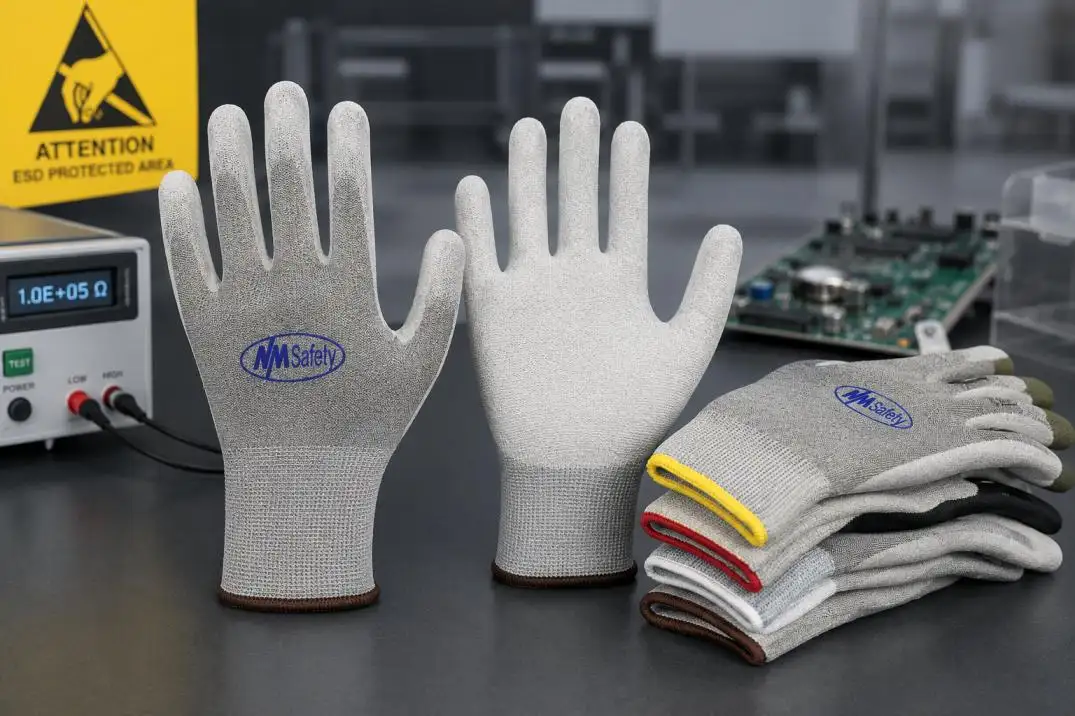
For example, NMSafety offers 13-gauge nylon/carbon knitted constructions in its ESD fingertip-coated range.
2. Gauge Affects More Than Dexterity
Gauge is commonly discussed as a comfort parameter, but changing the knitted structure also changes liner thickness, yarn spacing, and contact geometry.
A finer glove can improve fingertip control for small electronic components, but an Anti Static Gloves OEM in China still needs to verify that changes in gauge or yarn layout do not unintentionally change the targeted electrical behavior.
3. Coating Coverage Changes the System
PU coating is useful for grip and precision handling, but palm-coated, fingertip-coated, and uncoated gloves should not automatically be treated as electrically equivalent.
Construction
Main Benefit
Main Control Point
Uncoated knit
Maximum liner exposure
Grip and abrasion
PU fingertips
Fine-component handling
Dip depth and fingertip coverage
PU palm
Larger gripping surface
Coating uniformity
ESD + cut-resistant
Multi-hazard protection
More complex liner/coating interaction
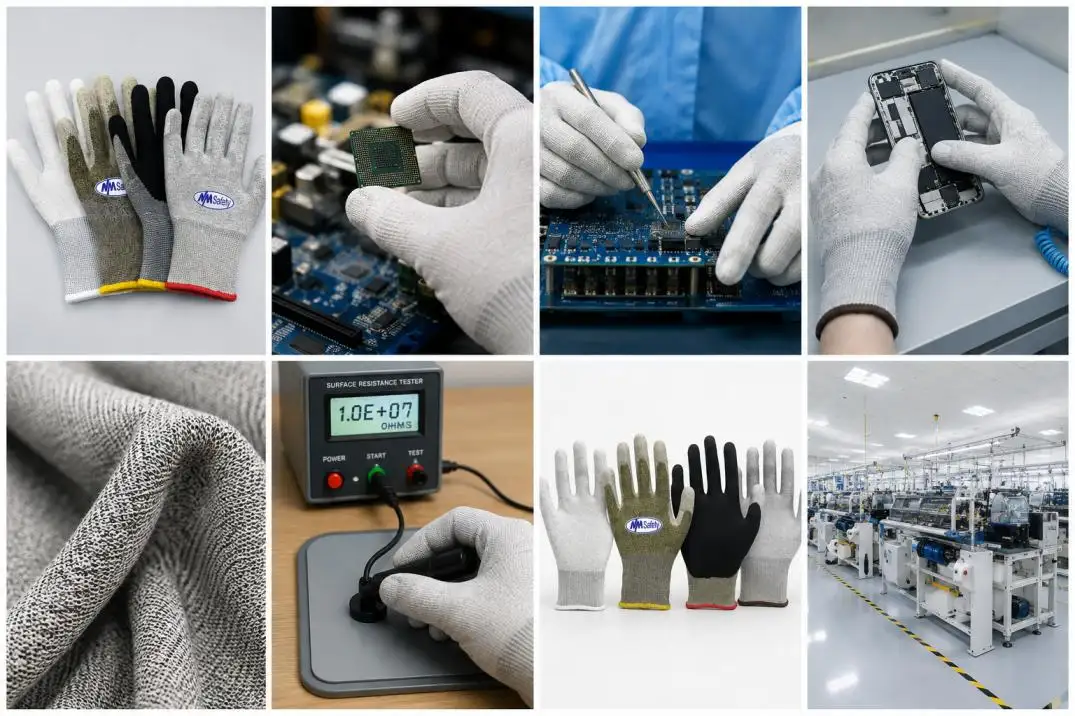
NMSafety currently offers uncoated ESD knitted gloves, PU fingertip constructions, PU palm styles, and ESD cut-resistant coated designs, illustrating how different mechanical requirements can require different glove structures.
Test Conditions Matter as Much as the Number
A specification stating only "Resistance: X Ω" is incomplete for technical sourcing.
Electrical verification should identify the applicable test method and record relevant conditions such as:
• Temperature
• Relative humidity
• Conditioning period
• Test voltage
• Electrode arrangement
• Sample location and quantity
Humidity is particularly important because electrostatic behavior is environment-dependent. Buyers comparing samples from different laboratories should therefore avoid treating two resistance values as directly comparable unless the test conditions are also comparable.
For Anti Static Gloves OEM in China programs, the approved test method and conditioning conditions should ideally be frozen together with the physical glove specification.
Sample Approval Is Not Bulk-Production Control
A common sourcing mistake is approving one sample and then checking bulk production mainly for size, color, coating appearance, and packaging.
For ESD products, the approved sample should become a controlled technical reference.
Recommended OEM Control Flow
Define
• Application and ESD-control requirement
• Liner material and gauge
• Coating type
• Electrical acceptance criteria
Approve Prototype
• Fit and dexterity
• Grip
• Coating coverage
• Electrical performance
Freeze Pre-Production Parameters
• Yarn specification
• Knitting structure
• Coating process
• Agreed test conditions
Verify Bulk Production
• Incoming yarn lot
• Liner construction
• Coating consistency
• Electrical sampling
• Batch identification
This is where a technically capable Anti Static Gloves OEM in China differs from a supplier that only reproduces the visual appearance of the approved sample.
Initial ESD Performance vs. Service-Life Performance
ESD behavior may also change during use. Repeated flexing, abrasion, contamination, washing, detergent residues, coating wear, and damage to conductive fibers can affect the glove system.
For reusable electronics assembly gloves, buyers should therefore define:
• Expected service life
• Permitted cleaning method
• Replacement criteria
• Whether periodic verification is required
The question is not simply, "Does the new glove pass?" but also, "How will the glove be controlled throughout its intended use?"
IEC 61340 and EN 16350: Do Not Mix the Applications
Standards are another common sourcing problem.
Standard
Primary Purpose
IEC 61340-5-1:2024
ESD control program for electronic devices
IEC TS 61340-5-4:2026
Compliance verification within ESD control programs
EN 16350:2014
Electrostatic dissipative gloves for flammable/explosive environments
IEC TS 61340-5-4:2026 specifically addresses compliance verification for protection of electronic devices from electrostatic phenomena.
By contrast, EN 16350 addresses gloves used where flammable or explosive atmospheres may exist, and its scope explicitly excludes protection of electronic devices.
Therefore, an Anti Static Gloves OEM in China should not present EN 16350 alone as proof that a glove is suitable for every electronics ESD application.
How NMSafety Supports Different ESD Glove Structures
NMSafety provides a useful example of an Anti Static Gloves OEM in China offering multiple constructions instead of applying one glove architecture to every task.
• PU fingertip-coated designs for controlled handling;
• PU palm-coated structures for greater grip coverage;
• Uncoated knitted anti-static gloves;
• 18-gauge ESD cut-resistant liners with PU or nitrile coatings.
This allows glove selection to start with the application—dexterity, grip, mechanical protection, touchscreen use, and ESD-control requirements—rather than simply choosing one generic "anti-static glove."
Conclusion: Control the Process, Not Just the Sample
For buyers sourcing from an Anti Static Gloves OEM in China, consistent ESD performance requires control of conductive yarn, knitting geometry, coating, environmental conditions, test methods, production batches, and service life.
A low resistance value from one sample is not enough. Repeatability under an agreed specification is the more useful purchasing metric.
For electronics or private-label programs, NMSafety's range of carbon-fiber knitted, fingertip-coated, palm-coated, uncoated, and cut-resistant ESD constructions provides a practical basis for comparing samples and developing an OEM specification around the actual application rather than relying on a generic anti-static claim.
FAQs
Q1. Does NMSafety provide Anti Static Gloves OEM?
Yes, NMSafety offers OEM services for anti-static gloves used in industrial settings and electronics. This includes customization for various liner constructions, coatings, sizes, colors, logos, and packaging.
Q2. What materials does NMSafety use for anti-static gloves?
NMSafety provides ESD gloves made of conductive liner constructions combining nylon and carbon fiber. The selection of the liner construction depends on the required dexterity and the user’s trade off between ESD performance and durability for a specific application.
Q3. What coating options are available for NMSafety ESD gloves?
Depending on the application, NMSafety can provide uncoated knitted gloves, gloves with PU fingertip coating, gloves with PU palm coating, and a number of ESD gloves designed to provide basic mechanical protection.
Q4. What is the difference between PU fingertip and PU palm anti-static gloves?
PU fingertip coating enhances grip at the fingers and allows for precision handling since most of the coating is liner. PU palm coating is more protective and enhances grip for larger handling.
Q5. Can NMSafety customize anti-static gloves for private-label buyers?
Yes, private label (OEM) anti-static gloves can be customized for logos, colors, packaging, and labeling. Further, the applicable commercial specifications can be included. However, the technical specifications will be required to be fulfilled during the sample development process.