Home > Uncategorized > PU-Coated Gloves for Electronics & PCB Assembly
PU-Coated Gloves for Electronics & PCB Assembly
15 May, 2026
By arafatshuvo509
PU coated gloves for electronics work best when the glove is thin, low-lint, and ESD-compatible for the actual PCB task. Use PU fingertip coating for SMT pinch sensitivity, PU palm coating for broader handling grip, and a tested ESD PU variant for static-sensitive components. Validate with a dust pickup test, pinch test, and ESD documentation check before bulk rollout.
A PCB line needs more than a glove that “feels comfortable.” Operators need grip without losing small-part control. Quality teams need fewer fibers, marks, and handling defects. ESD teams need proof that the glove fits the site’s static-control rules. That is why PU coated gloves should be tested by task, not approved from a catalog photo.
Are PU coated gloves good for electronics and PCB assembly?
PU coated gloves can work well for electronics and PCB assembly when they are thin, clean-handling, and matched to the ESD needs of the line. For SMT and inspection, choose PU fingertip or thin palm coating over heavy general-purpose coatings.
PU coating gives a dry, flexible grip without the thick feel of many heavier coatings. That makes it useful for PCB inspection, light assembly, tray handling, packing, and some SMT support work. If your team needs a basic material refresher, start with PU coating basics.
The key is not the word “PU” alone. A PCB plant should look at coating layout, liner gauge, lint behavior, fit, and ESD test data. A thin PU fingertip glove can feel very different from a bulky palm-coated glove made for general warehouse work.
Dry grip on boards, trays, tools, and fixtures
Better control than bare hands during repeated handling
Light abrasion protection without heavy coating
Cleaner handling than direct skin contact
ESD compatibility, if the glove is built and tested for it
What problem is the glove solving on a PCB line?
A PU glove should be selected for a specific production problem, not because one glove seems good for the whole factory. On a PCB line, the glove may protect the product, the worker, or both. Those are different jobs.
OSHA’s hand protection rule says glove selection should match the task, conditions, duration, hazards, and glove performance characteristics under 29 CFR 1910.138. For broader cut risks, hand hazards, and glove ratings, send the reader to cut-resistant glove selection instead of turning this article into a full cut-level guide.
PCB line problem
Better glove direction
Why it matters
Finger oils on boards
Thin PU fingertip or palm glove
Reduces direct skin contact
Small SMT part handling
PU fingertip, 18G liner
Keeps pinch control higher
Repeated tray handling
PU palm coating
Gives broader dry grip
Static-sensitive parts
Tested ESD PU glove
Standard PU may not be enough
Sharp panel edges
Cut-resistant ESD PU option
Adds hand protection where needed
Dust or fiber concern
Low-lint candidate, tested first
Avoids quality surprises
One glove for the whole electronics line is usually a purchasing shortcut, not a process decision. SMT, inspection, packing, and sharp-edge handling may need different PU constructions.
Will PU gloves reduce fingertip sensitivity for SMT work?
PU gloves can reduce bare-hand feel slightly, but thin PU fingertip or 18-gauge PU palm gloves usually preserve enough pinch sensitivity for SMT handling. Validate this with a timed small-component pickup test, not with a catalog claim alone.
Bare hands still give the highest skin-level feedback. That does not make them the best production choice. If oils, fingerprints, dust, or board marks matter, a thin PU fingertip glove that passes a handling test can be the better option.
For SMT work, focus on liner thickness and coating placement. A thinner 18G liner often feels closer to the fingers than a thicker general-purpose glove. PU fingertip coating can also reduce coating bulk because only the contact area is coated.
Bare-hand vs PU finger pinch test
Run this test before approving gloves for SMT support, feeder setup, or rework benches. Give each operator the same tray, same component type, and same work surface.
Test item
Bare hand
PU fingertip glove
ESD PU fingertip glove
Pick up 20 tiny parts
Record time
Record time
Record time
Dropped parts
Count drops
Count drops
Count drops
Misalignment
Count errors
Count errors
Count errors
Operator comfort
1 to 5 score
1 to 5 score
1 to 5 score
Final decision
Baseline only
Approve or reject
Approve or reject
Do not approve a glove just because it feels fine for one minute. If a glove slows small-part pickup, causes drops, or makes operators over-grip parts, test a thinner liner or fingertip-coated version.
Should you choose PU palm coating or PU fingertip coating?
Choose PU fingertip coating when the task is tiny-part manipulation, inspection, or rework. Choose PU palm coating when the task involves repeated board trays, cartons, fixtures, or general handling where broad grip and abrasion resistance matter more.
PU fingertip coating keeps the coated area limited to the fingers. That can help with small contact points and better airflow on the rest of the hand. PU palm coating gives a larger grip area, which helps when workers handle trays, tools, fixtures, packaging, or finished assemblies.
If the team is also comparing other coatings for dry grip, oily grip, or general assembly use, the next step is a broader look at coating for grip.
Task
Best coating layout
Why
Risk to watch
Validation test
SMT pickup
PU fingertip
Better small-part contact
Loss of pinch feel
20-part pickup test
PCB inspection
PU fingertip or thin palm
Light grip, less bulk
Fibers or dust
Bright-light board check
Rework bench
ESD PU fingertip
Control plus ESD support
Poor tool control
Tweezer and tool trial
Board tray handling
PU palm
Broad dry grip
Too much coating bulk
Tray transfer test
Final packing
PU palm
Better carton and tray grip
Heat or sweat discomfort
One-shift trial
Sharp panel handling
Cut-resistant ESD PU
Adds hand protection
Dexterity loss
Fit and handling trial
Are PU coated gloves clean enough for electronics handling?
PU coated gloves are not automatically cleanroom-safe, but the right low-lint liner and controlled packaging can work for many electronics handling tasks. A dust pickup test should check visible particles, fibers, and residue before the glove reaches the production line.
Clean handling depends on the full glove, not only the coating. Liner fiber, knit quality, coating finish, storage, packaging, and worker habits all affect the result. A white or light-color glove can help teams spot dirt, fiber, and coating wear faster.
Do not claim a glove is cleanroom-ready unless the supplier gives the right documentation for that environment. For normal electronics handling, a practical dust pickup test can still catch obvious problems before purchasing buys cartons of the wrong glove.
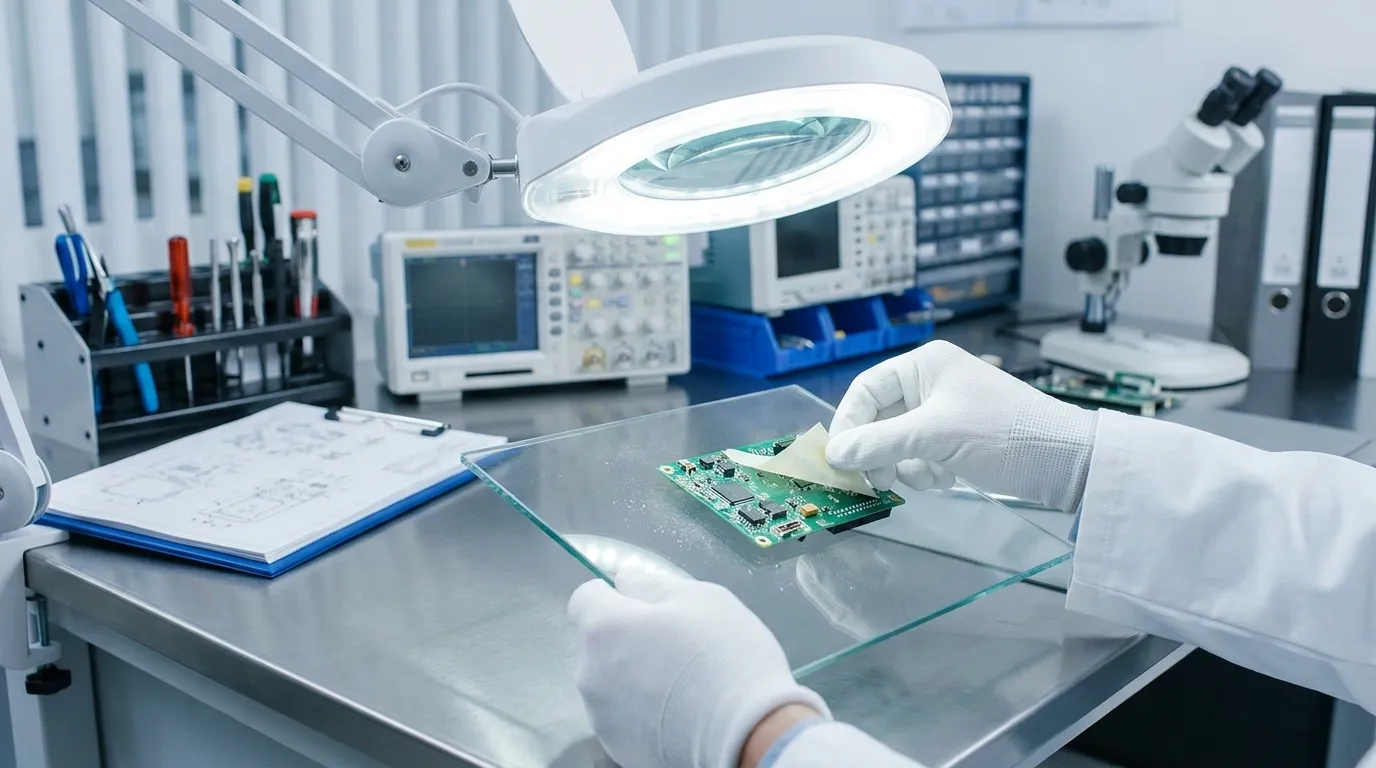
Simple clean-handling dust pickup test
Use this test with each glove candidate before a production trial. It is simple enough for a quality engineer, line leader, and ESD coordinator to run together.
Wash or clean the test surface according to your normal line practice.
Place a clean sample PCB, glass plate, or inspection card on the surface.
Ask one operator to wear the glove for 10 minutes during normal handling.
Touch the same points on the test surface with light, repeatable pressure.
Inspect the surface under bright light for fibers, dust, coating marks, or smudges.
Check the glove fingertips for visible dirt pickup or coating transfer.
Reject the glove if fibers, peeling, or residue appear during the short test.
A glove can pass a comfort check and still fail this test. That is why clean handling should be tested before the line trial, not after defects appear.
Do PU coated gloves provide ESD protection by default?
Standard PU coated gloves should not be treated as ESD gloves unless the supplier provides ESD test evidence. For electronics assembly, specify conductive or dissipative fibers, tested glove resistance, and compatibility with the site’s ESD control program.
ESD stands for electrostatic discharge. In PCB work, it means a static event can damage sensitive parts, even when the damage is not visible right away. A standard PU palm glove may improve grip, but that does not prove it can control static.
For ESD programs, ANSI/ESD S20.20 gives the broader control-program context, including personnel grounding and compliance verification. For glove and finger cot resistance testing, the ESDA lists ANSI/ESD STM15.1 as an endorsed standard.
Conductive vs static dissipative glove wording
Conductive and static dissipative do not mean the same thing. Conductive materials allow charge to move more easily. Static dissipative materials control charge more gradually within a target resistance range.
For purchasing, the safer wording is simple: ask the supplier for the glove construction, test method, and resistance data. If the product page only says “anti-static” with no test support, do not treat it as approved for ESDS parts.
What should a topcoat ESD PU glove variant include?
A topcoat ESD PU glove should combine PU grip with a tested static-control construction. Look for conductive or dissipative fibers in the liner, a thin PU coating layout, and clear resistance data from the supplier.
The right layout depends on the station. SMT and rework may need PU fingertip coating. Inspection and general PCB handling may use thin PU palm coating. Packing may need more palm coverage if broad grip matters more than ultra-fine feel.
Conductive carbon or copper fiber in the liner
PU fingertip or PU palm topcoat based on task
ANSI/ESD STM15.1 or other relevant resistance test documentation
Low-lint construction and clean packaging expectations
Proper sizing for close finger fit
Touchscreen compatibility if operators use scanners, tablets, or HMIs
Sample approval before bulk shipment
Procurement should also avoid guessing customs classification from coating alone. Knit and coated glove construction can affect import treatment, and a CBP ruling mirror shows how glove details may change classification logic.
How should a PCB plant test PU coated gloves before rollout?
Test PU coated gloves on the actual line before bulk buying: compare pinch accuracy, visible dust pickup, grip, operator comfort, and ESD documentation. A glove that passes catalog specs but slows SMT work or fails quality inspection should not be approved.
The best test is small, controlled, and close to real work. Use the same boards, trays, parts, tools, and shift conditions operators already handle. Include production, quality, safety, and ESD staff in the decision.
OSHA’s PPE guidance also points to fit, clean condition, maintenance, training, and proper use as part of a working PPE process through its personal protective equipment guidance.
30-minute line trial checklist
Step
What to do
Pass sign
1. Confirm task
Choose SMT, inspection, rework, packing, or sharp-edge handling
Clear test station
2. Select samples
Test PU fingertip, PU palm, and ESD PU if needed
2 to 3 glove candidates
3. Pinch test
Pick up 20 small parts per glove
Low drops, steady time
4. Dust pickup test
Inspect board or plate after handling
No visible fibers or residue
5. ESD check
Review supplier test data
Method and resistance data provided
6. Tool control
Use tweezers, trays, scanners, or HMIs
No major slowdown
7. Operator feedback
Ask about fit, heat, grip, and feel
No repeated complaints
8. Decision
Approve, reject, or retest
Evidence-based choice
Use the trial to catch station-specific problems. A glove may work well for packing and fail at rework. Another may pass ESD review but feel too thick for SMT support.
Which PU glove spec fits each electronics task?
Different electronics tasks need different glove specs. Start with the station, then choose coating layout, liner type, ESD support, and cut resistance only where needed.
If the team is still comparing coating materials, this is the natural point to review PU vs nitrile gloves. Nitrile may be better in some oily or higher-wear tasks, but PU is often stronger for dry precision handling.
Electronics task
Suggested PU glove spec
Why it fits
Decision point
SMT feeder support
18G PU fingertip, ESD if needed
Better pinch feel
Compare drops vs bare hand
PCB inspection
Light-color PU fingertip or thin palm
Easier dust and mark checks
Run bright-light inspection
Rework bench
ESD PU fingertip
Static support plus dexterity
Test tweezers and tools
Board tray handling
PU palm coating
Broader dry grip
Check grip and comfort
Final packing
PU palm, breathable liner
Better tray and carton handling
One-shift trial
Sharp panel handling
Cut-resistant ESD PU
Adds hand protection
Check dexterity loss
For sharp-edge handling, do not choose cut resistance by habit. If the task includes depanelized boards, trimmed leads, or metal fixtures, test whether the extra liner still allows safe control.
When should you avoid PU coated gloves on an electronics line?
Avoid PU coated gloves when the line needs verified ESD control and the supplier cannot provide test data, when the task is wet or chemical-heavy, or when trial operators lose reliable control of small SMT parts.
Standard PU is not always the right electronics glove. It works well when the task needs dry grip and dexterity. An ESD PU variant is safer when workers handle static-sensitive boards or components.
You should also avoid PU when the task is wet, oily, or exposed to chemicals that the glove was not built to handle. In those cases, the buyer may need another coating or material. For alternative coating discussions, compare latex vs nitrile rather than forcing PU into the wrong job.
Situation
Better decision
Supplier cannot show ESD test data
Do not approve for ESDS handling
Operators drop small SMT parts
Try thinner liner or fingertip coating
Fibers appear in dust pickup test
Reject or test another low-lint glove
Wet or oily handling dominates
Compare other coating materials
Coating peels during short trial
Reject before bulk purchase
One glove is proposed for every station
Split by task and risk
Getting the Next Step Right
PU coated gloves for electronics should be chosen by line evidence, not by a generic product label. Start with the task, then test dexterity, cleanliness, grip, and ESD documentation before scaling the glove across the plant.
For most PCB lines, the safest shortlist is simple: PU fingertip for SMT and rework, thin PU palm for inspection and tray handling, and tested ESD PU where static-sensitive components are present. Run the trial first. Then purchase the glove that protects the product, supports the operator, and fits the station.
Frequently Asked Questions
What is a PU glove?
A PU glove is a textile work glove with a thin polyurethane coating on the palm, fingers, or fingertips. In electronics, it is used when workers need dry grip, touch sensitivity, and light abrasion protection without bulky coating.
Are PU coated gloves suitable for electronics assembly?
Yes, PU coated gloves are suitable for many electronics assembly tasks when they are thin, low-lint, and properly fitted. For static-sensitive PCB handling, choose a tested ESD PU version rather than a standard PU glove.
What is the difference between PU palm coating and PU fingertip coating?
PU palm coating gives broader grip across the hand, while PU fingertip coating keeps coating only where small-part contact happens. For SMT and inspection, fingertip coating often gives better precision, and palm coating is usually more practical for tray handling and packing.
Do PU coated gloves provide ESD protection by default?
No, standard PU coated gloves should not be assumed ESD-safe. For PCB and semiconductor handling, ask for conductive or dissipative fiber construction and glove resistance test data that fits your ESD control program.
What ANSI/ESD standard should ESD gloves meet?
ANSI/ESD S20.20 is the broader ESD control program standard, and ANSI/ESD STM15.1 relates to resistance testing for gloves and finger cots. A supplier should be able to explain which test data applies to the glove.
Are PU coated gloves suitable for touchscreen device operation?
Only some PU coated gloves are touchscreen-compatible. If operators use scanners, HMIs, or tablets, specify conductive fingertip materials or a touchscreen-rated ESD PU glove before testing on the production floor.
How long do PU coated gloves typically last in industrial use?
Service life depends on task intensity, coating wear, and contamination rules. In electronics, replace gloves when grip drops, fibers appear, the coating peels, or quality checks show particles or residue.