Home > Uncategorized > Needle-Resistant Gloves for Police & Security
Needle-Resistant Gloves for Police & Security
15 May, 2026
By arafatshuvo509
Needle resistant gloves for police should be specified by ASTM F2878 needlestick rating, protected zones, and field dexterity, not by generic “puncture resistant” claims. For patrol, corrections, and security searches, prioritize tested palm-and-fingertip coverage, cut protection, secure cuff fit, and a trial that proves officers can cuff, search pockets, handle evidence, and use radios without removing gloves.
Do police and security teams need needle-resistant gloves for searches?
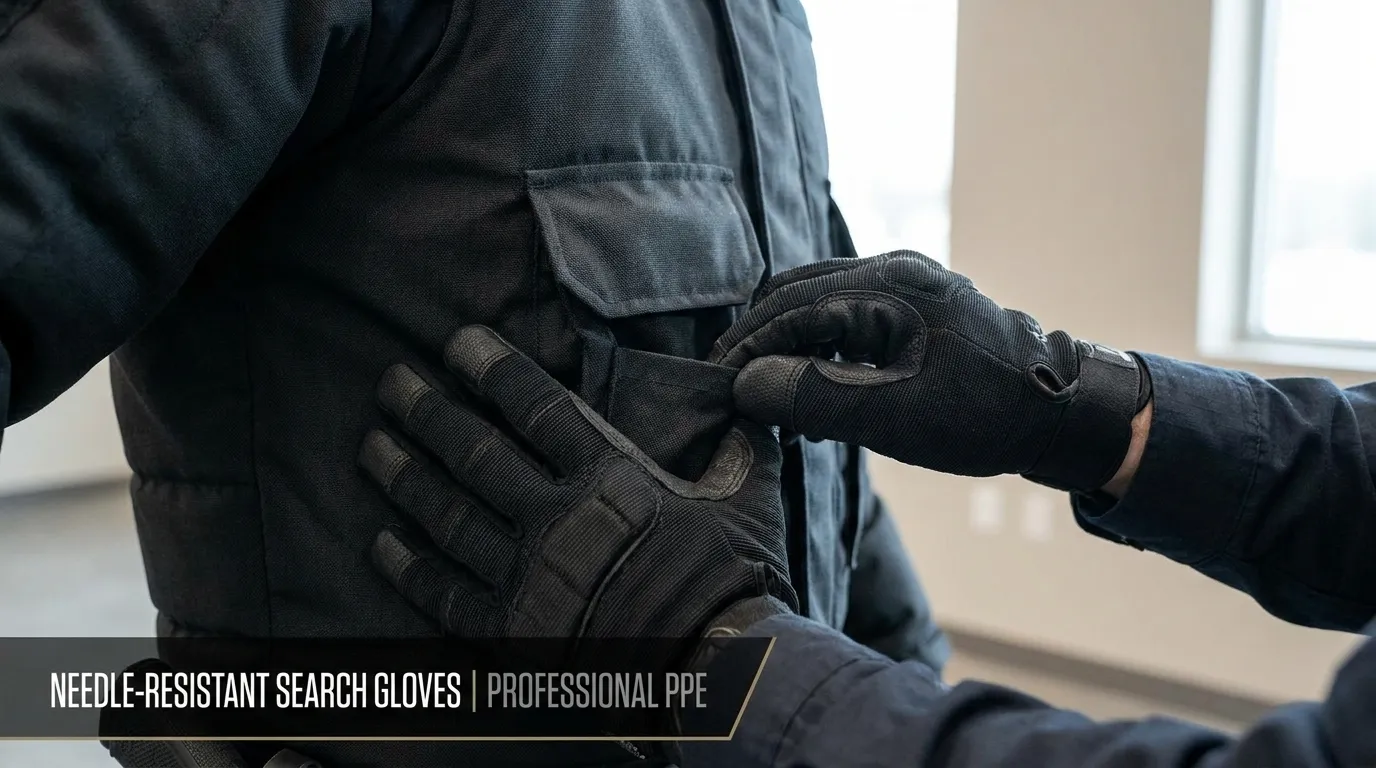
Yes, police and security search teams should use needle-resistant gloves when officers may contact hidden syringes, blades, or contaminated sharps. The need is tied to real search tasks, including pat-downs, vehicle searches, property searches, and corrections searches.
CDC/NIOSH data describes needlestick and exposure incidents among police officers, including events linked to pat-down, property, and vehicle searches. That makes this more than a general PPE issue. For agencies, the question is not whether every officer needs the same glove, but which roles face hidden sharps often enough to require tested needlestick protection.
A patrol officer doing a frisk, a corrections officer searching a cell, and a security team checking bags may all face different levels of risk. The glove specification should match the search environment, the expected hazards, and the level of hand control required during the task.
What does ASTM F2878 actually tell a procurement officer?
ASTM F2878 is the key needlestick test because it measures the force needed for a hypodermic needle to penetrate protective material. Procurement should ask for the level, Newton score, needle gauge, and tested zones.
This matters because “puncture resistant” can mean different things. A glove may resist blunt puncture from a larger probe, or it may resist blade cuts, but that does not automatically prove resistance against a fine hypodermic needle. For police searches, the buyer should check whether the glove has specific ASTM F2878 needlestick data.
ASTM F2878 vs cut resistance vs blunt puncture
Protection type
What it helps evaluate
Why police buyers should care
ASTM F2878 needlestick resistance
Resistance to hypodermic needle penetration
Relevant for hidden syringes during pat-downs, vehicle searches, and corrections searches
Cut resistance
Resistance to blade contact
Relevant when officers may contact razors, knives, broken glass, or sharp metal
Blunt puncture resistance
Resistance to larger puncture probes
Useful, but not the same as fine needle protection
When the article discusses broader blade protection, link once to the cut-resistant glove ratings guide instead of repeating the full cut glove topic here.
Which hand zones need needle protection during pat-downs and searches?
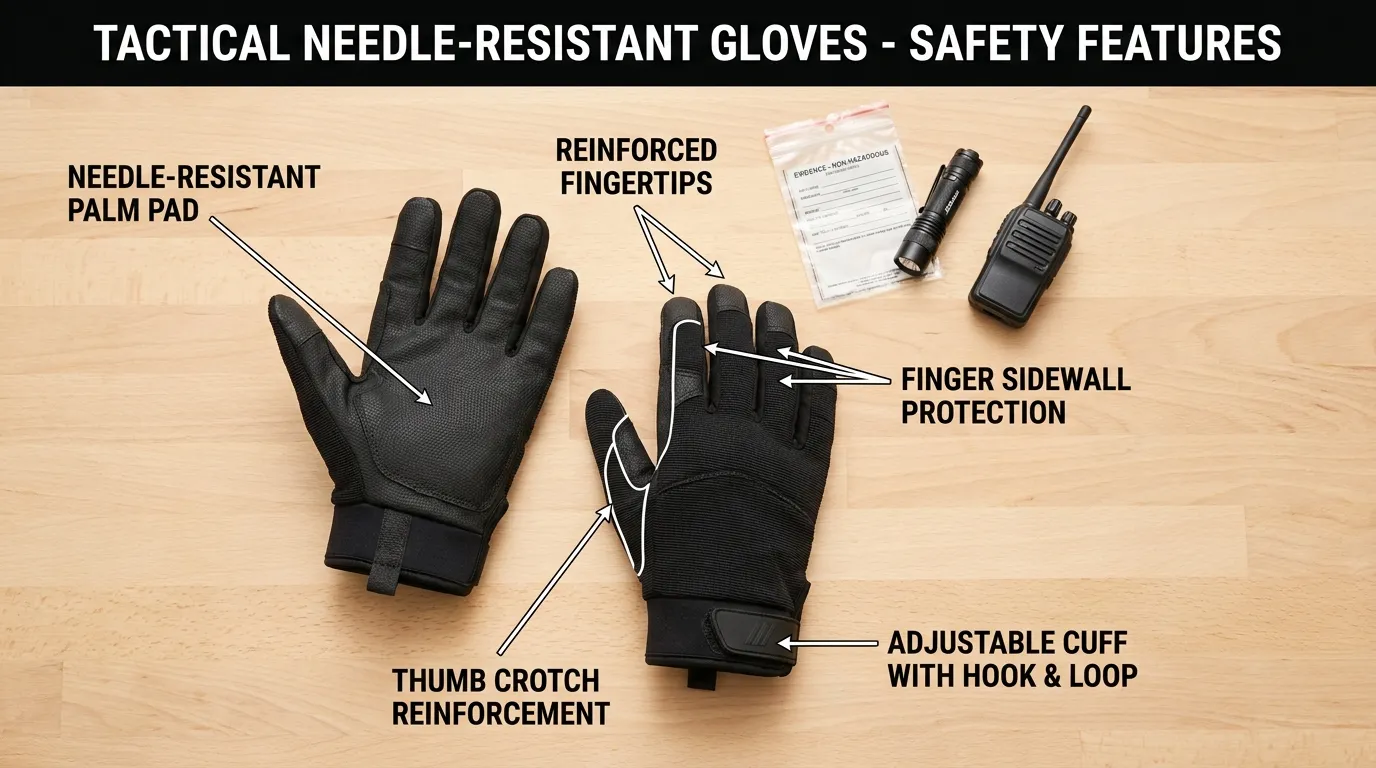
Palm protection alone is not enough for police searches. Fingertips, finger sidewalls, and cuff fit matter because officers touch pocket seams, waistbands, bags, vehicle gaps, and cell fixtures before they can fully see the hazard.
Some product pages separate palm and fingertip needlestick ratings, which is useful for buyers. A procurement officer should not accept a broad “needle resistant” claim without asking which zones were tested and where the protective layer actually sits.
Hand zone
Search risk
Procurement question
Palm
Pressing against pockets, bags, seats, or surfaces
Is the palm tested under ASTM F2878?
Fingertips
Feeling seams, corners, wallets, waistbands, and small objects
Are fingertips tested separately or only covered by general product language?
Finger sidewalls
Sliding fingers along tight gaps and fabric seams
Does protection wrap around the fingers or only sit on the palm face?
Thumb crotch
Gripping objects, cuffs, bags, and search tools
Is this high-wear area reinforced?
Cuff area
Gap exposure near the wrist during reaching or bending
Does the cuff stay secure during searches?
How much dexterity should needle-resistant police gloves preserve?
The right glove is the one officers will keep on during cuffing, pat-downs, evidence handling, and radio use. Test dexterity in field tasks before bulk buying, even when the ASTM rating looks strong.
A glove that scores well on paper can still fail in duty use if officers remove it for routine tasks. The agency should test glove size, finger control, grip, and tactile feedback across patrol and corrections teams before approving a large order.
Apply and remove handcuffs safely.
Search pocket seams and waistbands with controlled hand position.
Retrieve an ID from a wallet.
Seal an evidence bag.
Operate a radio and body camera controls.
Use keys and a phone screen.
Inspect the glove after the trial.
Record comfort issues and any glove removal events.
Grip also matters when officers handle evidence bags, radios, flashlights, and vehicle surfaces. If grip becomes a separate buying question, link to the best grip coating guide for broader coating comparison.
Which glove style fits patrol, corrections, property search, and security screening?
No single glove style fits every police or security task. Patrol teams may prioritize dexterity and fingertip feel, while corrections and property search teams may need stronger needle and cut protection because they handle higher-risk search environments.
Use case
Main concern
Glove priority
Decision point
Patrol pat-down
Hidden syringes, blades, and pocket hazards
Fingertip feel, palm protection, secure fit
Can the officer cuff and search without removing the glove?
Corrections cell search
Needles, razors, fixtures, and hidden contraband
Higher needlestick and cut protection
Does the glove protect key zones while allowing controlled searching?
Vehicle search
Seat gaps, door pockets, mats, broken glass, and hidden sharps
Palm and fingertip protection with grip
Can the officer use a flashlight and inspect tight spaces safely?
Property or evidence search
Seized syringes, razors, contaminated bags, and sharp debris
Needlestick protection plus disposal procedure
Are sharps containers and contamination controls also in place?
Security screening
Bag checks and unknown personal items
Flexible search glove with tactile control
Does the glove allow careful inspection without blind probing?
Disposable nitrile gloves may help with contamination control, but they should not be treated as tested needle protection unless the supplier provides relevant test data. For a broader material comparison, use the nitrile vs latex guide.
What should an agency put in the glove specification?
A strong agency specification names the standard, target zones, cut rating, size range, test documentation, sample policy, and replacement rules. Vague language like “puncture proof” should be rejected because no retrieved authority supports that absolute claim.
The specification should make suppliers prove what they are selling. A buyer should request ASTM F2878 data, the tested glove zones, cut-resistance information, sizing support, sample availability, and written guidance for inspection and replacement.
Minimum supplier documents to request
ASTM F2878 test report or clear needlestick rating documentation.
Tested zones, including palm, fingertips, and any sidewall coverage.
Cut-resistance rating where blade hazards are expected.
Size range and fit guidance for patrol and corrections teams.
Cleaning, inspection, and replacement instructions.
Sample policy for agency field trials.
Any bloodborne pathogen or chemical barrier test data if those hazards are part of the use case.
Spec item
Why it belongs in the RFQ
Weak wording to avoid
ASTM F2878 rating
Shows the glove was evaluated for hypodermic needle resistance
Needle proof
Protected zones
Confirms where the protection actually applies
Full protection without zone details
Dexterity trial
Checks whether officers can do real duty tasks
Comfortable tactical fit only
Replacement rules
Prevents continued use after damage or suspected puncture
Long-lasting with no inspection policy
If the procurement team also needs a broader explanation of cut ratings and blade protection, link to the cut protection buyer’s guide.
What are the limits of needle-resistant gloves?
Needle-resistant gloves reduce risk but do not make searches safe by themselves. The article must state limits on “proof” claims, palm-only ratings, damaged gloves, bloodborne pathogen barriers, and chemical permeation.
Needle resistance is only one part of a search safety system. Officers still need safe search technique, visibility, controlled hand placement, sharps disposal procedures, and clear replacement rules. A glove with strong needlestick data can still become unsafe if it is cut, punctured, poorly fitted, or used outside its tested purpose.
Misconception
Clearer buying guidance
Needle resistant means needle proof
Use “needle resistant” and verify ASTM F2878 data instead of accepting absolute claims.
Cut resistance means needle resistance
Check needlestick, cut, and blunt puncture ratings separately.
Palm rating protects the whole hand
Ask which zones were tested and where the protective layer is placed.
Search gloves also protect against bloodborne pathogens
Request separate barrier test data when bloodborne pathogen exposure is part of the risk.
One glove solves all chemical risks
Request chemical permeation data if drug residue or chemical exposure is part of the task.
How should departments trial, train, inspect, and replace search gloves?
A department should trial needle-resistant search gloves before full rollout. The trial should include patrol, corrections, property, and security users if those teams have different tasks. Each group should test the glove in realistic movements, not just wear it at a desk.
Choose sample sizes for the actual officer group.
Test cuffing, pat-downs, evidence handling, radio use, flashlight grip, keys, and phone use.
Record where officers lose dexterity or remove the glove.
Inspect gloves after use for cuts, punctures, seam damage, and fit changes.
Set replacement triggers for visible damage, suspected puncture, heavy contamination, torn seams, or failed inspection.
Train officers to avoid blind probing and to use proper sharps disposal procedures.
Sharps disposal should not be treated as a glove feature. FDA guidance describes sharps containers as rigid, puncture-resistant, leak-resistant, and fitted with puncture-resistant lids. The article should keep glove selection and sharps disposal connected, but not mix them into one claim.
What proof photos and product evidence should the page show?
The article should show real product evidence, not only generic tactical images. Useful visuals include palm and fingertip closeups, glove fit on an officer’s hand, controlled search-position photos, and test-style images that show where the protective layer is located.
Authorized seizure or sharps photos, only when privacy-safe and approved.
Palm and fingertip closeups showing tested protection zones.
Stab-test or needlestick-test style photos, without making unsafe “proof” claims.
Tactical-fit photos showing cuffing, pocket search, radio use, and evidence bag handling.
Grip and palm texture photos when explaining coating options.
If coating comparison becomes relevant to grip or tactile feel, use a short internal reference to crinkle latex vs PU. If high-dexterity glove construction comes up as a contrast, mention PU coated gloves briefly without turning this article into an electronics glove guide.
FAQ
What are puncture resistant gloves made of?
Puncture-resistant gloves may use engineered yarns, leather, synthetic liners, coated palms, or layered protective materials depending on the hazard. For police search gloves, the buyer should focus less on material names alone and more on ASTM F2878 needlestick test data.
What types of puncture resistant gloves are available?
The main types include general puncture-resistant work gloves, cut-and-puncture gloves, and needlestick-resistant search gloves. Police and corrections teams should prioritize gloves tested for hypodermic needle puncture, not only gloves rated for blunt puncture or blade cut resistance.
What mistakes should be avoided when using puncture resistant gloves?
The biggest mistake is treating “puncture resistant” as a universal safety claim. Agencies should check whether the glove was tested for hypodermic needles, which zones were tested, whether the glove is damaged, and whether officers can still search safely while wearing it.
When should you replace puncture resistant gloves?
Replace puncture-resistant gloves after visible damage, suspected puncture, torn seams, loss of fit, heavy contamination, or failed inspection. A department should also set a replacement schedule based on duty use, cleaning limits, and supplier guidance.
Are needle-resistant gloves the same as cut-resistant gloves?
No, needle-resistant gloves and cut-resistant gloves are not the same. Cut ratings measure blade resistance, while ASTM F2878 focuses on hypodermic needle puncture resistance, so police buyers should check both when officers face blades and hidden needles.
Do needle-resistant gloves protect against bloodborne pathogens or chemicals?
Not automatically. CDC/NIOSH guidance warns that puncture-resistant gloves may not protect against bloodborne pathogen or chemical permeation hazards unless the supplier provides relevant barrier test data such as ASTM F1671 or ASTM D6978.
What ASTM F2878 level should police search gloves have?
The right ASTM F2878 level depends on the search risk, protected zones, and required dexterity. High-risk corrections, property, and vehicle searches may justify higher needlestick protection, while patrol teams still need enough flexibility to cuff, search, and handle equipment.