Home > Uncategorized > Cut Resistant Gloves Factory in China: What Procurement Professionals Need to Know in 2026
Cut Resistant Gloves Factory in China: What Procurement Professionals Need to Know in 2026
22 Jul, 2026
By hqt
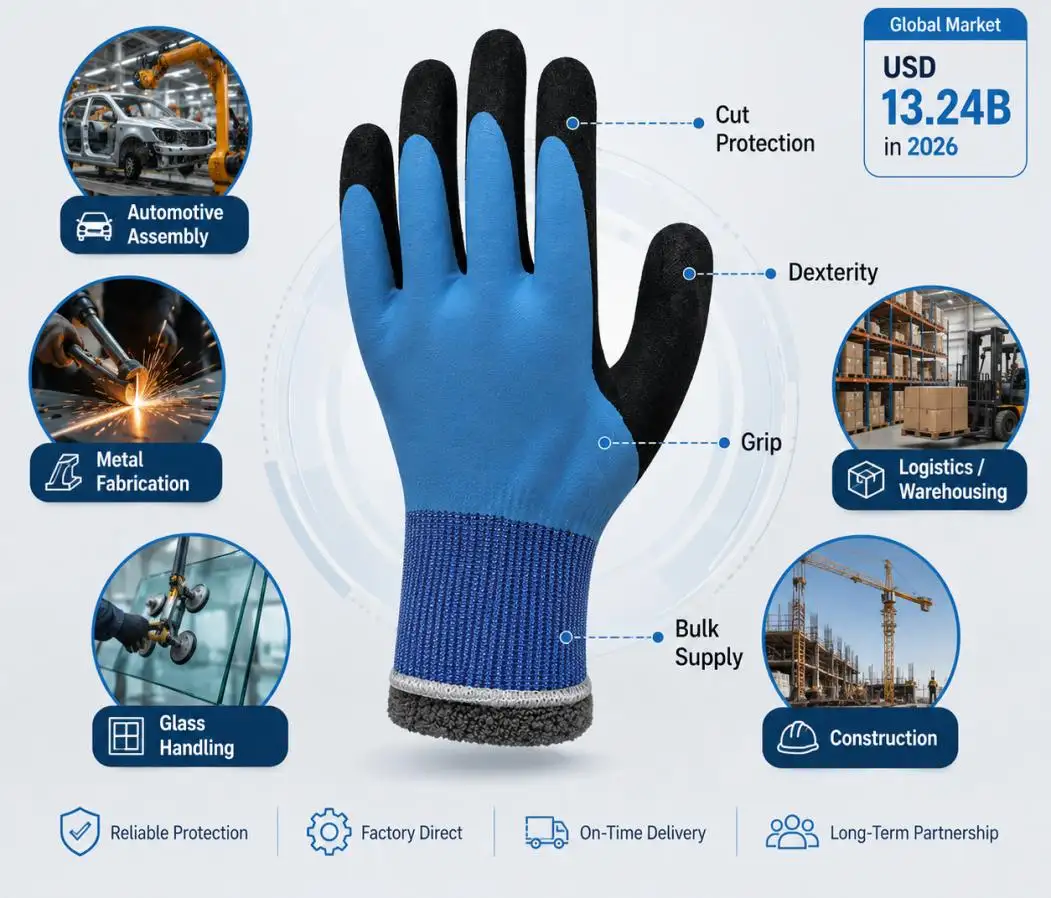
The protection offered by safety hand gear worldwide is evolving toward task-specific protection against various elements including cuts, punctures, impacts, heat and liquids. The market for industrial safety gloves is projected to be USD 13.24 billion in 2026 and is expected to grow further by 2031.
Various industries that include automotive, metal fabrication, glass handling, recycling, logistics, and construction have found that cut protection is essential. Due to China's developed technical infrastructure for yarns, knitting, coating, packaging and exporting, it has become an attractive sourcing destination.
When considering cut resistant gloves manufacturers in China, price is of course one of the things that will be evaluated, but buyers will also consider standards, materials, coatings, capacity, certifications and more when placing an order, especially for a repeat order.
The two main systems serve different markets and should not be directly converted.
Standard
Rating
Main Market
Buyer Focus
ANSI/ISEA 105
A1–A9
United States
Cutting force and product-specific reports
EN 388
Coup 1–5; ISO 13997 A–F
Europe and CE markets
Mechanical-risk marking and traceable test data
An ANSI A6 glove is not automatically equivalent to EN 388 level E. Test methods and thresholds differ. A qualified Cut Resistant Gloves Factory in China should provide reports matching the exact liner, coating, reinforcement and product code ordered.
Materials, Gauge and Coating
Variable
Main Benefit
Procurement Use
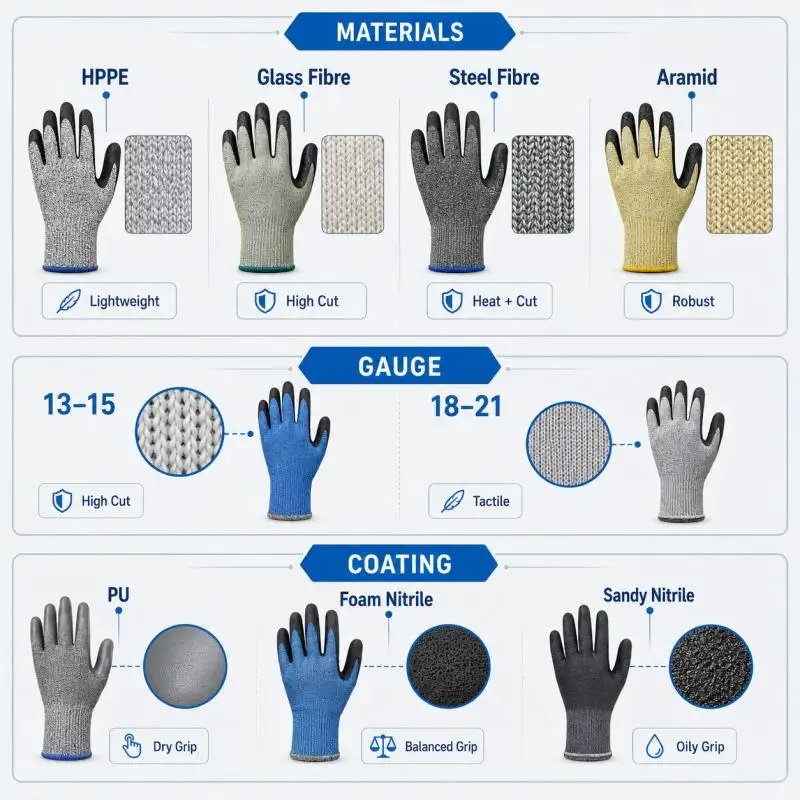
HPPE
Lightweight strength and flexibility
Dexterous cut-resistant gloves
Glass fibre
Economical cut enhancement
Higher protection at controlled cost
Steel fibre
High cut resistance
Heavy-duty handling
Aramid
Cut and heat resistance
Thermal-risk applications
13–15 gauge
Robust construction
General and heavy-duty work
18–21 gauge
Thin, tactile profile
Precision handling
PU coating
Flexible dry grip
Assembly and small-part handling
Foam nitrile
Breathability and balanced grip
Dry and light-oil work
Sandy nitrile
Strong wet and oily grip
Metal and maintenance tasks
Gauge indicates knitting density, not protection level. Verified performance depends on yarn structure, liner weight, coating and reinforcement.
China's Manufacturing Landscape
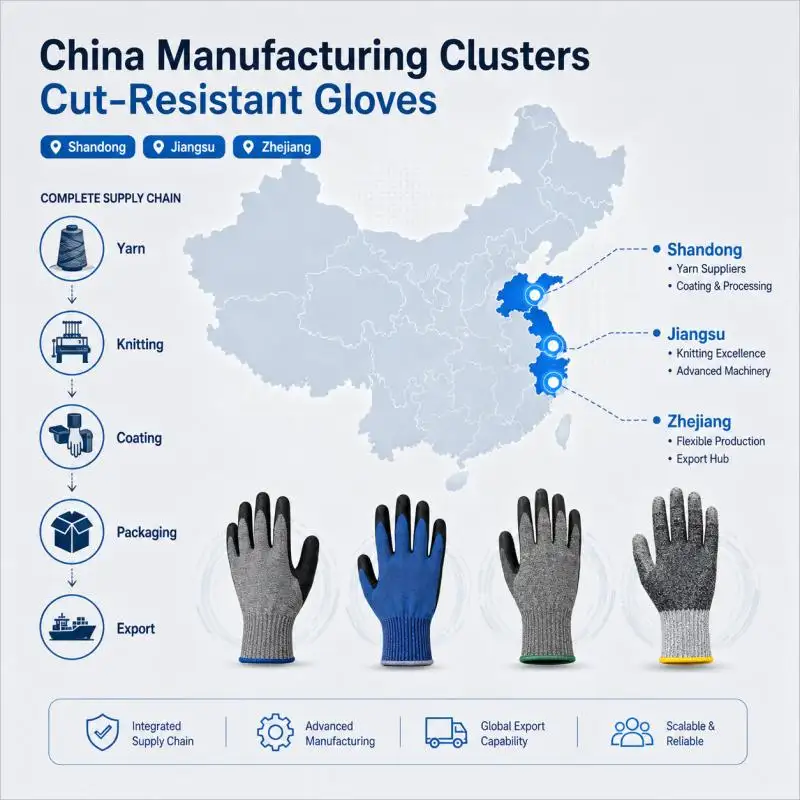
China's industry for cut-resistant gloves has established concentrations in the following areas:
• Shandong: Safety product clusters with resources for both knitting and coating.
• Jiangsu: High concentration of UHMWPE fibre and technical yarn as well as industrial PPE.
• Zhejiang: Strong focus on gloves manufacture, packaging, and export services.
These clusters provide materials, machines, testing, and logistics services, but factories differ in automation, coating control and consistency of quality.
Some of the major advantages of sourcing from a Cut Resistant Gloves Factory in China include:
• Integrated resources for yarn, knitting, coating, and packaging
• Capacity for bulk and repeated orders
• Well-developed OEM and ODM services
• Cost-effective manufacturing
• Familiarity with ANSI, EN 388 and CE related regulations and standards
Having a factory in China does not guarantee quality of the cut resistant gloves. The quality of the gloves is highly dependent on control of the processes and discipline in inspections.
NMSafety Manufacturing Profile
Founded in 1998, NMSafety is headquartered in Shanghai and operates production bases in Jiangxi, Jiangsu and Shandong, plus a Canadian branch.
Production Scale
• 15 production lines
• 1,500 knitting machines
• 600 employees
• Monthly capacity above 600,000 dozen
• 7.2+ million pairs monthly
Compliance and Product Capability
NMSafety reports ISO 9001-based quality management, Sedex and BSCI audits, and product programs developed for CE, EN 388 and ANSI requirements.
• Cut protection combined with impact, heat, liquid or puncture resistance
• Custom colours, logos, sizes and packaging
For buyers seeking broad product coverage, this range can reduce supplier-management complexity.
Comparison of Supplier Types in China
Dimension
Small Factory or Trader
Mid-Sized Manufacturer
NMSafety
Monthly capacity
Variable or outsourced
Moderate
600,000+ dozen
Documentation
Product-dependent
Basic to developed
ISO system, audits and market testing
Cut range
Limited models
Several levels
A4–A8 plus multi-hazard options
Knitting capability
Mainly 13–15 gauge
Usually 15–18 gauge
18–21 gauge programs
OEM capability
Logo or packaging changes
Moderate customization
Design, manufacturing and delivery
Factory footprint
Single site or outsourced
One or two sites
Three factories plus overseas branch
The most important difference is not factory size alone. Procurement risk decreases when approved samples, test reports, production specifications and inspection criteria are connected to the same product code across repeat orders.
Chinese Manufacturers vs. International Brands
Advantages of International Brands
Brand names like Ansell, Honeywell, SHOWA, and PIP have significant brand equity. They have established large distribution networks and have extensive resources available for research and development of new products. In industrial markets, their product systems are widely known and typically are supported by sophisticated and ample product engineering and technical documentation.
However, buyers may face:
• Higher purchasing prices
• Longer approval and delivery cycles
• Higher customization thresholds
• Less flexibility for private-label programs
How Chinese Manufacturers Have Evolved
Chinese suppliers were once viewed mainly as low-cost alternatives. Leading manufacturers now use engineered HPPE, glass-fibre and steel-fibre yarns, together with 18- to 21-gauge knitting and coatings designed for precision or oily handling.
A qualified Cut Resistant Gloves Factory in China can also develop products for both ANSI/ISEA 105 and EN 388 requirements. Scaled manufacturers such as NMSafety increasingly compete for the same wholesale, distribution and OEM programs served by international brands.
Key Procurement Considerations
Buyers Should Compare
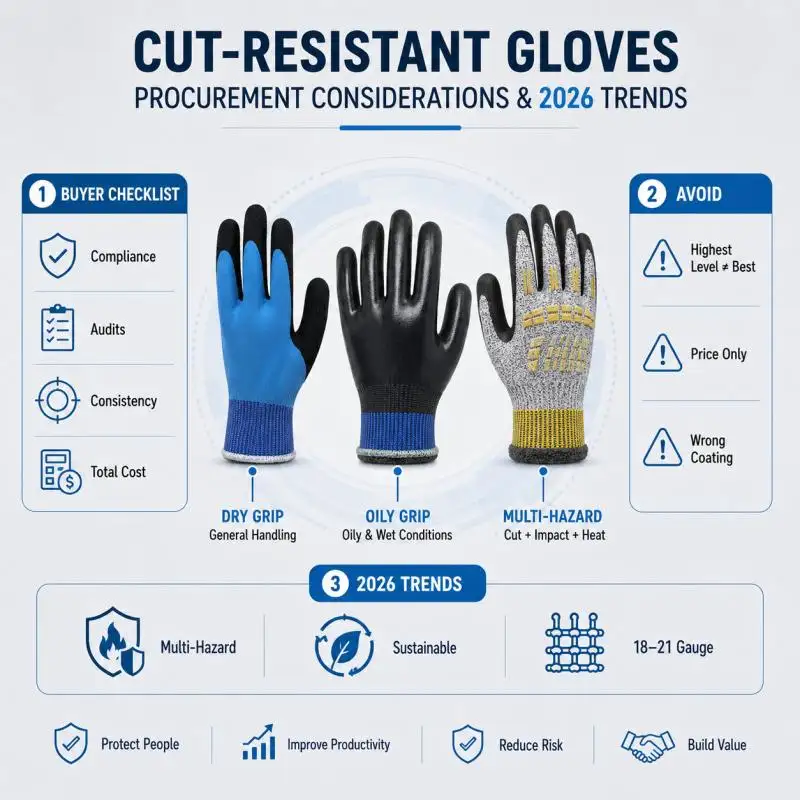
• Compliance: ANSI ratings for U.S. programs; EN 388 documentation for Europe
• Factory audits: Sedex, BSCI and quality management systems
• Consistency: Repeatability over larger production batches
• Total cost: Unit price, freight, duties, sample costs, lead time and effort
Common Procurement Mistakes
❌ Choosing the highest cut level for a glove may be counterproductive: Too much protection can be uncomfortable and may even cause workers to evade wearing the glove.
❌ Overemphasis on unit price: gloves that last longer have a much lower overall operating cost due to the decreased rate of replacement.
❌ Ignoring the match between coating and work environment: Nitrile coatings are generally better suited to oily conditions, while thin PU coatings support precision assembly and fine handling.
Industry Outlook
Multi-hazard gloves combining cut, impact, heat and water protection will become increasingly common.
Sustainable manufacturing, including solvent reduction and waste minimization, will receive greater attention.
Demand for lightweight 18- to 21-gauge gloves with high cut protection is expected to continue growing.
Closing Words
China's cut-resistant glove industry has evolved from low-cost production toward standardized, high-capacity manufacturing. Selecting the right Cut Resistant Gloves Factory in China depends on verified standards, stable production, product-specific testing and repeatable quality control.
NMSafety reflects the profile of a scaled manufacturer through its three production bases, A4–A8 portfolio, thin-gauge knitting and multi-hazard capabilities. Final approval should rely on factory audits, production-equivalent samples and measurable inspection criteria.
FAQs
Q1. What certifications should a Chinese glove factory provide?
ISO 9001, Sedex or BSCI audits, CE documentation, EN 388, and reports for tests per the relevant market should be available for buyer review.
Q2. What cut-resistance standards should buyers look for?
The primary standards are ANSI/ISEA 105 in the U.S. and EN388 with the ISO 13997 test for Europe. The ratings are not to be converted directly.
Q3. What do ANSI cut levels A1 to A9 mean?
ANSI levels refer to the amount of cutting force the glove can withstand. Protection increases with higher levels, but flexibility, lightness, and higher protection incur higher costs.
Q4. What are the main materials used to make cut-resistant gloves?
HPPE, aramid, GP, steel fiber, and engineered composite yarns are the main materials. The trade-offs for protection and less cost and weight vary.
Q5. Is a higher knitting gauge always better?
No. While higher is thinner and more flexible, it is not inherently more cut-resistant. The composition and construction of the yarn are equally important.