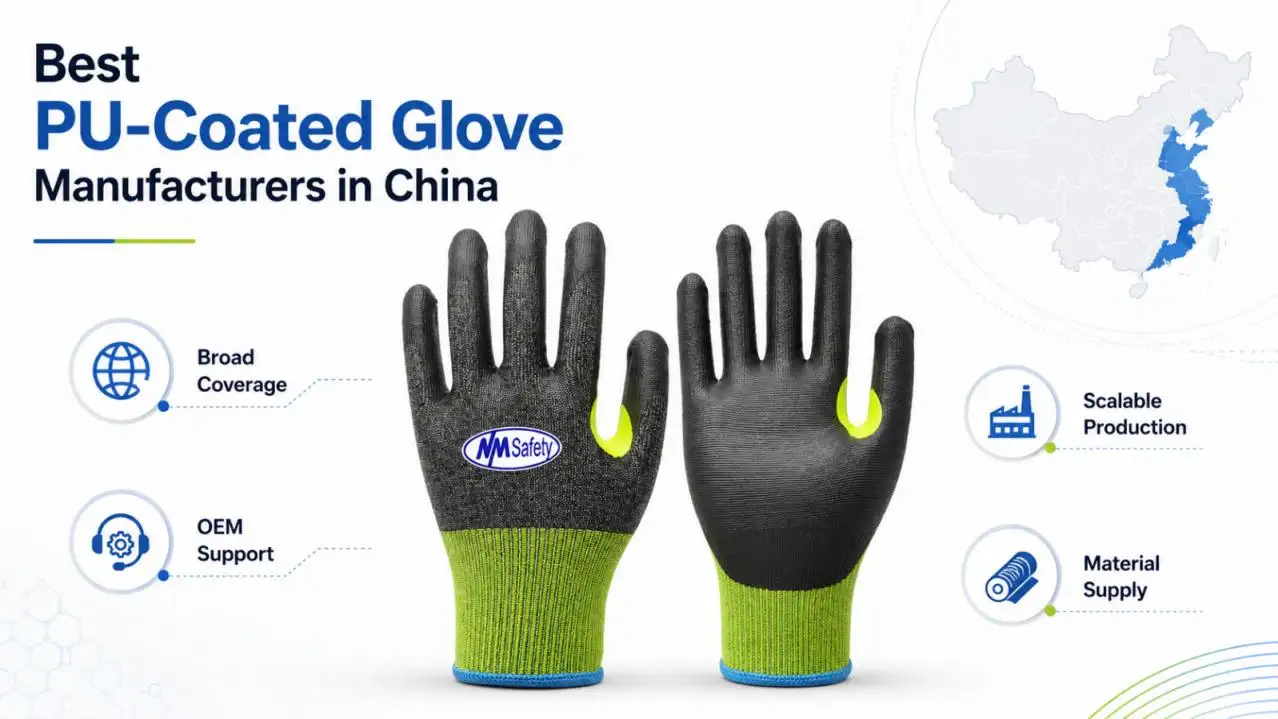
China is a major sourcing base for polyurethane-coated work gloves. Its supply chain covers seamless knitting, yarn blending, PU dipping, cut-resistant liner development, testing, packaging, and export logistics.
For buyers searching for the best PU-coated glove manufacturers in China, supplier selection should go beyond unit price.
Sourcing Advantage
Buyer Value
Point to Verify
Broad product coverage
Consolidate several glove categories
Confirm in-house production
OEM support
Customize logos, colors and packaging
Check MOQ and development costs
Scalable production
Support recurring bulk orders
Audit effective capacity
Mature material supply
Access nylon, polyester and HPPE yarns
Control batch variation
This guide compares leading Chinese PU-coated glove suppliers by manufacturing scope, product range, and order suitability. The order is not an absolute ranking. Buyers should verify each factory, product code, and test report before approval.
Founded in 1998, NMSafety is headquartered in Shanghai and operates production facilities in Jiangxi, Jiangsu, and Shandong. The company has 15 production lines, approximately 1,500 knitting machines, around 600 employees, and a monthly production capacity of more than 600,000 dozen gloves.
Main Capabilities:
• Polyester and nylon PU palm-coated gloves
• High-gauge precision-handling gloves
• HPPE and composite cut-resistant liners
• Touchscreen and carbon-fibre antistatic constructions
• Reinforced thumb-crotch designs
• OEM logos, colors and packaging
2. Shandong Deely Gloves
Shandong Deely Gloves supplies PU-, nitrile-, and latex-coated gloves, together with cut-resistant and ESD products.
• Strength: Broad coated-glove portfolio
• Order fit: Mixed PU, cut-resistant, and antistatic programs
3. Qingdao Uneed Safety
Qingdao Uneed Safety supplies PU-coated, cut-resistant mechanic and other industrial gloves.
• Strength: Multi-category glove sourcing
• Order fit: Importers building a broad PPE catalog
4. Nantong Mega Safety
Nantong Mega Safety presents an integrated chain covering yarn processing, knitting, dipping, and packaging.
• Strength: Process integration and technical glove production
• Order fit: Industrial programs requiring material control
5. Aibon Safety
Aibon Safety provides safety work gloves with options for custom polyurethane coating.
• Strength: Flexible coordination with its Original Equipment Manufacturer (OEM) for a variety of gloves.
• Order fit: Aggregation of private label offerings.
6. Anbu Safety
Anbu Safety offers a broad PPE catalog that includes standard customized PU coated gloves.
• Strength: Multi-product PPE sourcing
• Order fit: Buyers purchasing gloves with other safety products
Comparison of Leading PU Coated Glove Manufacturers
The best PU-coated glove manufacturers in China should be compared by technical range, production model, and order fit—not price alone.
Selecting among the Best PU Coated Gloves Manufacturers In China also requires understanding product structure. Two PU-coated gloves can differ significantly in dexterity, abrasion life and protection level.
13 Gauge vs 15 Gauge vs 18 Gauge
Gauge
Hand Feel
Dexterity
Typical Use
13 gauge
Thicker
Moderate
Warehousing and general handling
15 gauge
Balanced
High
Assembly, inspection and packaging
18 gauge
Very thin
Very high
Electronics and precision work
A higher gauge means a finer knitted structure, not automatically higher protection.
Liner Material Comparison
Liner
Main Advantage
Limitation
Typical Use
Polyester
Economical and durable
Less soft than nylon
General work
Nylon
Flexible and close-fitting
Usually higher cost
Precision assembly
HPPE composite
Supports tested cut resistance
More complex construction
Metal and automotive
Carbon-fibre blend
May support antistatic performance
Resistance data must be verified
Electronics
Coating and Construction Options
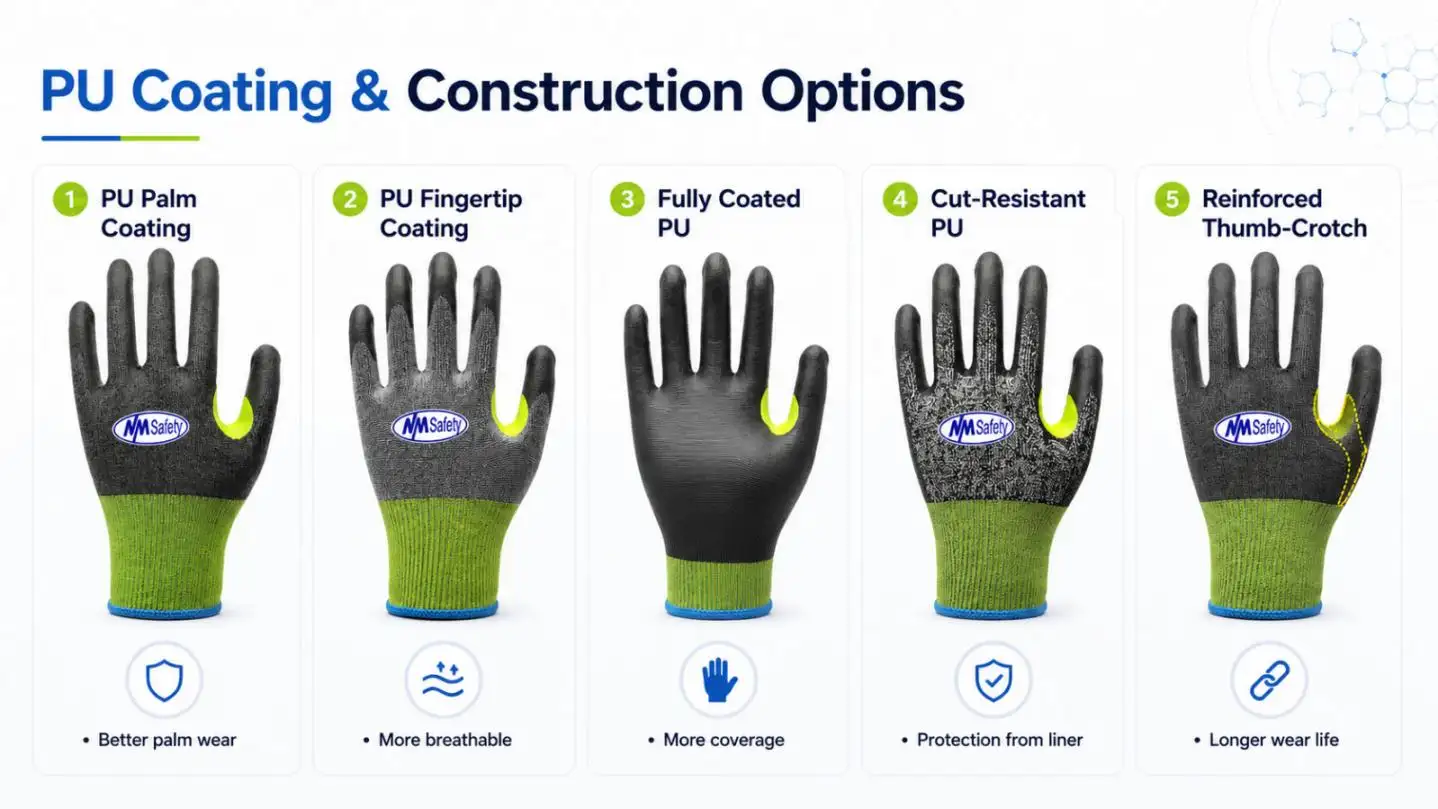
• PU Palm Coating: Coverage over the palm provides better resistance against palm abrasion.
• PU Fingertip Coating: Better breathability designed for handling light components.
• Fully Coated PU: Generally less breathable and flexible, but more coverage.
• Cut Resistant PU: Protection is primarily from the liner, not from the PU coating.
• Reinforced Gloves: Added thumb-crotch reinforcements improve wear life at the expense of added cost and stiffness.
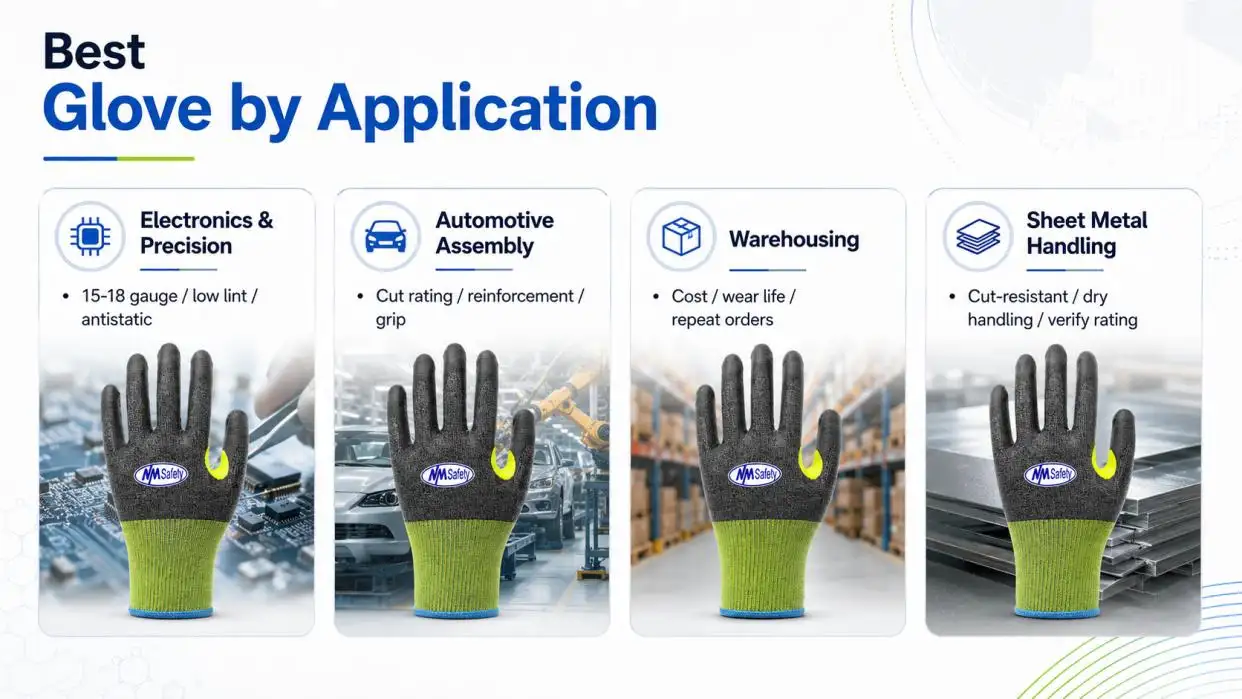
Selecting PU Coated Gloves Based on Application
Application
Optimal Liner
Gauge
Primary Consideration
Primary Concern
Electronics
Nylon or Antistatic Blend
15-18
Dexterity and low lint
Unverified antistatic protection
Automotive Assembly
HPPE Composite
15-18
Cut rating and reinforcement
Over emphasis on thinness
Warehousing
Polyester or Nylon
13-15
Balancing cost and wear
Thin coating
Sheet Metal Handling
Cut Resistant Composite
13-18
Specific model of EN or ANSI
Generic level reports
✔ Electronics and Precision Assembly
Fine gauge and low lint with verified antistatic protection, along with a fingertip interface designed for compatibility with touchscreens.
✔ Automotive and Metal Processing
Focus on cut classification, thumb-crotch wear, coating abrasion, small-component grip and size consistency.
✔ Warehousing and General Handling
The main considerations are wear life, stable pricing, packaging efficiency and repeat-order consistency.
✔ Glass and Sheet-Metal Handling
PU-coated cut-resistant gloves can suit dry handling. Heavy oil exposure may require a nitrile-coated alternative.
How to Audit a PU Coated Glove Supplier
When choosing from the best PU-coated glove manufacturers in China, make sure you do all four of the following checks:
• Approve production-equivalent samples: These samples must be made with the same yarn, gauge, and coating and be packaged in the same way as planned for bulk production.
• Verify model-specific reports: Identify the product code, liner, and coating as well as the version of the test standard.
• Definition of Inspection Criteria: Develop parameters for Acceptable Quality Limit (AQL) for gloves’ dimensions and weight and degrees of defects in coating and packaging.
• Evaluating Operational Aspects: The order quantity and size and the order fulfillment period and the limits of the order in the peak season must comply with requirements.
Choosing a Suitable Manufacturer
Typical High Volume Orders: The manufacturer should have the ability to automate the coating process and have consistent and cost-effective coating.
• Functional or cut-resistant gloves: Manufacturers must have the ability to design and engineer specific yarn to your requirements and have the ability to provide supporting documentation and test results.
• Multi-category programs: Manufacturers must have a broad product line and be able to balance supply and demand.
• Small private-label launches: Manufacturers must be able to provide a small MOQ and a flexible and supportive packaging and sampling requirement.
• Among the best PU-coated glove manufacturers in China, NMSafety is particularly relevant to buyers needing multiple gauge options, functional liner combinations, and recurring medium-to-large orders.
The final decision should still be based on factory verification, approved production samples, product-specific reports, and measurable inspection standards. The best manufacturer is the one that can repeatedly reproduce the approved glove—not simply the supplier offering the lowest quotation.
Contact NMSafety to discuss your required glove construction, performance level, customization needs, sample approval process, and inspection standards for recurring medium-to-large orders.
FAQs
Q1. Do Chinese manufacturers of PU coated gloves offer OEM services?
Most will provide services for custom logos as well as custom color choices for liners, coatings, labels, and packaging. Buyers should check the minimum order quantity, tooling charges, sampling charges, and lead time for production.
Q2. What do buyers need to check prior to selecting a manufacturer for PU coated gloves?
Buyers need to check factory capacity, equivalent production samples, liner composition, coating coverage, size tolerances, MOQ, lead time, inspection criteria, and test reports of the specific product code.
Q3. What is the difference between 13, 15, and 18 gauge PU coated gloves?
As the lower number, a 13 gauge glove has a thicker coating, while a 15 gauge glove offers a better balance between coating thickness and flexibility. An 18 gauge glove has an even thinner coating, allowing for better fingertip sensitivity for precise handling.
Q4. Do higher gauge PU coated gloves offer better performance?
No, a glove with a higher gauge will have a finer knitted liner, but this will not provide better performance for cut protection or durability. What also needs to be considered is the coating and liner material.
Q5. What are the most common liner materials for PU coated gloves?
The most common liner materials for PU coated gloves are HPPE, composites of fiberglass and glass, and a carbon and glass fiber composite. These materials differ in cost, cut resistance, and level of dexterity.