Home > BLOG > Industry Blog > Oil Resistant Gloves OEM in China: Balancing Glove Cost, Service Life and Industrial Protection
Oil Resistant Gloves OEM in China: Balancing Glove Cost, Service Life and Industrial Protection
19 Oct, 2026
By hqt
When purchasing Oil Resistant Gloves OEM in China, comparing unit prices is often misleading when determining the best option. The true cost of the gloves should include how long they last, as a cheaper option may cost more over the production cycle.
The objective is to purchase the oil-resistant gloves that provide the best overall protection and oily-surface grip, for the least cost, with the shortest safe use time. The objective is not to purchase the most durable oil-resistant gloves.
There are many factors in addition to raw materials that affect pricing for OEM gloves:
•Coating formulations: the cost and the complexity of manufacturing is effected by the texture of coating, coating thickness and the method of dipping.
•Liner construction: cost and flexibility vary among different yarns and vary among different levels of cut resistance.
•Coating coverage: less coating material can reduce cost and complexity of manufacturing.
•OEM specifications: branding and packaging, size distribution, minimum order quantities, and inspections impact cost and complexity.
When reviewing oil resistant gloves made in China, the landed cost (total cost to purchase the goods, and to have the goods shipped, and to clear customs) should be analyzed, not the factory price.
Defective units and the rate of replacement should also be analyzed.
2. How Coating Technology Influences Glove Service Life
Nitrile Coating Types: Grip, Durability and Flexibility
Nitrile-coated gloves are widely used for oily industrial handling, but coating texture and coverage produce different functional characteristics.
Coating Construction
Main Performance Characteristic
Potential Trade-Off
Typical Application
Foam Nitrile
Flexible coating with good fingertip control
Oil grip depends on formulation and surface condition
Precision assembly
Sandy Nitrile
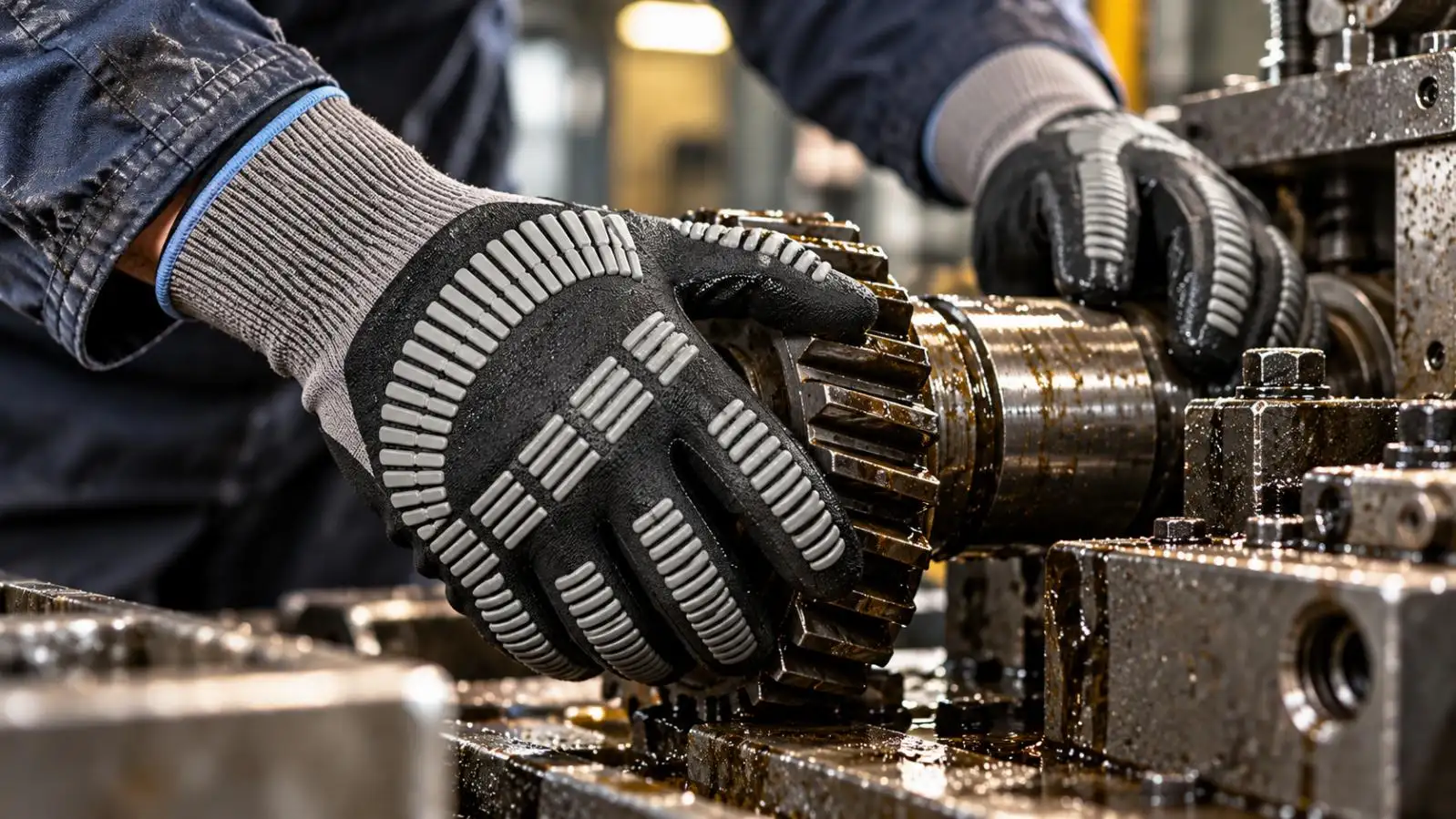
Textured surface for oily-part handling
Texture may wear under repeated abrasion
Metalworking
Smooth Nitrile
Continuous protective coating
Grip may decrease on heavily lubricated surfaces
General maintenance
Full Nitrile/PVC Coating
Extended liquid-contact coverage
Reduced breathability or flexibility
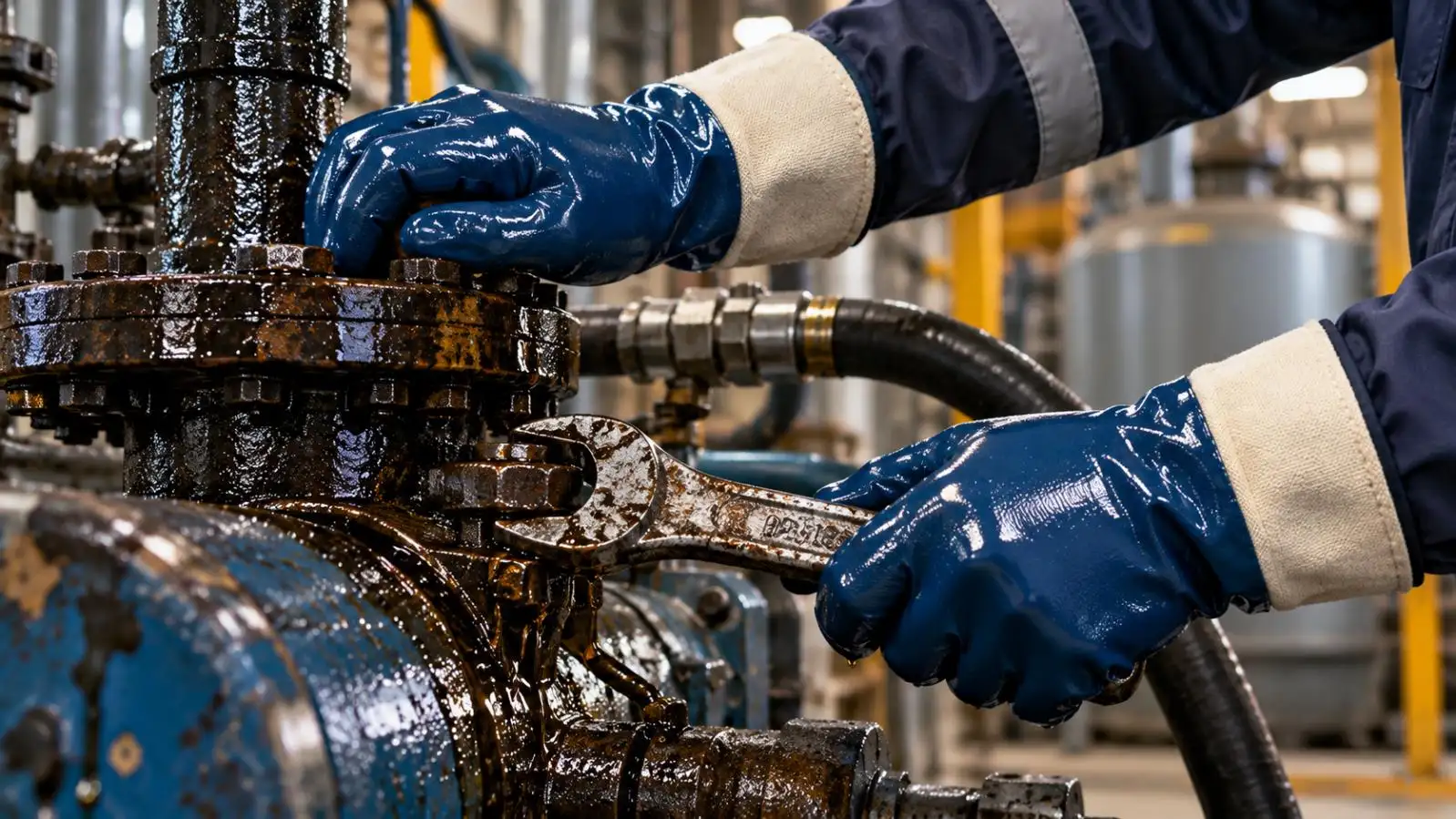
Wet industrial handling
Coating performance depends on more than thickness.
Key durability mechanisms include:
•Abrasion Resistance: Measures how the coating is resistant to contact with rough work pieces.
•Coating Adhesion: If coating does not stick well to the substrate, delamination or peeling may occur before the liner wears out.
•Grip Retention: Texture may wear away due to abrasion or other contaminants.
•Flex-Fatigue: May cause cracking and tearing in the material from creases in the hand, especially with prolonged use.
It is important to achieve the right balance, because a thicker coating may increase the material available for wear, but it may increase the gloves' bulk and reduce dexterity. Thicker coatings do not guarantee a longer useful life.
Liner Materials and Mechanical Protection
Construction of the liner influences the fit, protection, and fatigue during repetitive use of a glove.
For example, combining appropriately engineered HPPE (High Performance Polyethylene) with composite fibers may outperform a finer-gauge nylon liner.
For example, NMSafety's DY1350F-H3 has a 13-gauge nylon, HPPE, and glass fiber liner and a sandy nitrile palm coating. Their product specification states that the product meets the cut resistance levels of ANSI A3 and ISO 13997, Level C.
Using oil grip and cut protection as independent performance features illustrates how these two elements may be combined in a design.
3. Calculating Cost per Usable Shift
For Oil Resistant Gloves OEM in China, the most meaningful economic measure is often cost per validated usable shift.
Cost Per Usable Shift = Landed Cost Per Pair / Validated Usable Shifts
Suppose we have two gloves that both fulfill the protection requirements of a given workplace:
Cost Indicator
Glove A
Glove B
Landed Price
$0.80
$1.35
Validated Service Life
1 shift
3 shifts
Cost Per Usable Shift
$0.80
$0.45
Cost for 300 Shifts
$240
$135
These numbers are just for example, and are not NM Safety glove numbers or claims.
Using the data above, Glove B would cost 43.75% less per usable shift.
However, it should be noted that service life should be determined through workplace trials. EN 388 abrasion results can not be converted to a given number of work hours.
Gloves should be replaced if the coating is damaged, grip is lost, or the glove is contaminated or otherwise compromised, or if the liner deteriorates. Cleaning and reusing gloves should be in accordance with the manufacturer's instructions and workplace procedures.
4. Matching Protection Levels to Industrial Applications
Oil resistance is not sufficient when there are risks of cuts or impact from sharp or pointed objects, or if there is protracted exposure to liquids.
Application
Main Exposure
Selection Priorities
Automotive Assembly
Light lubricants, repetitive handling
Dexterity, oil grip, fit
Metal Fabrication
Sharp edges, cutting fluids
Verified cut protection, abrasion resistance
Machinery Maintenance
Grease, oil, intermittent liquid contact
Coating coverage, grip, chemical compatibility
Heavy Equipment Handling
Oily parts, abrasion, impact
Mechanical protection, grip
In the case of extended contact with chemicals, differentiation needs to be made between oil grip and chemical permeation.
Not all palm-coated nitrile gloves suitable for handling lightly oiled components are suitable for extended chemical immersion.
Gloves should be selected having regard to the type of oil, exposed surfaces, required movement, the temperature of the workplace and duration of exposure.
5. Verifying Performance before OEM Bulk Orders
Standards and Workplace Testing
When evaluating Oil Resistant Gloves OEM in China, published test standards and ratings can be useful, but application testing is essential.
Verification Method
What Buyers Should Evaluate
EN 388:2016+A1:2018
Mechanical protection against abrasion, cuts, tears, and punctures
Evaluating a supplier should cover the following aspects:
•Define Hazard Profiles. Evaluate length of time in contact with types of oil or chemicals, presence of sharp edges, required hand dexterity.
•Approve Representative Samples. Assess coating construction and materials, liner sizing and test reports.
•Conduct Controlled Tests. Assess reason for glove replacement, grip and worker feedback.
•Establish Inspection Guidelines. Define minimum acceptable defects for coating and thickness, labeling and batch sampling requirements.
Consider "Delivered Price". Consider minimum order quantity (MOQ), price for customization, lead time, freight terms, price per safe use shift, warranties and terms of warranties.
Any modification to the coating or material should be assessed with regard to performance evidence.
6. NMSafety's Approach to Oil-Resistant Glove OEM Sourcing
NMSafety evaluates oil-resistant gloves based on coating construction and mechanical protection in line with working conditions.
We offer a range of oil-resistant glove options (foam nitrile, sandy nitrile, smooth nitrile, and PVC coated) along with selected cut-resistant, impact resistant and thermal protective designs.
Our services cover design, manufacturing and distribution. We recommend buyers set up their samples, define inspection and commercial requirements and approve bulk production orders.
For Oil Resistant Gloves OEM in China, the purchasing value should be assessed with verified protection and usable service life, consistent product specs, and the total cost delivered.
Contact NMSafety for Oil Resistant Gloves and tell us about your application, protection requirements and OEM alterations to assess if our gloves meet your sourcing needs.
FAQs
Q1. What types of oil-resistant gloves does NMSafety offer?
NMSafety offers foam nitrile, sandy nitrile, smooth nitrile, and PVC-coated gloves for different industrial handling and protection requirements.
Q2. Does NMSafety provide OEM services for oil-resistant gloves?
Yes. NMSafety provides OEM design, manufacturing, and delivery services. Specific customization requirements can be discussed before production.
Q3. Which NMSafety gloves are suitable for oily metal handling?
NMSafety's sandy nitrile-coated gloves are candidates for oily metal handling. Grip and abrasion performance should be verified under actual working conditions.
Q4. Does NMSafety manufacture cut-resistant oil gloves?
Yes. NMSafety offers nitrile-coated gloves with HPPE and composite-fiber liners. Cut protection levels vary by product model.
Q5. Can NMSafety customize glove materials and packaging?
NMSafety provides OEM manufacturing services. Buyers can discuss liner materials, coatings, branding, and packaging requirements, subject to technical feasibility.