Home > BLOG > Industry Blog > Anti Static Gloves Factory in China: How Carbon Fiber and PU Coatings Affect ESD Protection
Anti Static Gloves Factory in China: How Carbon Fiber and PU Coatings Affect ESD Protection
19 Oct, 2026
By hqt
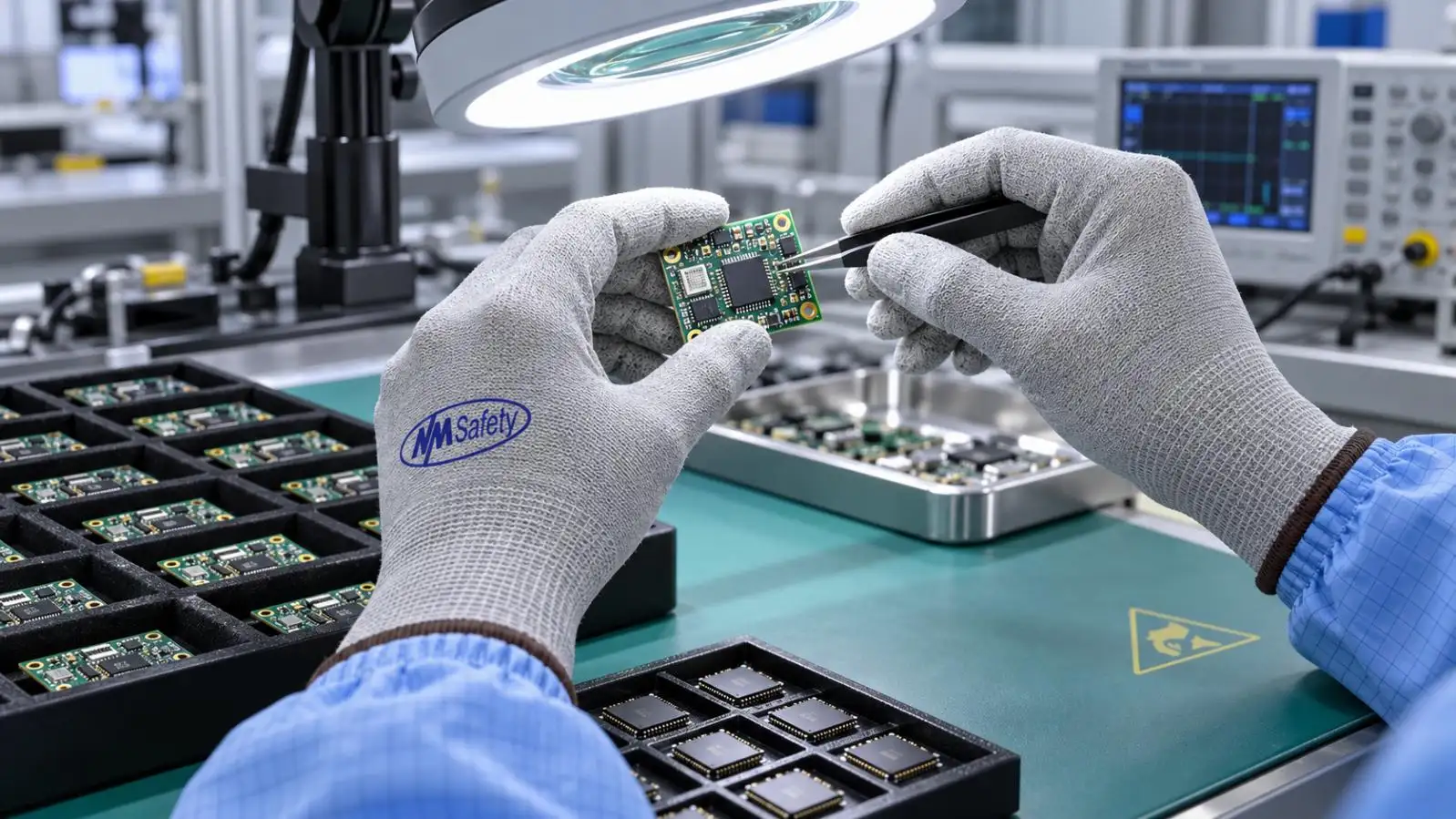
For electronics assemblers, the critical question is not whether a glove is labeled "anti-static," but whether its finished construction performs within the workstation's ESD control program. Carbon-fiber yarn can establish electrical pathways through a knitted liner; polyurethane (PU) coating changes the contact interface at the fingers or palm.
Effects are defined as test results or measurements of characteristics of material properties. An Anti Static Gloves Factory in China should be able to show evidence of both effects rather than simply supplying a material name.
Nylon has several properties that make it compatible with other types of fabric and filament. Incorporation of carbon-containing yarns in the nylon results in a path for the dissipation of the electrostatic charge. Thus, in the presence of an appropriately secured ground, electrostatic control may be accomplished.
Factors other than the carbon content of the yarn that may affect the total resistance of the material include the following:
• Continuity and Uniformity of Yarns: If the yarns that provide the path for the electrostatic charge are not uniformly distributed through the material, the total resistance of the material increases.
• Knitting Geometry: The gauge and stitch density affect how the fabric is laid. A finer knit does not necessarily mean the material has an ESD rating.
• Service Conditions: Stretching, wearing and washing can change the electrical response.
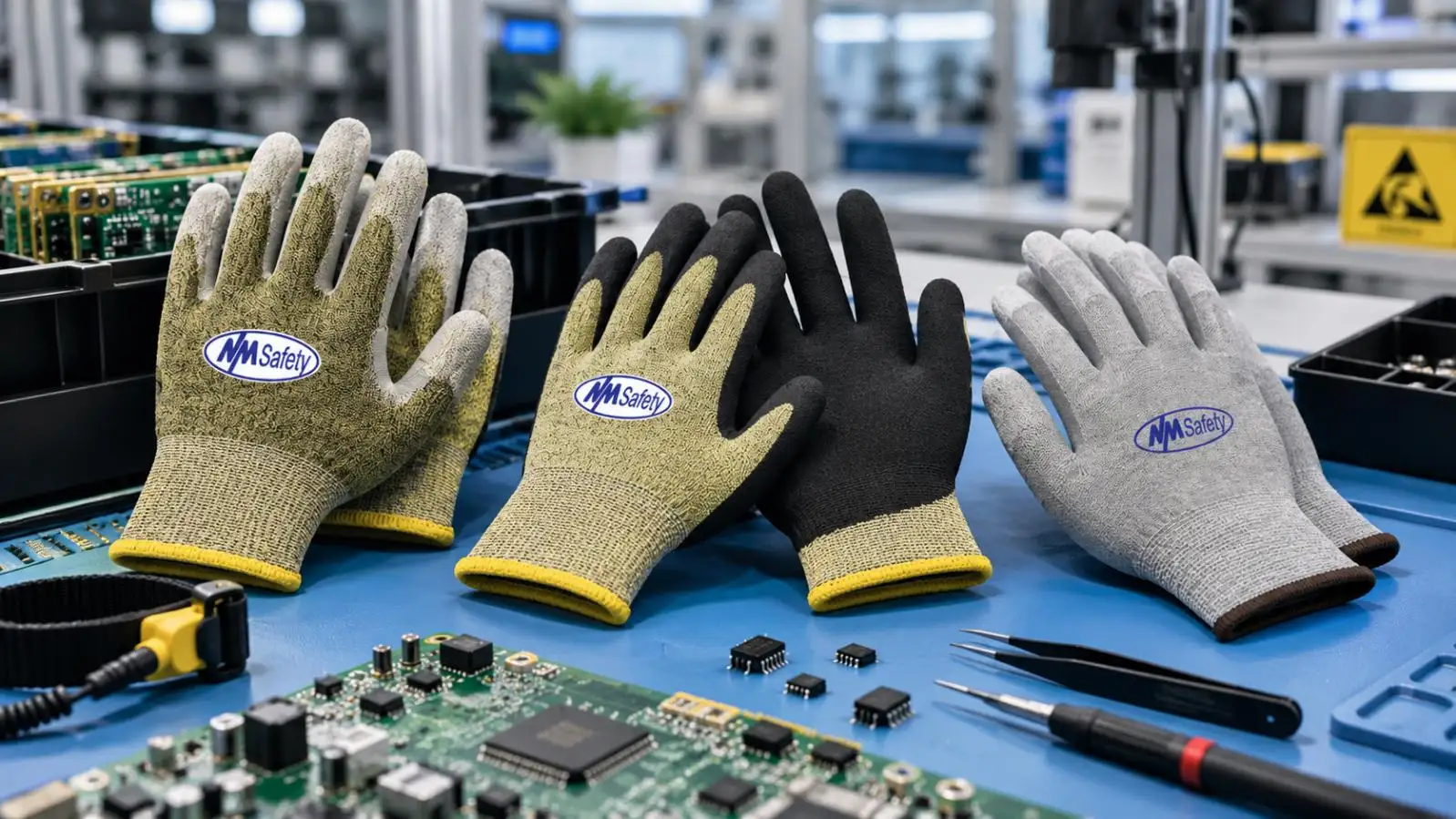
At NMSafety, our SK20.07 uses an uncoated 13-gauge nylon/carbon knit for a reference construction to allow buyers to compare textile contacts to coated designs.
Carbon fibers do not replace wrist straps, footwear/flooring controls, or other grounding provisions.
How PU Coating Changes Electrical Contact and Handling
PU Fingertip vs. PU Palm Coating
PU adds friction and local abrasion protection, but standard PU is not automatically electrically dissipative. Its formulation, film thickness, coverage, and contact with conductive yarns can influence the resistance measured through a finished glove.
A continuous insulating layer can interrupt a contact route, even when the underlying liner contains carbon.
High tactile feedback; limited abrasion protection
Liner and in-use resistance
PU Fingertip Coating
Fingertips
Local grip for small components
Coated fingertip resistance
PU Palm Coating
Palm and finger contact areas
Broader grip coverage; less exposed textile
Palm and finger contact resistance
Our PU20.07F and PU20.07P use 13-gauge nylon/carbon liners with PU fingertip and palm coatings, respectively.
Neither is inherently the better ESD option: comparing coating patterns requires equivalent resistance methods, conditioning, and wear states.
An Anti Static Gloves Factory in China should therefore treat PU coating thickness, coverage uniformity, adhesion, and post-abrasion behavior as specification variables—not merely cosmetic features.
Why Coating Thickness Matters
Greater PU coverage can improve handling security, but it may also change the electrical contact between the component, glove surface, and conductive liner.
For ESD-sensitive operations, buyers should examine:
•Coating resistance at the actual handling points
•Thickness consistency across production batches
•Conductive continuity after repeated flexing
•Changes in grip and resistance after abrasion
Match Glove Construction to Manufacturing Tasks
The required balance changes with component size, grip demand, mechanical hazards, and contamination limits.
Workstation
Construction to Evaluate
Qualification Focus
PCB Placement or Rework
PU fingertips
Fine grip, fingertip resistance, lint
Electronics Inspection
Uncoated carbon knit
Tactility, textile shedding, resistance
Electronic Parts Transfer
PU palm
Grip, abrasion, electrical contact
Semiconductor Handling
Application-qualified low-particle glove
ESD results and particle/ionic cleanliness
Sharp-Edged Component Assembly
Cut-resistant ESD glove
Electrical resistance and cut testing
For combined handling and cut hazards, our DY1850PU-ESD has an 18-gauge nylon/carbon/HPPE/glass-fiber liner and PU palm coating.
Its cut classifications are ANSI A3 and ISO 13997 Level C. These assess mechanical protection, not ESD compliance.
A glove described as "ESD" is also not automatically cleanroom-qualified. Semiconductor applications may require additional particle-release and contamination testing.
Which ESD Tests and Standards Matter?
Electrical Resistance and Grounding Compatibility
A resistance figure is meaningful only when the measurement method, electrodes, environmental conditioning, and test location are known.
Humidity, oils, detergent residues, and coating wear can affect results. Unusually low resistance should not automatically be considered preferable.
Standard
Technical Scope
Buyer Consideration
ANSI/ESD STM15.1
Glove and glove-person resistance testing
Verify electrical behavior
IEC 61340-5-1:2024
Electronic-device ESD control programs
Assess EPA compatibility
ANSI/ESD S20.20
ESD control-program requirements
Establish qualification criteria
EN 16350
Electrostatic gloves for explosive-atmosphere risks
Not an electronics ESD qualification
An Anti Static Gloves Factory in China should provide finished-glove test documentation rather than relying solely on conductive-yarn specifications.
What Should Buyers Request?
When considering bulk sample approval, you must evaluate:
•Electrical Tests Data: Resistance measurement values, electrode arrangements, test voltage and test locations.
•Environmental conditions: Temperature and relative humidity, and sample conditioning.
•System Verification: Glove-person resistance measurement under the system intended grounding arrangement.
•Durability Evaluation: Results of abrasion, flexing and/or allowed cleaning cycles.
•Batch Consistency: Measurement representations across various sizes and lots.
Acceptance criteria must be aligned to the customer ESD Protected Area (EPA) requirements and not to a general assumed universal resistance threshold.
Important: ESD gloves are not electrical-insulating gloves and must not be used for protection against electric shock.
What Should OEM Buyers Verify with a Chinese Factory?
Choosing an Anti Static Gloves Factory in China means controlling production repeatability. A passing prototype doesn’t say much about subsequent batches unless approved construction and test requirements are specified.
Procurement Checklist
•Liner Specification: Fiber composition, yarn distribution, knitting gauge and size and fit are reviewed for each liner specification.
•Coating Control: We evaluate coverage and thickness consistency of our customers’ specified PU coating, and adhesion and wear resistance.
•Quality Assurance: Approved samples are traceable by lot. Customer specified inspections and resistance test records are maintained.
•Customization: Customization includes logo, color and size range. Packaging specifications and types are also customizable.
•Commercial Terms: including MOQ and lead time, sample approval, change in material, and other terms.
NMSafety is able to supply both coated and uncoated ESD constructions. We also provide custom logo, color and packaging.
This range gives OEM buyers a practical starting point for matching glove construction with electrical, mechanical, and handling requirements.
Explore NMSafety Anti Static Gloves
When sourcing from an Anti Static Gloves Factory in China, buyers should define the workstation task, grounding method, required test documentation, and anticipated wear conditions before selecting a coating.
At NMSafety, our anti-static knitted, PU-coated ESD gloves are available in a variety of options for electronics manufacturing and industrial handling.
Q1. What types of anti-static gloves does NMSafety offer?
NMSafety offers uncoated carbon-fiber knitted gloves, PU fingertip-coated gloves, PU palm-coated gloves, and cut-resistant ESD gloves for electronics and industrial applications.
Q2. What materials are used in NMSafety anti-static gloves?
Our SK20.07, PU20.07F, and PU20.07P models use 13-gauge nylon-carbon knitted liners. Carbon fibers help create conductive pathways for static dissipation.
Q3. How do NMSafety's PU fingertip and PU palm coatings differ?
PU fingertip coating provides localized grip for precision handling. PU palm coating offers broader grip and abrasion protection across the palm and fingers.
Q4. Does PU coating automatically make NMSafety gloves ESD-safe?
No. ESD performance depends on the conductive liner, coating characteristics, and finished-glove resistance. Buyers should verify suitability through electrical testing.
Q5. Which NMSafety gloves are suitable for PCB assembly?
Our PU20.07F fingertip-coated gloves are an option for precision PCB handling, while PU20.07P gloves provide broader grip. Final selection requires application-specific ESD verification.