Home > BLOG > Industry Blog > PU Coated Gloves Factory in China: Water-Based PU Coating and Sustainability Trends
PU Coated Gloves Factory in China: Water-Based PU Coating and Sustainability Trends
20 Oct, 2026
By hqt
Selecting a PU coated gloves factory in China has become more complicated as customers must consider coating chemistry along with abrasion resistance, dexterity, and cost. Conventional PU coatings contain solvents such as Dimethylformamide (DMF) raising concerns with exposure and manufacturing emission. Water-based PU technology is an alternative to conventional PU technology. However, the environmental benefits of this technology are dependent on the formulation and processing, as well as the longevity of the finished product.
At NMSafety, we believe sustainable glove selection requires an integrated approach and consideration to coating technology, liner construction, protective performance, and other product specifications.
Polymers dispersed in water (PUDs) are the basis of water-based polyurethane coatings. Water-based polyurethane coatings are applied to a liner and, upon the removal of water, polyurethane particles coalesce to form a film.
Critical Coating Parameters
A PU coated gloves factory in China has to be know how the following manufacturing parameters relate to one another:
•Dispersion viscosity: affects the uniformity of coating and its ease of picking up.
•Solid content: increases the weight and drying time of the coating.
•Coating penetration: excessive coating may result in stiffness of the liner and lose of glove flexibility.
•Drying and film formation: affect the integrity and adherence of the surface coating to the substrate.
•Polymer type: impacts the abrasion and fatigue resistance of the coating.
These relationships illustrate that it is not as simple as substituting a solvent with water when using water based PU technology.
Water-Based vs. Solvent-Based PU
Concerns relating to exposure and safety may exist in the case of the use of solvents in traditional solvent systems and may also require a solvent recovery system. Water-based PU technology may eliminate or reduce reliance on solvents, however, other solvents and additive may still be of concern.
Evaluation Factor
Water-Based PU
Solvent-Based PU
Primary carrier
Water
Organic solvents
DMF use
Can be avoided through formulation
Depends on solvent selection
VOC implications
Potentially lower emissions
Greater solvent-management requirements
Coating stability
Depends on dispersion control
Depends on solution and process control
Abrasion resistance
Formulation and film-dependent
Formulation and film-dependent
Production considerations
Water removal, drying energy
Solvent removal and recovery
Sustainability evidence
Chemical and process records
Chemical and process records
The critical distinction is process chemistry, not guaranteed mechanical superiority. A water-based coating is not automatically more abrasion-resistant, biodegradable, recyclable, or carbon-neutral.
For buyers considering PU Coated Gloves Factory in China, to substantiate environmental claims, formulations declarations, emissions data and product testing are required.
Is Water-Based PU Maintains Industrial Glove Performance?
PU coating alone does not determine the suitability of a glove. Other parameters including liner thickness and coating coverage, working environment etc are equally important.
Abrasion Resistance, Grip, and Dexterity
•Abrasion Resistance: Coating thickness and adhesion affect wear, but in some cases, a thicker film may reduce tactile sensitivity.
•Dexterity: In order to improve small part picking performance, fine gauge liners are used with controlled coating penetration.
•Grip: Conventional smooth PU coating, without further surface functionalization, should not be assumed to be suitable for continuous oily handling.
•Breathability: Palm or fingertip coating leaves more uncoated textile exposed than full coating.
•Cut protection: Depends principally on protective yarn construction and verified finished-glove ratings, not PU coating alone.
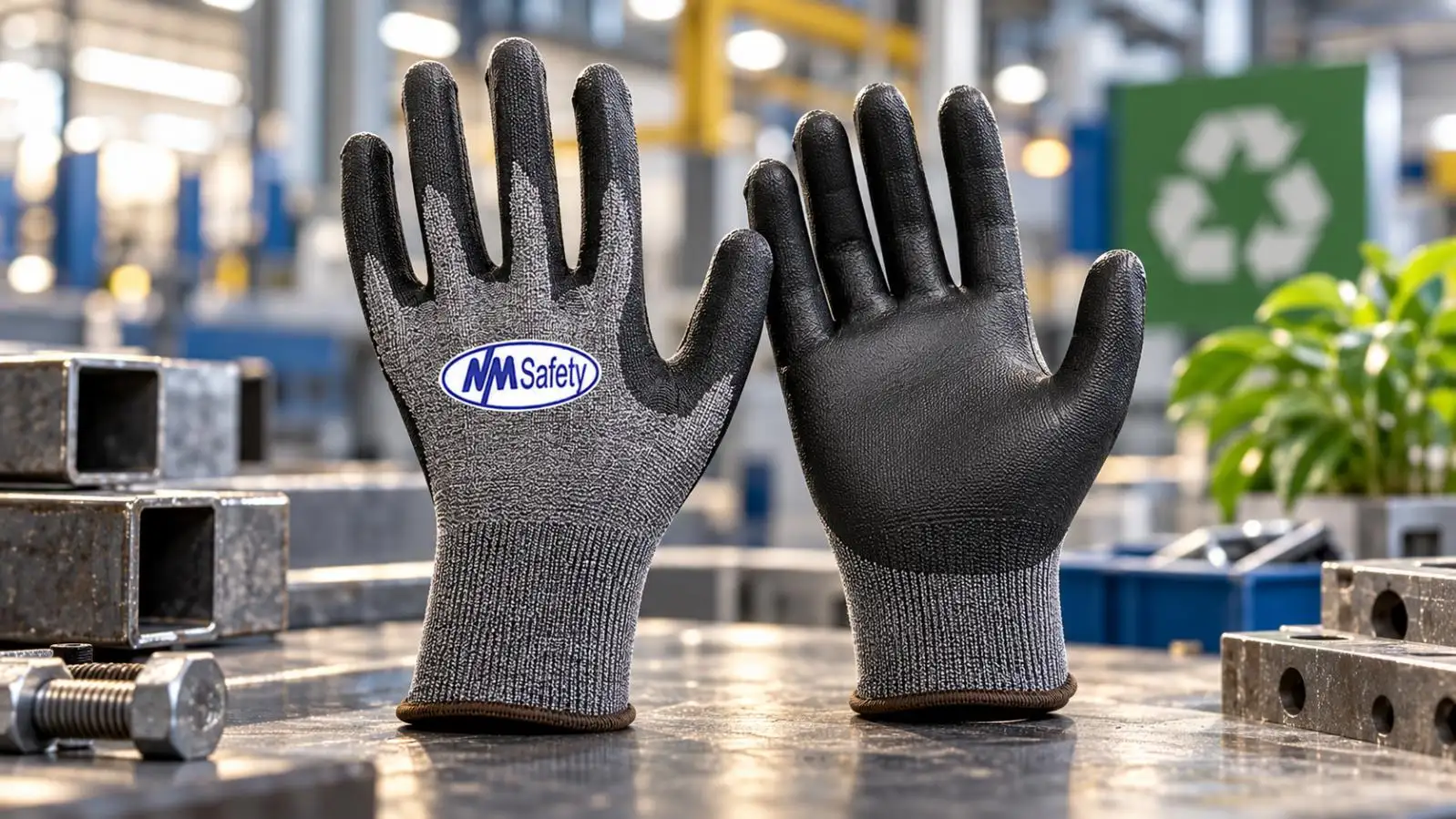
At NMSafety, our PU product range illustrates these construction differences. The PU1850 uses an 18-gauge nylon liner with PU palm coating for lightweight handling. The DY1850PU-H4 combines nylon, HPPE, and steel fiber with PU coating and thumb-crotch reinforcement for cut-resistant applications.
Neither product's standard PU specification should be assumed to indicate a water-based formulation without model-specific confirmation.
Application
Preferred Construction
Buyer Verification
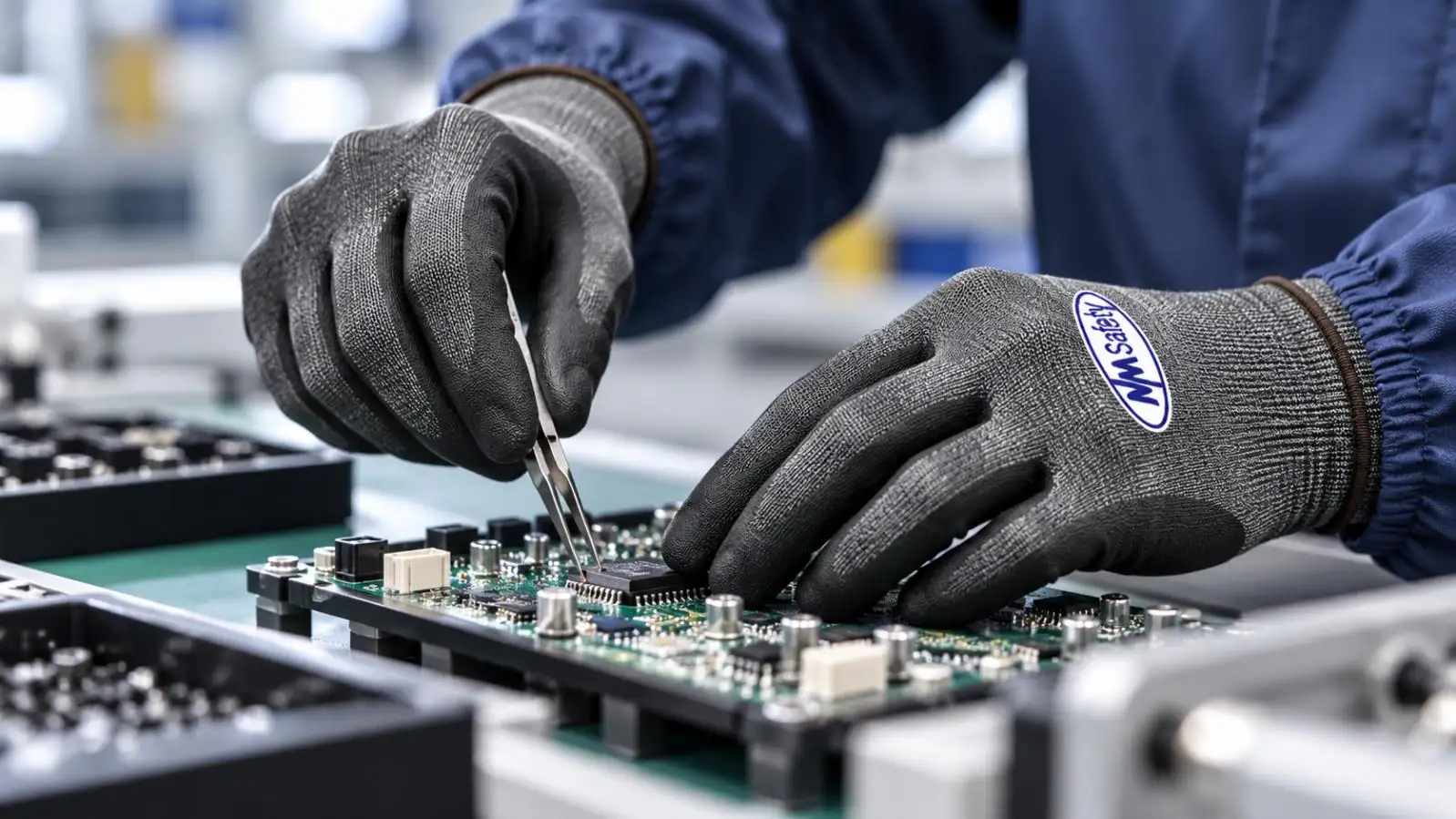
Electronics assembly
Fine-gauge PU or suitable ESD design
Dexterity, cleanliness, electrostatic properties
Automotive components
Abrasion-resistant PU with suitable liner
Grip, coating wear, fit
Metal-part handling
Cut-resistant liner with PU coating
EN 388/ISO 13997 results
Warehouse operations
Flexible palm-coated gloves
Dry grip, replacement frequency
A 21-gauge glove is not automatically safer than a 13-gauge glove. Mechanical protection depends on the complete material structure.
Sustainability Beyond the Water-Based Label
The sustainable sourcing assessment should evaluate more than the substitution of solvents.
•Chemical management: Determine if DMF or other ATP restricted substances are present and request relevant residual chemical tests.
•Resource consumption: Energy is still required for water-based coatings to dry. Auxiliary chemicals, wastewater treatment and process water impact the total environmental load.
•Material selection: Using other liner materials (recycled polyester, for example) may also give additional possibilities for sustainability, if the material can be documented.
•Working life: Depending on usage, a glove that requires fewer replacements (and therefore less material used and disposed of) may also be more sustainable.
Using the principles of ISO 14040/14044, the comparisons made should be made within defined system boundaries and consistently. A lower total carbon footprint is not automatically implied by lower solvent use.
Compliance and Documentation
Standard / Requirement
What Buyers Should Check
EN 388:2016+A1:2018
Abrasion, cut, tear, puncture and applicable impact results
EN ISO 21420:2020+A1:2024
Glove innocuousness, sizing, dexterity and marking
REACH
Applicable chemical restrictions and declarations
EU PPE Regulation 2016/425
CE conformity documentation for EU markets
ISO 14040/14044
Methodology for substantiated life-cycle comparisons
EN ISO 21420 specifies a DMFa limit below 1,000 mg/kg for PU containing gloves. This finished product requirement is different from the REACH considerations for DMF substances, mixtures and occupational exposure.
Assessing OEM Sourcing for PU coated gloves from China
As with bulk approvals, consistency of coating is important. Prior to sample coating, acceptance criteria need to be agreed upon.
•Performance Testing: Mechanical Ratings, Grip and Flex, Wear Resistance
•Environmental Verification: Chemical Declarations, Rel. Lab Reports, Sustainability Claims
•Batch Consistency: Coating Weight, Defects, Dimensions, Lot Traceability
•Commercial Terms: Sample Approval, MOQ, Lead Time, Packaging, Shipping
Unit price may not reflect true cost when considering other factors such as usable working hours or frequency of replacement, the condition and the environment in which the gloves are handled and the cost of disposal.
Explore Our Sustainable PU Gloves at NMSafety
At NMSafety, we take part in the sourcing of lightweight PU, fingertip-coated, ESD and cut-resistant gloves in the OEM/ODM capacity. We also consider water-based PU and alternative liners when project requirements require it.
When choosing a PU Coated Gloves Factory in China, buyers should check coating chemistry, protection standards, and sample performance before production.
Q1. What types of PU coated gloves does NMSafety offer?
NMSafety offers nylon PU palm-coated gloves, fingertip-coated gloves, ESD designs, and cut-resistant PU gloves for various industrial applications.
Q2. Does NMSafety offer water-based PU coating options?
Yes. NMSafety identifies water-based PU as a coating development option. Buyers should confirm formulation availability and technical specifications for their selected glove construction.
Q3. Are all NMSafety PU coated gloves water-based?
No. Standard PU product listings do not necessarily indicate water-based formulations. Buyers should request model-specific coating information before placing orders.
Q4. What sustainable liner materials can NMSafety provide?
NMSafety discusses RPET recycled polyester, bio-based nylon, and bamboo-derived materials for sustainable glove development, subject to application and material requirements.
Q5. Does NMSafety manufacture lightweight PU gloves for precision work?
Yes. NMSafety's PU1850 features an 18-gauge nylon liner with PU palm coating, designed for lightweight industrial handling and flexible finger movement.