Home > BLOG > Industry Blog > Touch Screen Gloves Supplier in China: Sustainable Materials and Coating Trends in 2026
Touch Screen Gloves Supplier in China: Sustainable Materials and Coating Trends in 2026
20 Oct, 2026
By hqt
For buyers evaluating a Touch Screen Gloves Supplier in China, the key sustainability question is not simply whether a glove contains recycled yarn. It is whether the complete design can maintain capacitive-screen response, mechanical protection, and an acceptable service life while supporting a substantiated environmental claim.
In 2026, liner traceability, coating chemistry, and product-level verification deserve closer scrutiny than broad "eco-friendly" labels.
1. Sustainable Liner Materials: What Actually Changes?
RPET Polyester vs. Bio-Based Nylon
RPET and bio-based nylon offer different routes to reducing reliance on conventional fossil-based feedstocks. Neither automatically makes a finished glove recyclable, biodegradable, or lower-carbon.
Liner Material
Sustainability Consideration
Technical Evaluation
RPET Polyester
Traceable recycled PET content
Yarn uniformity, stretch recovery, abrasion
Bio-Based Nylon
Renewable feedstock percentage varies
Strength, flexibility, bio-based content
Virgin Nylon/HPPE Blends
Established performance baseline
Cut protection, fit, conductive-fiber integration
The environmental claim must match the component. A liner made with recycled polyester does not mean the entire glove has the same recycled percentage. Coatings, cuffs, conductive fibers, and reinforcement contribute to total mass.
Buyers must check:
•Recycled and bio-based contents by component.
•The traceability of the fiber and its composition.
•The tenacity and the dimensional stability of the yarn.
•Its compatibility with conducting yarns and protective fibers.
At NMSafety, we use bio-based nylon or RPET to manufacture eco-friendly gloves. Our touchscreen gloves are designed with an option for touch screen functionality. For a given sustainable fiber, the integration of touch screen functionality requires sample validation by the end user.
2. Trends in Coatings in 2026: Water-based PU versus Nitrile
For Coatings, a Touch Screen Gloves Supplier in China should also consider performance in addition to formulation. "Water-based" indicates a process route. It neither indicates a greater reduction in environmental impact or a lower carbon footprint, nor does it indicate greater durability.
There are three crucial factors associated with the design of touchscreen protective products.
•Coating thickness and cover age: The application of too much coating can increase bending resistance and diminish fingertip sensitivity.
•Surface texture: The surface texture of a coating can affect the level of grip, and the performance of a touchscreen cover may vary depending on the surface conditions.
•Curing and Adhesion: Process inconsistency can lead to failure of the coating.
There are PU coated products within our Touchscreen product range as well as Nitrile coated products. Within our product range, there are Touchscreens featuring 18 and 21 gauge constructions as well as PU and Nitrile coatings.
Fine gauge knitted liners can facilitate fingertip contact and therefore better touchscreen control.
3. Performance Requirements by Application
Application
Performance Priority
Recommended Evaluation
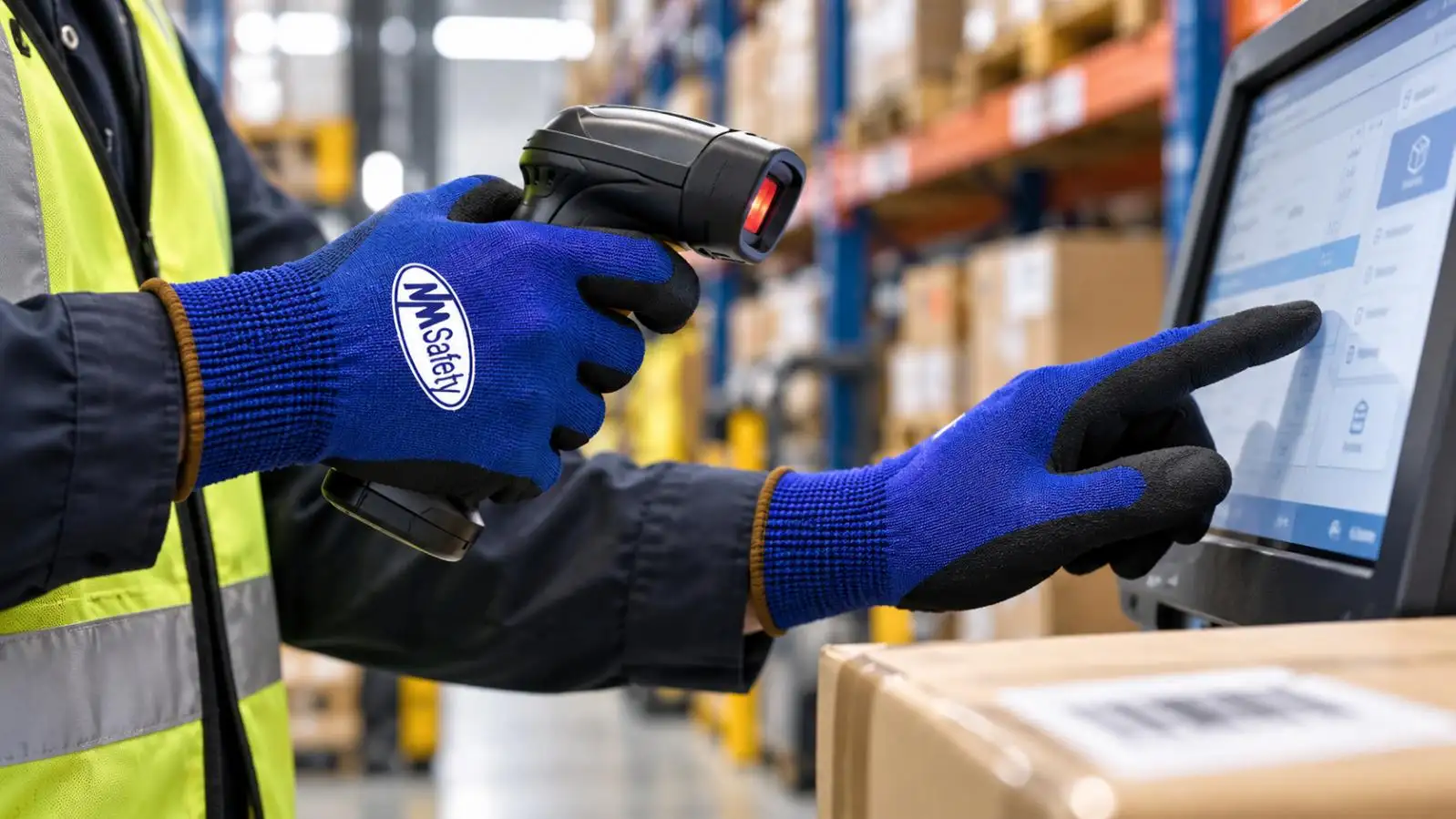
Smart Warehousing
Repeated touchscreen operation
Input accuracy and abrasion resistance
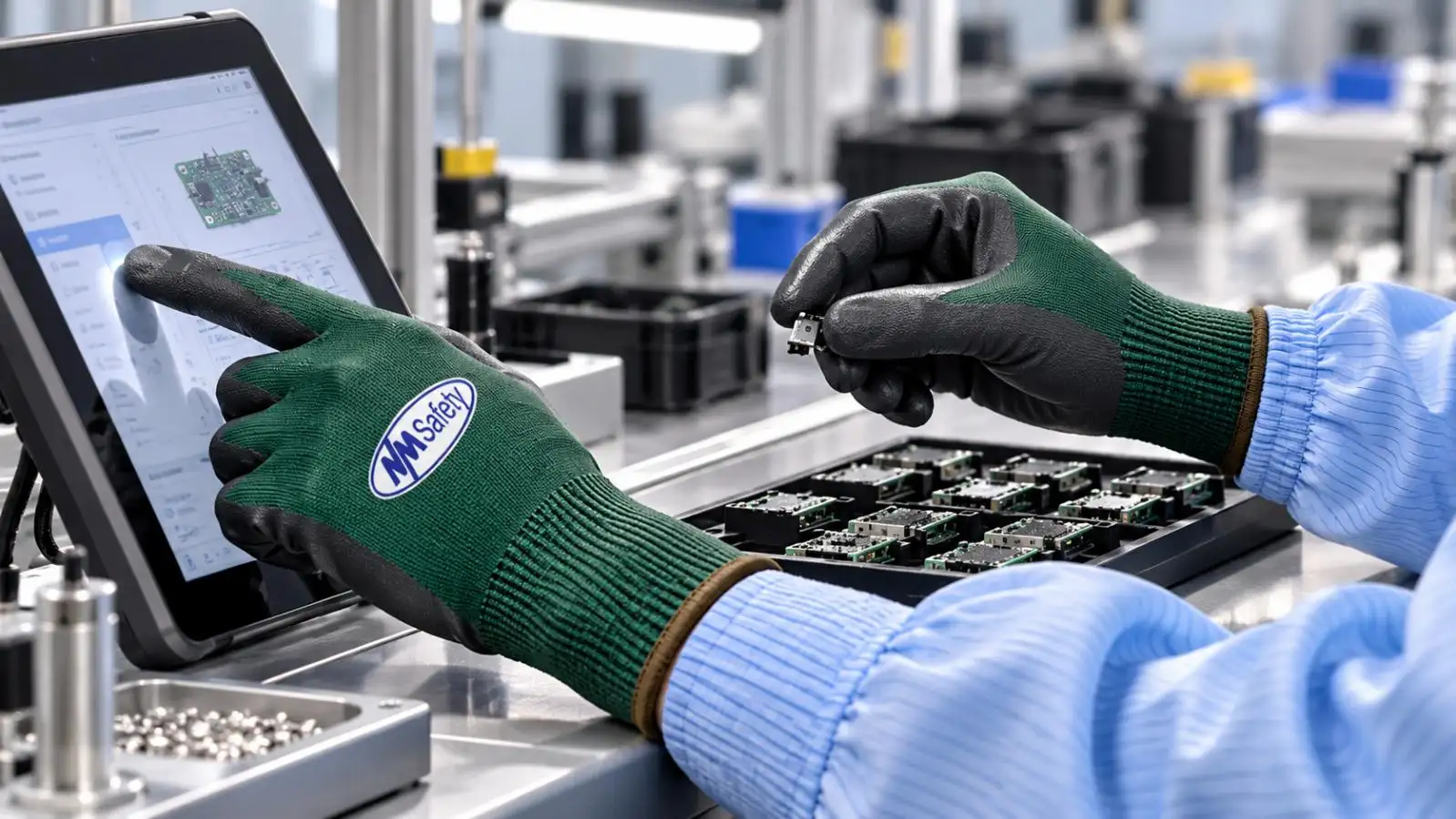
Electronics Assembly
Precise fingertip device handling
Dexterity, device compatibility
Industrial Manufacturing
Grip and impact protection
EN 388, coating durability
Quality Inspection
Terminal control
Conductive contacts, fingertip fit
A Touch Screen Gloves supplier in China should perform application-based assessment, and not just demonstrate their gloves for use on a smart phone.
Testing should include the following:
• Tapping or swiping small screen controls.
• Determine if the correct inputs are made, or if touches are missing.
• Identify if unintended screen controls are activated.
• Assess the performance of different size gloves.
• Evaluate the grip and cut protection.
IMPORTANT: The assessment of touchscreen compatibility should not be interchanged for assessment of ESD protection. The level of control required for ESD should be assessed and confirmed by the Electronics Manufacturing Company.
4. Environmental Verification, Safety Standards and Product Durability
The documentation that supports an environmental claim should define its scope.
For a Touch Screen Gloves Company in China, the documentation and evidence required to prove the PPE and the Touch Screen Gloves are made with recycled materials, are two different cases.
Standard or Framework
Procurement Relevance
RCS / GRS
Recycled content and supply-chain traceability
ISO 14021:2026
Substantiation of self-declared environmental claims
EN ISO 21420
Protective glove construction and general requirements
EN 388
Mechanical protection testing
ANSI/ISEA 105-2024
Hand protection performance classification
EU PPE Regulation 2016/425
EU PPE conformity and applicable CE requirements
Textile Exchange is transitioning recycled-material certification toward its Materials Matter Standard. Buyers should verify certification scope, validity, and applicable transition requirements.
Why Product Lifespan Matters
A glove containing recycled material may still generate unnecessary consumption if its coating wears prematurely.
A useful purchasing metric is:
Cost per Usable Working Hour = Purchase Cost ÷ Verified Service Hours
This accounts for replacement frequency under comparable operating conditions.
Lower replacement costs do not always reduce carbon footprint. Setting consistent lifecycle limits is important in environmental assessments.
5. Choosing a Touch Screen Gloves Supplier in China for Sustainable OEM Sourcing
Buying sustainable gloves is closely tied to the traceability of the raw materials, the repeatability of the production process, and the documentation of the performance of the product.
In the case of bulk purchases, NMSafety suggests the establishment of acceptance criteria prior to bulk production.
To help prevent specification changes, procurement best practices suggest:
• Approve finished samples: A material sample alone does not demonstrate complete glove performance.
• Control production changes: Fiber composition and coating and conductive yarn placement should be consistent with approved samples.
• Compare life cycle costs: An inexpensive glove may increase replacement costs due to a short service life.
The NMSafety touchscreen range incorporates different coating, fine-gauge and cut resistant materials. These provide a starting point for sustainable material discussion with OEMS and require further technical confirmation.
Explore Sustainable Touchscreen Glove Options with NMSafety
Procurement of sustainable gloves depends on verifiable materials, protective performance, and touch screen operation.
NMSafety offers a variety of sustainable, cut resistant, and touch screen gloves, as well as various materials and coatings for further development. To learn more and to discuss sample evaluation, material and OEM preferences, as well as your specific application, contact us.
FAQs
Q1. What types of touchscreen gloves does NMSafety supply?
NMSafety offers 18-gauge and 21-gauge touchscreen gloves with PU, foam nitrile, and sandy nitrile coatings, including cut-resistant options.
Q2. Does NMSafety offer sustainable glove materials?
Yes. NMSafety's eco-friendly glove portfolio includes recycled polyester (RPET) and bio-based nylon. Availability in specific touchscreen designs requires confirmation.
Q3. Can NMSafety customize sustainable touchscreen gloves?
NMSafety supports OEM glove development. Material combinations, conductive yarn integration, and coating requirements should be confirmed during sample development.
Q4. What coating options are available for NMSafety touchscreen gloves?
NMSafety offers PU, microfoam nitrile, and sandy nitrile constructions. Selection depends on grip requirements, dexterity, abrasion resistance, and working conditions.
Q5. Does NMSafety offer water-based PU touchscreen gloves?
NMSafety offers water-based PU within its broader glove offerings. Buyers should confirm its availability and compatibility with their required touchscreen construction.