Home > Uncategorized > Impact Gloves for Mining: Drilling & Rig Workers
Impact Gloves for Mining: Drilling & Rig Workers
07 May, 2026
By arafatshuvo509
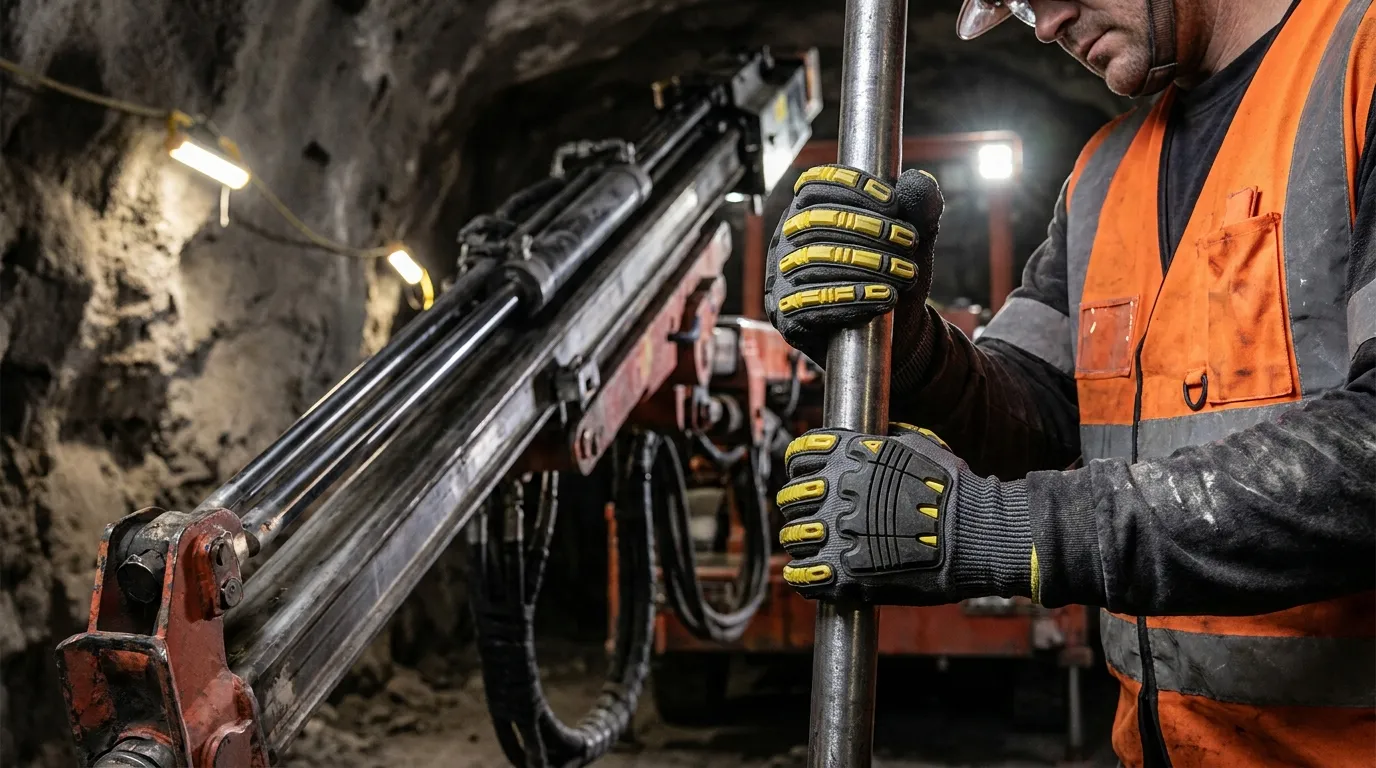
Impact resistant gloves for mining should match the job hazard, not the product label alone. For drilling, rig work, hauler maintenance, and ore handling, buyers should usually specify ANSI/ISEA 138 Level 2-3, TPR back-of-hand protection, sandy nitrile palm grip, a cut-resistant liner, and reinforced thumb/index wear zones.
Mine-site glove buying gets expensive when one glove is expected to fit every crew. A jumbo drill operator, hauler mechanic, and ore handling worker all face different hand hazards. Some need maximum back-of-hand impact protection. Others need better grip, abrasion life, or thumb reinforcement. This guide gives PPE buyers a practical way to match mining impact gloves to the task before ordering samples or writing an RFQ.
Are impact resistant gloves actually necessary for mining?
Impact resistant gloves are necessary in mining when workers face crush, pinch, drilling, maintenance, or ore-handling hazards. Cut protection helps with sharp rock and metal, but impact-rated TPR protection is needed for knuckles, fingers, and metacarpal areas.
Mining work puts hands close to moving steel, heavy tools, abrasive rock, and tight service spaces. The NIOSH Mining Program reports that hand and finger injuries in mining often involve maintenance, material handling, roof bolting, and equipment operation. Those are exactly the jobs where a basic coated glove may not be enough.
Cut-resistant gloves protect against sharp edges, wire, sheet metal, and rough ore. Impact gloves add raised back-of-hand protection, often TPR, to absorb and spread force from knocks, pinches, and dropped objects. For crews facing both hazards, cut impact gloves are usually a better starting point than cut-only gloves.
A practical rule is simple: if the worker’s hand can be struck, squeezed, or trapped near equipment, impact protection belongs in the glove spec. If the hazard is only sharp edges, the broader cut-resistant glove guide can handle the cut-level decision.
Which mining tasks create the biggest hand impact risks?
The highest mining hand-impact risks usually appear around drilling equipment, heavy maintenance, rock handling, conveyors, and haul-truck service. These jobs combine blunt impact with cuts, abrasion, vibration, oil, and poor grip conditions.
A PPE buyer should not choose mining gloves by department name alone. Start with the hand task. Look at what the worker grips, what can move suddenly, what surfaces are abrasive, and where fingers can be caught.
Mining Impact Glove Task Matrix
Mining task
Main hand hazard
Impact level target
Palm and reinforcement
Field-test task
Jumbo drill work
Crush and pinch near drill steel, rods, and controls
ANSI/ISEA 138 Level 3 for frequent exposure
Sandy nitrile palm, reinforced thumb, full TPR fingers
This matrix should guide your sample request. If one crew handles drill steel all shift and another handles abrasive ore, don’t force the same glove unless field trials prove it works for both.
What ANSI/ISEA 138 level should mining buyers specify?
Specify ANSI/ISEA 138 Level 2 for routine mining maintenance, material handling, and moderate pinch risk. Move to Level 3 for drilling, rig work, heavy equipment service, or frequent crush exposure where dexterity loss is acceptable.
ANSI/ISEA 138 is the impact glove standard used to classify dorsal hand protection on a 1-3 scale. The ANSI overview of ANSI/ISEA 138 explains that the standard focuses on back-of-hand impact performance, which helps buyers compare gloves beyond marketing claims.
Level 3 is not automatically the best mining glove. It works when repeated crush and drilling exposure are real. Level 2 can be safer for tasks where tool control, grip feel, and bolt handling matter more than maximum padding.
When Level 2 is enough
Level 2 fits many material handling, general maintenance, ore sorting, and service tasks. It gives meaningful back-of-hand protection without making the glove too stiff for common tools.
Use Level 2 when workers need to handle bolts, radios, wrenches, small parts, or controls during the shift. If workers reject the glove because it feels bulky, the protection on paper will not help much in the field.
When Level 3 is worth the added bulk
Level 3 makes sense for jumbo drill crews, rig workers, heavy hauler service, and jobs with regular crush or pinch exposure. It is also useful where workers handle heavy steel parts in tight spaces.
For deeper rating education, link the buyer team to impact glove ratings before the field trial. The goal is not to buy the highest number every time. The goal is to match the rating to the task.
Mining situation
Better starting point
Why
Routine ore handling
Level 2
Abrasion and grip may matter more than max TPR bulk
Jumbo drill work
Level 3
Frequent crush, pinch, and heavy steel handling
Hauler maintenance
Level 2-3
Depends on hand clearance and metal contact
Conveyor service
Level 2-3
Depends on pinch exposure and moving parts
Light inspection tasks
Level 1-2
Dexterity may matter more than heavy padding
How should glove specs change for underground versus open-pit mining?
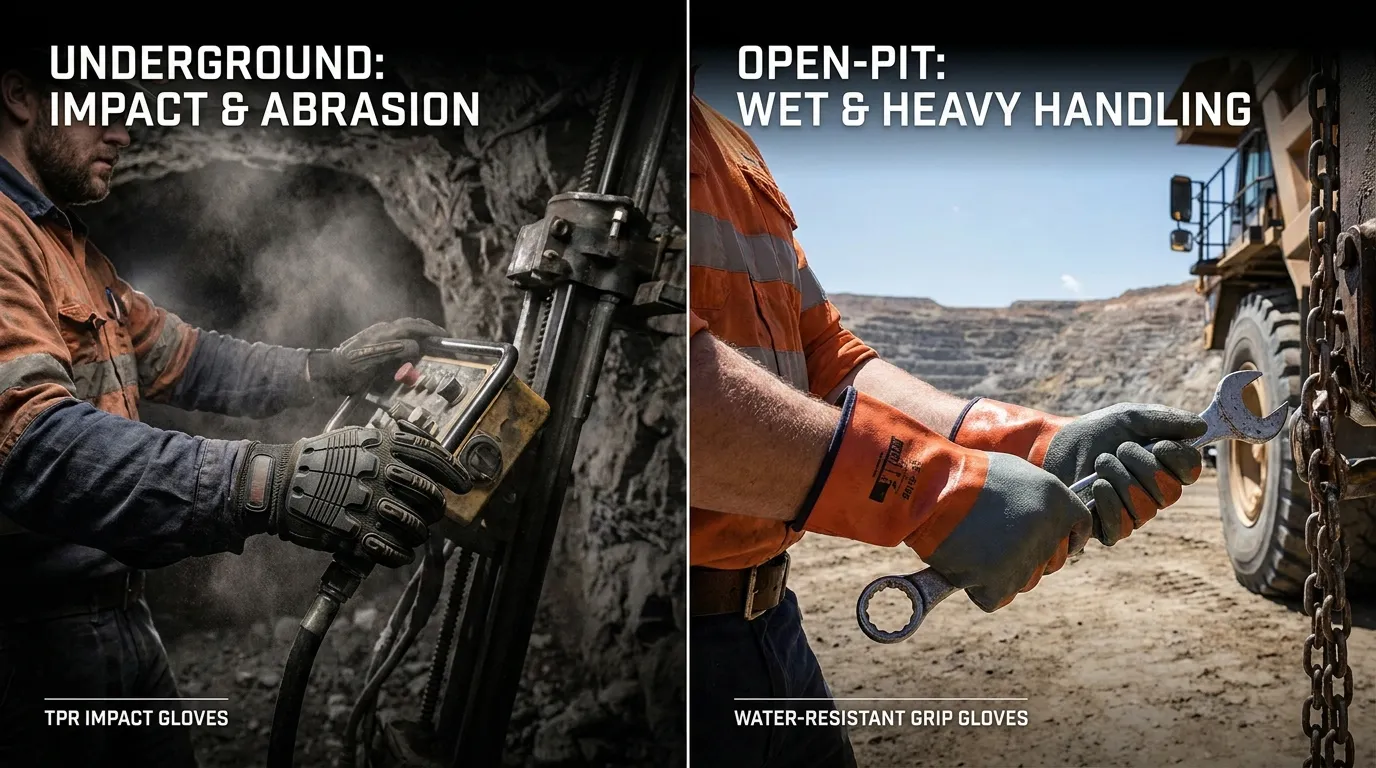
Underground mining usually needs stronger dorsal impact protection because workers operate close to drills, bolters, conveyors, and confined machinery. Open-pit mining often shifts the glove priority toward abrasion, wet grip, visibility, and weather resistance.
One glove can work across both sites, but only after a field trial. Underground crews often work in tighter spaces with less hand clearance. Open-pit crews deal with wet tools, weather, long maintenance shifts, and rough outdoor handling.
Underground vs Open-Pit Glove Spec Comparison
Work setting
Main risk
Grip need
Recommended glove focus
Underground drilling
Crush near rods, drill steel, and controls
Dusty steel grip
Level 3 TPR, sandy nitrile, reinforced thumb
Underground maintenance
Pinch around machines, guards, and lines
Oil and dust grip
Level 2-3, flexible TPR, strong palm coating
Underground conveyor work
Pinch and abrasion
Dry or dusty grip
Secure cuff, cut liner, back-of-hand protection
Open-pit haulage
Wet tools, panels, and metal edges
Wet and oily grip
Sandy nitrile trial, high-visibility back, abrasion zones
Open-pit winter repair
Cold metal, wet surfaces, reduced feel
Weather grip
Test coating and cuff before bulk order
Ore and rock handling
Sharp rock and palm wear
Abrasion grip
Cut liner, sandy nitrile, reinforced thumb/index
This is where buyer judgment matters. Underground drilling crews may justify Level 3 more often. Open-pit repair crews may need coating and cuff changes more than a higher impact rating.
Which palm coating and reinforcement details matter most?
For mining, sandy nitrile is usually the safest default palm because it balances grip, abrasion resistance, and oil handling. A reinforced thumb crotch matters because ore handling, wrenches, drill rods, and metal edges quickly wear that stress point.
Palm coating is not a small detail in mining. Dust, ore, oil, moisture, and rough surfaces can make a smooth glove feel unsafe. A sandy nitrile palm gives texture, so workers can grip tools, rods, panels, and rock with less slip.
A reinforced thumb crotch is also worth specifying. This is the zone between the thumb and index finger. It wears quickly when workers pull rods, grip wrenches, carry ore, or handle sharp metal. A glove that fails there can lose value before the liner or TPR wears out.
Site condition
Better glove detail
Why it helps
Dusty ore handling
Sandy nitrile palm
Adds texture for rough, dry material
Oily maintenance
Textured nitrile coating
Helps workers hold tools and metal parts
Drill rod handling
Reinforced thumb crotch
Reduces wear at the main stress point
Abrasive rock handling
Cut liner plus reinforced palm zones
Protects against cuts and coating failure
Wet open-pit work
Field-tested coating
Confirms grip before bulk ordering
Smooth coatings can look clean in a catalog, but mining work is not clean. Dusty ore, oily tools, and rough rock need texture and wear resistance. Use impact glove selection guidance when comparing coating, TPR layout, cuff style, and liner options.
How do you avoid choosing a glove that is too bulky?
The best mining glove is the one workers can wear correctly for the task. Too much padding can reduce grip, control, and finger movement, especially when crews use bolts, hand tools, radios, and control panels.
This is why Level 3 should be targeted, not automatic. Some roles need heavy TPR protection. Other roles need a lighter impact design that still protects the back of the hand without slowing work. The wrong glove can create a new risk if workers remove it for detailed tasks.
Use a short field trial before standardizing:
Test drill steel handling with the actual crew.
Ask mechanics to remove guards, turn bolts, and handle hydraulic lines.
Check whether workers can use radios and small tools.
Watch for thumb crotch wear after several shifts.
Compare grip in dust, light oil, and wet conditions.
Record complaints about stiffness, heat, or hand fatigue.
Confirm the cuff stays secure around machinery and debris.
Leather gloves are not a strong default for modern mining impact hazards. They may feel durable, but they do not prove back-of-hand impact performance unless the glove is impact-rated and tested.
How should a mine-site PPE buyer write the glove spec?
A mining impact glove spec should state the task, ANSI/ISEA 138 level, cut-resistance target, palm coating, TPR coverage, thumb reinforcement, cuff style, sizes, and field-trial requirements. Do not accept “impact resistant” as a vague marketing claim.
A clear spec protects both the buyer and the workers. OSHA’s hand protection rule says employers must select hand protection based on hazards, conditions, duration, and task needs under 29 CFR 1910.138. That makes task-based glove selection a safety requirement, not only a purchasing choice.
Sample RFQ spec
Use this as a starting point for mining drilling and rig crews:
Application: drilling, rig work, hauler maintenance, and ore handling.
Impact rating: ANSI/ISEA 138 Level 2 or Level 3, based on task.
Back-of-hand protection: TPR over fingers, knuckles, and metacarpal zones.
Palm: sandy nitrile coating for dusty, abrasive, and oily handling.
Liner: cut-resistant liner such as HPPE, Kevlar, or equivalent.
Reinforcement: thumb crotch and index wear zone reinforcement.
Cuff: secure cuff that stays in place during tool and machine work.
Sizes: full size range for crew fit.
Evidence: rating documents, material details, and sample test support.
Trial: field test by drilling, maintenance, and ore handling crews.
For teams buying across drilling, oil, gas, and mining environments, compare related oil gas mining gloves before finalizing one shared spec. Similar hazards can exist, but grip, weather, and coating needs may differ by site.
What should buyers check before importing bulk mining gloves?
Buyers should check classification, shipment documents, material details, and test evidence before importing bulk mining gloves. Most delays start when product construction, coating, fiber content, or paperwork is unclear.
The U.S. Trade.gov PPE HTS report page shows that PPE reporting uses specific HTS code detail. Trade.gov’s import documentation guidance also notes that shipments may need documents such as commercial invoices, packing lists, bills of lading or airway bills, certificates of origin, and other certificates where required.
Use this pre-shipment checklist:
Confirm HS or HTS classification with the importer or broker.
Ask for fiber content, coating material, and glove construction details.
Match product descriptions across invoice, packing list, and test documents.
Request ANSI/ISEA 138 evidence if the glove is sold as impact-rated.
Confirm whether the glove is knit, coated, leather, synthetic, or mixed material.
Check whether certificates of origin or declarations are needed.
Keep sample photos and technical sheets ready for broker review.
Classification can change based on glove construction and materials. A CBP glove ruling example shows how coating, fibers, and design details can affect classification. Don’t wait until the shipment is already moving to clarify those details.
What is the best practical glove choice for drilling and rig workers?
For drilling and rig workers, start with ANSI/ISEA 138 Level 2-3 impact gloves with TPR back-of-hand coverage, a sandy nitrile palm, cut-resistant liner, and reinforced thumb crotch. Use Level 3 for repeated crush and pinch exposure.
For a jumbo drill crew, Level 3 is often the safer starting point because hands work near drill steel, rods, chucks, and controls. The glove should still allow the worker to grip steel and operate controls without fighting the padding.
For a hauler maintenance crew, Level 2 or Level 3 depends on the task. Removing guards, handling hydraulic lines, and working around metal panels may require stronger TPR. Small bolts and tight service areas may need a more flexible Level 2 glove.
For ore handling, abrasion and grip often drive the choice. A cut-resistant liner, sandy nitrile palm, and reinforced thumb/index area can matter more than the heaviest back-of-hand build. This is where a sample trial should compare coating wear after real shifts.
Worker scenario
Recommended starting spec
Decision point
Jumbo drill crew
Level 3, full TPR, sandy nitrile, reinforced thumb
Choose if crush and pinch exposure is frequent
Hauler mechanic
Level 2-3, flexible TPR, strong grip coating
Match rating to clearance and tool control
Ore handling worker
Level 2, cut liner, sandy nitrile, reinforced wear zones
Prioritize abrasion life and grip
Open-pit wet-weather crew
Level 2, grip-focused coating, secure cuff
Field-test coating before bulk order
Bulk import buyer
Rating proof, material details, clear documents
Prevent classification and paperwork delays
What to Do Next
The right impact resistant gloves for mining should come from task mapping, not from a one-line product claim. Start with the crews facing the highest crush, pinch, and abrasion exposure. Then request Level 2 and Level 3 samples with sandy nitrile palms, reinforced thumb crotches, cut-resistant liners, and clear test documentation.
Run the trial on real work: drill steel handling, hauler maintenance, ore movement, conveyor service, and wet open-pit repair. After that, standardize the glove spec by crew type, not by guesswork.
Frequently Asked Questions
What are impact gloves?
Impact gloves are work gloves with added back-of-hand protection for knuckles, fingers, and metacarpal areas. They are used where workers face pinching, crushing, striking, or dropped-object hazards during maintenance, drilling, handling, and equipment work.
What ANSI/ISEA 138 level is best for mining?
ANSI/ISEA 138 Level 2 is a strong starting point for many mining maintenance and material-handling tasks. Level 3 is better for drilling, rig work, and repeated heavy pinch or crush exposure where extra bulk is acceptable.
How do impact gloves work?
Impact gloves use raised TPR, foam, or similar protective material to absorb and spread impact energy across the back of the hand. This helps reduce force reaching fingers, knuckles, and metacarpal areas during knocks or pinches.
Which coating is best for mining safety gloves in dusty or wet environments?
Sandy nitrile is usually best for dusty, abrasive, oily, and lightly wet mining work. Heavy rain, snow, or very wet open-pit work may need a separate coating trial before standardizing the order.
Are cut-resistant gloves enough for mining?
Cut-resistant gloves are not enough when miners face crush, pinch, or blunt impact hazards. Mining buyers should combine cut resistance with impact protection when crews handle drills, heavy tools, rocks, ore, or machinery.
What is impact resistance testing?
Impact resistance testing measures how much force reaches the hand after a controlled impact on the glove. ANSI/ISEA 138 classifies impact gloves from Level 1 to Level 3, with Level 3 offering the highest impact protection.
How long do mining safety gloves typically last?
Mining glove life depends on abrasion, coating wear, chemical exposure, task intensity, and worker fit. Buyers should field-test samples by task and replace gloves when grip, coating, TPR, seams, or thumb reinforcement start failing.