Home > Uncategorized > Impact-Resistant Gloves Buying Guide for OEMs
Impact-Resistant Gloves Buying Guide for OEMs
05 May, 2026
By arafatshuvo509
This impact resistant gloves buying guide helps OEM and private-label buyers choose by impact zone, standard, material, and RFQ detail. Specify knuckle, finger, back-of-hand, and thumb saddle coverage, confirm ANSI/ISEA 138 or EN 388 claims, compare molded TPR with EVA foam, and send a clear RFQ covering MOQ, lead time, logo, packaging, and sample approval.
Impact gloves can look similar in a catalog, but small design choices change how they perform in the field. A distributor buying a private-label line needs more than a good product photo. You need a clear protection map, the right test language, a workable customization plan, and a quote that can survive sampling and bulk production.
What should an OEM buyer check first in an impact glove?
Choose an impact glove by mapping the worker’s strike zones, grip conditions, and required cut level first. Price only becomes useful after you know the protection zones, coating, certification, and customization needs.
Start with the job, not the glove style. OSHA’s hand protection rule says employers should select gloves based on the task, conditions, duration, and hazards involved in the work. That logic also helps OEM buyers avoid quoting a glove that looks protective but misses the real use case. OSHA 1910.138
Before you ask for a unit price, define the target user. A construction buyer may need hard back-of-hand protection and good dry grip. An oil and gas buyer may need oil grip, high visibility, and stronger impact documentation. A warehouse buyer may need lighter pads because workers scan, lift, and pack all day.
What hits the hand: tools, pipes, blocks, parts, cartons, or machinery edges?
Where does the hand get hit: knuckles, fingers, thumb saddle, or metacarpal area?
What grip condition matters: dry, wet, oily, cold, or mixed?
Does the glove also need cut resistance?
Does the buyer need ANSI/ISEA 138, EN 388, or both?
Is this a stock line, private-label line, or custom OEM program?
Which TPR coverage zones matter most for private-label impact gloves?
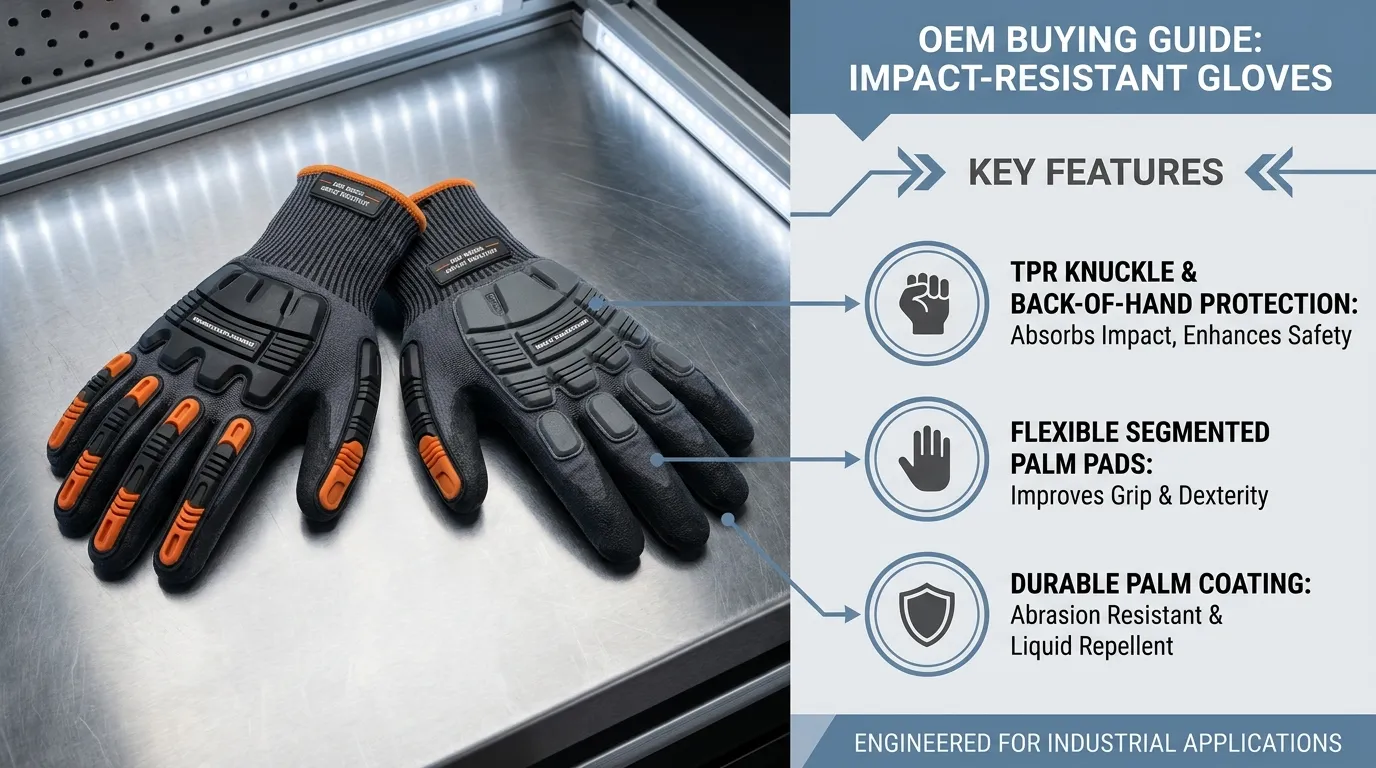
The most important impact zones are the knuckles, fingers, thumb saddle, and back-of-hand metacarpal area. Strong designs protect these zones without blocking flex grooves, grip control, or natural hand movement.
TPR, or thermoplastic rubber, is the raised impact material often placed on the back of the glove. For OEM buyers, the question is not “Does the glove have TPR?” The better question is “Which zones does the TPR protect, and does the layout match the worker’s real risk?”
A glove with oversized pads can feel safe in a product photo, but it may reduce movement. The glove with the biggest TPR pads is not always the best choice. It works for heavy strike risks, but a segmented TPR layout is safer when workers need repeated gripping and finger movement.
TPR coverage zone
Risk it helps protect
Buyer should ask for
Overbuild warning
Best-fit buyer segment
Knuckles
Direct blows from tools, parts, or materials
Raised segmented knuckle pads
One stiff block can restrict bending
Construction, mining, oil and gas
Fingers
Pinch, crush, and side impacts
Finger guards with flex breaks
Thick finger pads can reduce dexterity
Manufacturing, rigging, assembly
Thumb saddle
Tool rubbing, pipe handling, and pinch points
Reinforced thumb saddle area
Too much bulk can hurt grip control
Oil and gas, construction, utilities
Back-of-hand metacarpal
Blunt force across the hand
Wider back-of-hand coverage
Poor spacing can trap heat and stiffness
Heavy handling, mining, metalwork
Cuff edge
Light wrist contact and product finish
Cuff style matched to use case
Extra protection may raise cost without value
Custom programs, branded lines
For impact ratings, send the reader to the deeper impact rating guide rather than trying to explain every test detail here. This article should help buyers build the glove spec first, then confirm the rating target.
How do ANSI/ISEA 138 and EN 388 affect the buying decision?
ANSI/ISEA 138 is better for comparing impact glove performance because it uses Levels 1-3 and includes finger and thumb protection. EN 388 impact marking is useful, but it mainly confirms a pass result for claimed impact protection.
ANSI/ISEA 138 was created for back-of-hand impact protection in gloves. ISEA describes it as a standard for testing, classification, and labeling of impact performance. For a distributor, this makes it useful when comparing suppliers because the rating gives a clearer performance level. ISEA
The ANSI blog explains that ANSI/ISEA 138 uses Levels 1, 2, and 3, with lower transmitted force meaning stronger impact protection. EN 388 can also include impact protection, but Centexbel notes that the glove receives a “P” marking when the impact test is passed. ANSI BlogCentexbel
Standard
What it tells the buyer
Best use in OEM buying
ANSI/ISEA 138 Level 1
Entry-level impact reduction
Light handling or lower-risk lines
ANSI/ISEA 138 Level 2
Balanced impact protection
Commercial distributor line with broad use
ANSI/ISEA 138 Level 3
Higher impact protection
Heavy industry, mining, oil and gas
EN 388 impact “P”
Pass result for claimed impact protection
Useful for markets asking for EN 388 marking
What level should a distributor ask for?
ANSI/ISEA 138 Level 3 is not automatically the right private-label target. Level 2 can be a better commercial line when the buyer needs balanced protection, dexterity, and acceptable price. Ask for the test report, sample markings, and packaging claims before approving bulk artwork.
HexArmor notes that ISEA 138 tests knuckles and fingers or thumb areas, which helps buyers compare more than one visible pad area. Use this detail when asking suppliers whether the claimed rating applies across the glove design or only to a limited test zone. HexArmor
Molded TPR vs EVA foam: which option fits your product line?
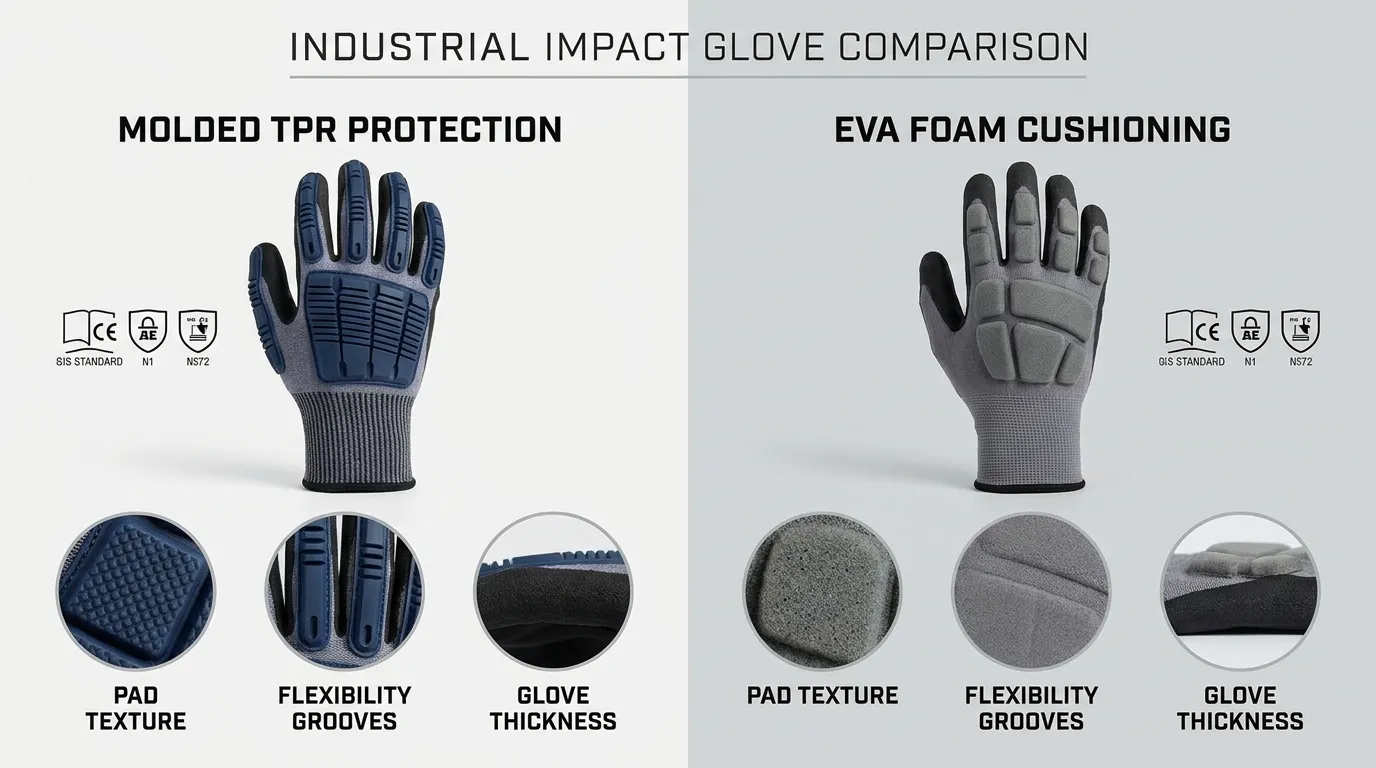
Molded TPR is usually the safer OEM choice for visible back-of-hand impact protection, while EVA foam is better as a lighter cushioning layer. Choose by risk level, flexibility target, and certified external impact zones.
Molded TPR gives the glove a clear protective structure on the outside. It is common on gloves for construction, oil and gas, mining, heavy material handling, and industrial work. It also gives private-label buyers a more visible product story because customers can see the protection zones at a glance.
EVA foam is lighter and softer. It can add cushioning without the same raised external look. That can help when the buyer wants comfort, lower bulk, or a lighter-duty glove. It may not create the same buyer confidence as external molded TPR when the market expects visible impact protection.
Choice
Best fit
Buyer advantage
Watch-out
Molded TPR
Heavy-duty back-of-hand impact gloves
Strong visual protection and clearer zone layout
Poor pad spacing can reduce flex
Segmented molded TPR
Commercial impact glove lines
Better movement across knuckles and fingers
Needs careful mold design
EVA foam
Lighter cushioning or internal padding
Softer feel and lower bulk
May look less protective to buyers
TPR plus cushioning layer
Premium or heavy-use gloves
Comfort plus visible protection
Higher cost and longer sampling
The difference between anti-vibration and impact gloves also matters. Anti-vibration gloves focus on vibration exposure from tools. Impact gloves focus on blunt-force contact to the hand. Some designs may address both, but buyers should not treat those terms as the same spec.
How should buyers balance impact protection with cut resistance, grip, and dexterity?
Impact protection should not be selected alone. A private-label impact glove also needs the right cut level, liner, palm coating, and dexterity for the job. If workers cannot grip, bend, or handle parts properly, they may avoid wearing the glove.
For cut protection, link the impact spec back to the broader cut-resistant glove buying guide. This child article should not repeat full cut-level selection. It should help the buyer combine cut protection with impact zones in one workable OEM spec.
Reinforced thumb saddle, flexible knuckles, grip coating
Protects common contact zones without blocking control
Liner choice also matters. HPPE and aramid fibers can both support cut-resistant designs, but they feel and perform differently. Buyers comparing liner options can review HPPE vs Kevlar before locking the glove build.
What should your RFQ include before asking for price?
A useful RFQ should include the use case, target impact level, TPR coverage map, liner, coating, size range, logo method, packaging, MOQ, sample needs, and required test documents. Without these, price comparisons are weak.
A low MOQ quote is not always the cheapest option. If logo, packaging, test reports, or sample revisions are unclear, the buyer may pay more later through delays and rejected samples. A good RFQ gives the supplier enough detail to quote the same glove you plan to sell.
For OEM or private-label impact gloves, price should come after the spec. If Supplier A quotes a simple TPR glove and Supplier B quotes ANSI/ISEA 138 documentation, custom packaging, and a revised sample plan, the unit prices are not directly comparable.
Quote cheat sheet for MOQ, lead time, and customization
RFQ item
What to send
Why it affects the quote
Target market
Construction, oil and gas, warehouse, manufacturing, food plant
Guides risk level and glove build
Impact standard
ANSI/ISEA 138 level target or EN 388 requirement
Affects testing and documentation
TPR layout
Knuckle, finger, thumb saddle, metacarpal zones
Changes mold design and material use
Liner
HPPE, aramid, blended yarn, or other choice
Affects cut level, comfort, and cost
Palm coating
Nitrile, sandy nitrile, PU, latex, or other finish
Affects grip and application fit
Size range
Common range such as S to XXL
Affects inventory and production planning
Logo method
Back-of-hand logo, cuff label, hangtag, carton mark
Changes artwork and approval steps
Packaging
Polybag, header card, retail pack, master carton
Affects lead time and landed cost
MOQ
Required order quantity by size or total order
Shapes price tier and production setup
Sample needs
Fit sample, logo sample, pre-production sample
Prevents bulk errors
Lead time window
Sample time and bulk production target
Helps plan launch dates
Documents
Test report, material details, marking artwork
Supports buyer and compliance review
A clear RFQ also helps the supplier answer faster. It reduces back-and-forth, avoids wrong samples, and helps the distributor compare offers on real value instead of the lowest first number.
How can buyers reduce sampling, compliance, and customs delays?
Buyers reduce delays by confirming the product spec, documents, labeling, packaging, and import description before bulk shipment. This is a process-control step, not a customs guide. If your import team or broker needs a specific classification review, involve them before production starts.
The safest approach is to keep every document aligned. The glove sample, product description, carton label, material information, test report, and packaging artwork should all describe the same product. Mixed wording can slow internal review and create questions during shipping.
Confirm the final glove material composition.
Match the product name to the actual glove build.
Request test reports before final artwork approval.
Check logo, label, hangtag, and carton marks.
Confirm size breakdown and packing method.
Ask the broker or import team to review the shipment description early.
Keep the approved sample as the reference for bulk inspection.
This step matters most when the buyer is launching a new private-label line. Sampling delays are easier to fix than bulk shipment delays.
What quality checks should happen before bulk approval?
Bulk approval should happen only after the buyer checks fit, flex, TPR bonding, markings, packaging, and documents. Impact gloves have more visible components than basic coated gloves, so small alignment issues can damage the buyer’s product image.
Do not approve only from photos. Ask for a physical sample that matches the chosen liner, coating, TPR layout, color, logo, and packaging. If the buyer plans to market washability or long wear life, review glove washing rules before making care claims.
Fit check: Test each key size for finger length, palm width, cuff feel, and grip comfort.
Flex check: Bend fingers and knuckles to see if TPR blocks movement.
TPR bonding check: Pull and flex raised pads to check edge lift or weak bonding.
Pad alignment check: Compare left and right gloves for symmetry and coverage.
Grip check: Test palm coating under the buyer’s main use condition.
Branding check: Confirm logo position, color, cuff label, hangtag, and carton marks.
Document check: Match test reports, artwork, and packaging claims.
For a distributor, quality control is also brand control. A private-label buyer owns the customer complaint, even when the factory made the glove.
Which impact glove spec should you quote for each buyer segment?
Start with a segment-based spec, then adjust after sample feedback. This keeps the buyer from overbuilding every glove or choosing a low-cost design that misses the real hazard.
Buyer segment
Starting spec to quote
Clear decision point
Construction distributor
Cut-resistant liner, sandy nitrile palm, segmented TPR, reinforced thumb saddle
Choose Level 2 or Level 3 based on strike risk
Oil and gas buyer
Full back-of-hand TPR, oil-grip nitrile, high-visibility color, stronger documentation
Confirm oil grip and impact rating before logo approval
A food-processing buyer may need cut protection and washability more than aggressive external TPR. A warehouse line may need lighter protection because workers handle cartons for hours. An oil and gas line needs stronger back-of-hand coverage and documentation because the end user expects a more serious safety glove.
What to Do Next
Use this impact resistant gloves buying guide as a spec worksheet before you request samples. Start with the buyer segment, then define the TPR zones, rating target, liner, coating, logo, packaging, MOQ, and lead time window. Ask for one quote-ready spec, one sample plan, and one document list from each supplier. That makes supplier comparison cleaner and reduces the chance of approving a glove that looks right but fails the buyer’s real use case.
Frequently Asked Questions
What are impact-resistant gloves made of?
Impact-resistant gloves often combine a liner, grip coating, and back-of-hand protection such as molded TPR or cushioning materials. The exact build depends on cut risk, grip needs, oil exposure, and required impact rating.
How do I know if a glove is truly impact-resistant?
Ask for the impact standard, test report, and marking details. Visual TPR pads are not enough because a glove can look protective without proving its impact performance.
Can impact-resistant gloves protect against cuts and punctures?
Some impact gloves also include cut or puncture protection, but not every impact glove does. Buyers should specify cut level, liner material, coating, and impact rating in the same RFQ.
Do impact-resistant gloves affect dexterity?
They can affect dexterity if the pads are too thick, stiff, or poorly placed. A good OEM design leaves flex grooves around fingers and knuckles while protecting the main strike zones.
What should be considered when buying impact gloves in bulk?
Bulk buyers should check protection zones, impact level, liner, coating, sizing, logo method, packaging, MOQ, lead time, samples, and test reports. A cheap quote is risky if these details are unclear.
Are all impact gloves compliant with safety standards?
No, not all impact gloves are tested or marked to the same standard. Buyers should request ANSI/ISEA 138 or EN 388 documentation when compliance matters for their market.