Heat resistant welding gloves should be chosen by welding process first: TIG needs dexterity, MIG needs balanced protection, and stick needs heavier leather, lining, and longer cuff coverage. For standards, use EN 12477 Type B when control matters most and Type A when heat, sparks, and spatter protection matter more.
A welding shop can’t treat every leather glove as the same glove. A TIG bench, a MIG fabrication bay, and a stick repair station put different stress on the hand. The right glove protects the welder without slowing the job. This guide helps a foreman set practical glove rules for leather type, lining, cuff length, markings, and common buying mistakes.
Which heat-resistant welding glove should a shop buy first?
For most shops, stock separate gloves for TIG, MIG, and stick. TIG needs dexterity first, MIG needs balanced heat and control, and stick needs heavier leather, lining, and longer cuff coverage.
Start with the process, not the product name. A glove that feels perfect for TIG may be too thin for stick welding. A heavy stick glove may protect well, but it can make TIG filler control clumsy and slow.
A good shop setup usually needs three glove bins:
TIG: soft, thinner leather with high finger control
MIG: medium-duty leather with lining and good movement
The OSHA hand protection standard supports this task-based approach. Gloves should be selected for the work being done, the hazards present, and the glove’s performance. For broader glove selection beyond welding heat, use a hand protection buying guide instead of turning this welding guide into a full PPE manual.
What hazards do heat-resistant welding gloves actually solve?
Heat-resistant welding gloves protect against thermal burns, sparks, slag, spatter, sharp metal edges, and short contact with hot materials. The right glove depends on the task, exposure time, and dexterity required.
Welding gloves are not just for comfort. They reduce exposure to hot parts, short contact heat, molten spatter, flying sparks, slag, sharp edges, and rough metal. In hot work guidance, OSHA points to leather gloves or equivalent protection for welding, cutting, and burning tasks through its hot work PPE guidance.
The exact hazard changes by station. A TIG stainless bench may need touch and control. A stick repair job may need more heat delay and spatter coverage. CCOHS explains welding as a process that joins materials by heating them, often with an electric arc, so hand protection must match real exposure.
Use this quick hazard check before buying:
Is the welder handling hot parts after the weld?
Is there heavy spatter or slag?
Is the weld overhead or close to the body?
Does the job need fine finger movement?
Is the glove also facing abrasion from rough steel?
Which gloves fit MIG, TIG, and stick welding?
TIG gloves should prioritize finger control, MIG gloves should balance heat protection and movement, and stick gloves should prioritize heavier leather, insulation, and spatter coverage. A single glove rarely performs best across all three.
This is the main decision. If the shop buys one “welding glove” for every process, someone usually loses. TIG welders lose control, or stick welders lose protection.
Welding process
Heat and spatter level
Dexterity need
Better glove build
Shop note
TIG welding
Low to medium
Very high
Soft goatskin, deerskin, or thin grain leather
Use when finger control matters most
MIG welding
Medium
Medium
Cowhide or similar leather with light to medium lining
Good balance for fabrication bays
Stick welding
High
Lower
Heavy split leather with stronger lining
Choose protection over feel
MIG/stick crossover
Medium to high
Medium
Durable cowhide or split leather gauntlet
Useful only when exposure is similar
Overhead welding
High falling spark risk
Medium to low
Long cuff, heavy leather, reinforced seams
Wrist and forearm coverage matter more
A TIG stainless bench needs the welder to feed filler rod smoothly. A bulky glove can make that job harder. A stick repair station has more sparks, slag, and heat, so a thin glove is the wrong tool even if it feels comfortable.
Which leather works best for welding gloves?
Cowhide or other heavier leather is usually safer for MIG and stick, while goatskin or deerskin is better for TIG control. Choose leather by heat, spatter, and dexterity, not by comfort alone.
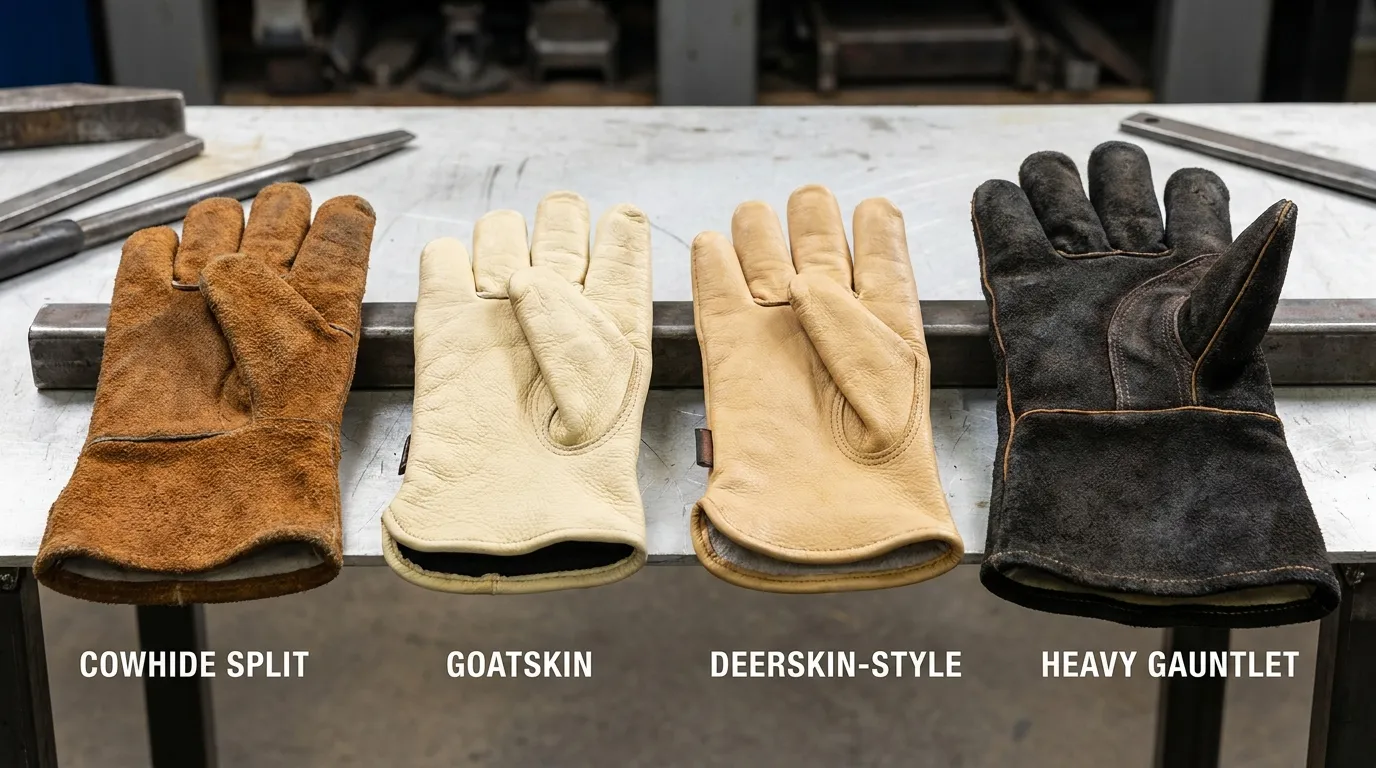
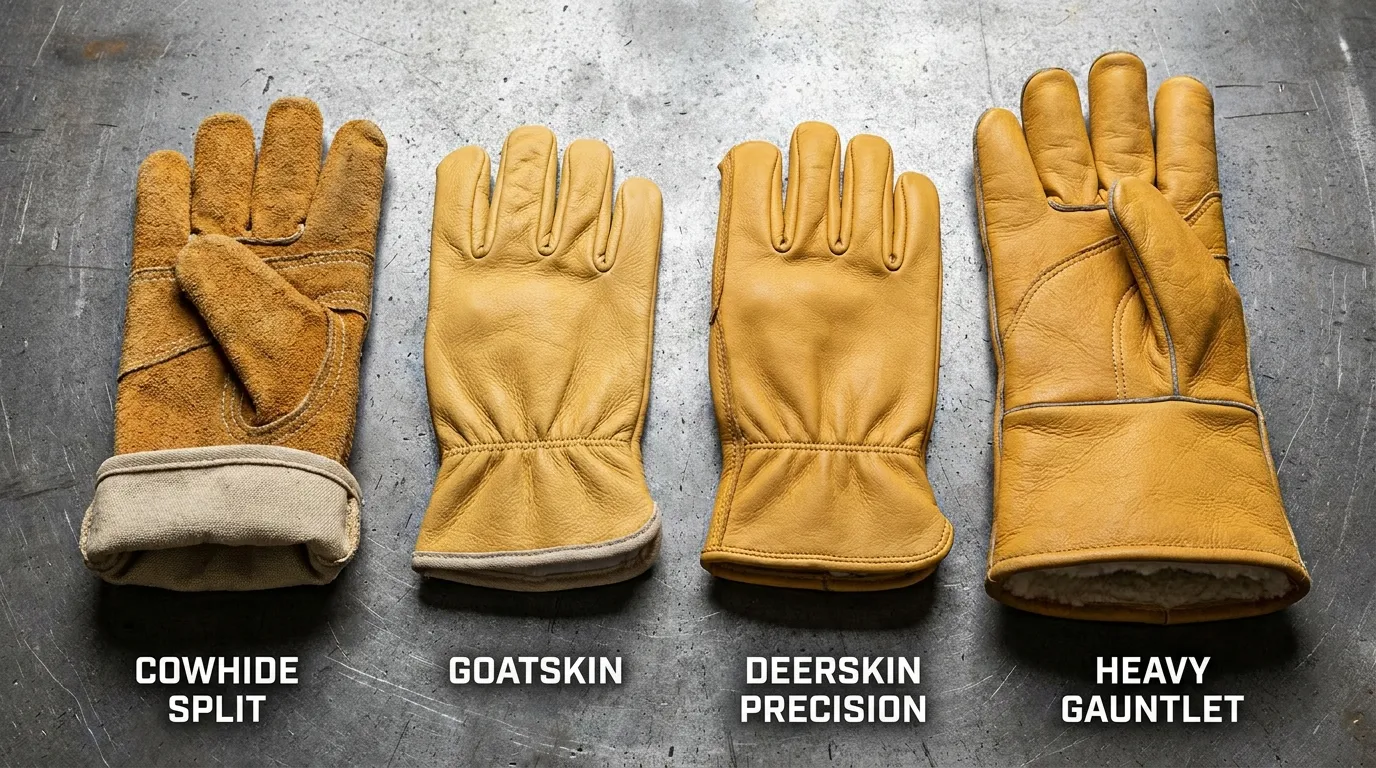
Leather type changes how the glove feels and how it handles heat, abrasion, and movement. Cowhide is a common choice for MIG and stick because it gives solid durability. Goatskin and deerskin are often used where hand feel matters more.
Leather type
Best fit
Strength
Watchout
Cowhide
MIG, stick, general welding
Durable, common, good heat protection
Can feel stiff if too thick
Goatskin
TIG, light MIG
Good touch and flexibility
Not ideal for heavy spatter alone
Deerskin
TIG and precision work
Soft feel, good movement
Can wear faster in rough work
Split leather
Stick, heavy MIG
Better for heat and spatter
Less fine control
Grain leather
TIG and lighter work
Smooth feel and dexterity
Needs correct thickness and build
The safest glove is not always the thickest glove. Thick gloves work when heat and spatter dominate, but they can create poor control when TIG precision is the real hazard. If leather choice is the main buying question, compare cowhide vs goatskin before approving a bulk order.
How much lining and cuff length does a welding shop need?
Lining and cuff length should increase as heat, spatter, and forearm exposure increase. A TIG glove may stay thinner for control, but heavy MIG, stick, and overhead work need more insulation and coverage.
Lining slows heat transfer, but it also reduces feel. That tradeoff matters. A TIG welder may reject an over-lined glove because it makes filler control harder. A stick welder may need that same bulk because sparks, slag, and hot parts are a bigger risk.
Work condition
Lining choice
Cuff choice
Buying note
TIG bench work
Unlined or light lining
Shorter cuff or light gauntlet
Keep finger movement high
General MIG
Light to medium lining
Gauntlet cuff
Balance heat and handling
Heavy MIG
Medium lining
Longer gauntlet
Add spatter coverage
Stick welding
Heavier lining
Long gauntlet
Protect wrist and lower forearm
Overhead work
Heavier lining
Long cuff with secure fit
Reduce falling spark exposure
Do not make cuff length a style choice. A long gauntlet helps protect the wrist and lower forearm when sparks fall or the welder works close to the arc. For tight bench TIG work, too much cuff and bulk can slow the job.
What does EN 12477 Type A vs Type B mean for buyers?
EN 12477 Type A means higher protection with less dexterity, while Type B means better dexterity with lower protection. Use Type B for TIG-style precision and Type A for heavier welding where heat and spatter matter more.
EN 12477 is a welding glove standard used to classify gloves for welding tasks. SATRA explains EN 12477 as a standard with Type A and Type B categories. Type A gives higher protection. Type B gives better dexterity.
EN 12477 type
Main benefit
Tradeoff
Best shop use
Type A
Higher protection
Lower dexterity
Stick, heavy MIG, cutting, higher spatter
Type B
Better dexterity
Lower protection
TIG, precision welding, filler control
Wenaas describes EN 12477 as connected to EN 388 and EN 407, which cover mechanical and thermal performance. A foreman does not need to turn every purchase into a standards lecture. The practical rule is simple: Type B for control, Type A for heavier protection.
Check markings before ordering. A catalog photo is not enough. Ask the supplier for the glove standard, type, size range, lining, cuff style, leather type, and intended welding process.
Heat-class chart: how should a foreman match glove build to exposure?
Use a heat-class chart to turn vague “heat resistant” claims into shop buying rules. The chart should match exposure pattern to glove build, not just a temperature number on a product page.
Shop heat class
Example station
Exposure pattern
Recommended glove build
Avoid
Class 1: precision heat
TIG stainless bench
Lower heat, high hand control
Soft grain goatskin or deerskin, light lining
Bulky stick gloves
Class 2: general welding heat
MIG fabrication bay
Moderate spatter, repeated handling
Cowhide, light or medium lining, gauntlet cuff
Thin unlined TIG gloves
Class 3: heavy welding heat
Stick repair station
High sparks, slag, and hot parts
Heavy split leather, stronger lining, long cuff
Short cuffs and soft TIG gloves
Class 4: overhead exposure
Overhead weld repair
Falling sparks and slag
Heavy leather, long secure cuff, reinforced seams
Loose cuffs
Class 5: radiant heat nearby
Foundry-adjacent or high-heat area
Radiant heat plus hot surfaces
Specialized high-heat glove with clear thermal marking
General welding gloves without review
This chart helps purchasing avoid one-glove orders. For example, a MIG fabrication bay can usually run a balanced cowhide gauntlet, but a stick repair station should step up protection. That keeps glove choice tied to the real heat class.
What glove mistakes cause burns, fatigue, and early failure?
The biggest mistake is using a thin TIG glove for a stick weld. TIG gloves improve control, but stick welding needs heavier leather, lining, spatter resistance, and longer wrist or forearm protection.
A TIG glove on a stick weld is a bad shop habit. It may feel comfortable, but it gives up the heavier build that stick welding usually needs. The result can be faster burn-through, poor wrist coverage, and more heat reaching the hand.
Watch for these common mistakes:
Buying one glove for every welding station
Choosing only by a heat claim
Ignoring cuff length for overhead work
Ignoring seam thread and reinforcement
Keeping gloves after holes, thinning, stiffness, or cracked leather appear
A welding glove purchase spec should name the process, leather, lining, cuff, stitching, sizing, and standard marking. That keeps purchasing from ordering a cheaper glove that looks similar but performs differently.
Use this checklist before approving a supplier quote:
Welding process: TIG, MIG, stick, or mixed use
Leather type: cowhide, goatskin, deerskin, split, or grain
Lining level: unlined, light, medium, or heavy
Cuff style: short cuff, gauntlet, or long gauntlet
Seam build: reinforced areas and heat-resistant thread
Standard marking: EN 12477 Type A or Type B where needed
Thermal and mechanical markings: EN 407 or EN 388 where listed
Do not buy only from a temperature claim. A foreman should check process fit, cuff coverage, seam thread, lining, and EN 12477 marking before approving bulk orders. If the job is not welding, compare other glove families instead of forcing welding gloves into every task.
What to Do Next
Build the glove list around real welding stations. Put TIG, MIG, and stick in separate buying rows, then assign leather, lining, cuff, and EN 12477 preference to each row. That gives purchasing a clean spec and gives welders gloves that match the job.
For heat resistant welding gloves, the next step is simple: review the highest-risk station first. If stick welding or overhead work is happening, fix that glove choice before fine-tuning TIG comfort.
Frequently Asked Questions
What are the best welding gloves for extreme heat?
The best gloves for extreme heat are heavy leather welding gloves with insulation, heat-resistant stitching, and long cuff coverage. For stick or heavy MIG work, choose protection over touch sensitivity.
Why do welders need heat-resistant gloves?
Welders need heat-resistant gloves to reduce burns from hot metal, sparks, spatter, slag, and short contact with heated tools or parts. The glove also helps maintain grip during hot work.
How long do heat-resistant welding gloves last?
Welding glove life depends on heat exposure, spatter, abrasion, leather quality, seams, and shift length. Replace gloves when leather thins, stiffens, cracks, burns through, or loses safe grip.
Are leather welding gloves better for high heat?
Leather is usually preferred for welding because it handles heat, sparks, abrasion, and spatter better than many general-purpose glove materials. The right leather still depends on process and dexterity needs.
What features should I look for in welding gloves?
Look for leather type, lining, cuff length, seam thread, grip, sizing, and relevant markings such as EN 12477 Type A or Type B. Match the final choice to TIG, MIG, or stick work.
How do heat resistant welding gloves protect your hands?
Heat-resistant welding gloves slow heat transfer, block sparks and spatter, and protect the wrist or lower forearm when the cuff is long enough. They also reduce cuts and abrasion from rough metal.
What are the most heat-resistant welding gloves available?
The most heat-resistant options are usually heavier insulated gloves built for high-heat welding, radiant heat, or molten splash exposure. For normal welding shops, do not buy maximum heat protection if dexterity is the main need.