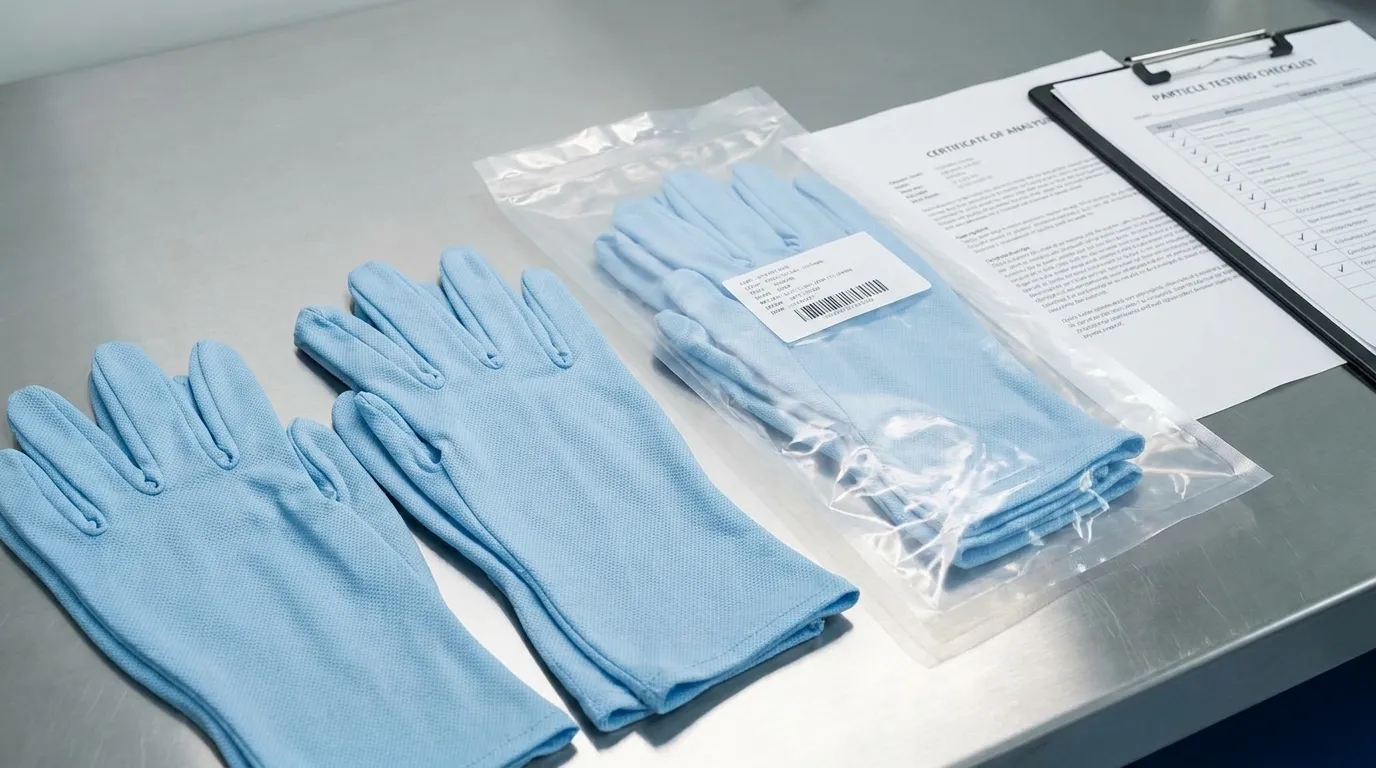
Home > Uncategorized > Cleanroom ESD Gloves: Lint-Free, ISO-Class Picks
Cleanroom ESD Gloves: Lint-Free, ISO-Class Picks
16 May, 2026
By arafatshuvo509
Cleanroom ESD gloves should be chosen by cleanroom class, not by “anti-static” claims alone. For ISO Class 5, require lint-free, low-particle gloves with lot-level particle data, cleanroom packaging, and verified ESD performance. For ISO Class 7, washable ESD gloves may work if laundry, particle release, and resistance checks are controlled. Always approve by COA, packaging, donning practice, and pilot-line results.
A glove can protect electronics from static and still fail cleanroom approval. That is the problem many protocol managers face when a supplier lists a glove as “ESD,” “dust-free,” or “lint-free” without enough test data. The right choice depends on the cleanroom class, contact risk, packaging, and how the glove performs after real use.
ESD approval does not automatically make a glove cleanroom suitable. A cleanroom ESD glove must control static while also showing low particle shedding, low residue risk, clean packaging, and lot traceability.
ESD control protects sensitive electronics from electrostatic discharge. Cleanroom control protects the process from particles, lint, residues, and handling contamination. A glove used in a controlled area needs both types of evidence, especially when workers handle wafers, sensors, boards, optics, or clean tools.
This is where many supplier claims become weak. “Anti-static” tells you the glove is meant to reduce static risk. It does not prove the glove has low particle release or suitable packaging for cleanroom entry. If your team needs a basic refresher, link the buyer to what ESD gloves do instead of turning this approval guide into a full ESD lesson.
For cleanroom glove approval, use recognized cleanroom and ESD references. ISO 14644-1 classifies cleanrooms by airborne particle concentration, while ISO 23464 covers nitrile cleanroom glove requirements for ISO Class 4, 5, and 6 use. For ESD programs, ANSI/ESD S20.20 gives a useful control-program framework.
Which cleanroom ESD glove fits ISO Class 5 vs Class 7?
For ISO Class 5, start with lint-free cleanroom nitrile or equivalent low-particle gloves with verified COA data. For ISO Class 7, washable ESD fabric or PU-coated options may work if laundering, particle release, and ESD performance stay validated.
ISO Class 5 is usually the stricter decision. Choose gloves by direct contact risk first, then by material. A Class 5 wafer inspection line should not approve a washable ESD fabric glove unless the supplier can prove cleanliness after laundering, particle release, and ESD performance for the actual use case.
Class 7 areas often allow more flexibility, especially for indirect handling, electronics assembly, or packing. A washable ESD glove can make sense there if the facility controls laundry cycles, recheck intervals, and visible wear. For semiconductor tasks, the reader may need a more focused page on wafer handling gloves.
Use area
Better starting choice
Particle data needed
ESD data needed
Washable option?
Approval caution
ISO Class 5 critical contact
Lint-free cleanroom nitrile
Lot result, unit, method, threshold
Surface resistance or facility-approved ESD test
Usually no
Do not approve from product title alone
ISO Class 5 indirect handling
Low-particle cleanroom glove
Lot COA and packaging status
Same test method across lots
Only after validation
Check contact surface and change-out rules
ISO Class 7 electronics assembly
Washable ESD or cleanroom nitrile
Baseline and after-use checks
Initial and scheduled checks
Often possible
Track wash cycles and wear
ISO Class 7 packing or inspection
ESD fabric or coated glove
Facility acceptance limit
Resistance range and retest plan
Often possible
Keep clean storage rules clear
If the glove uses nitrile or another coating for grip, hand off broader material selection to nitrile coating choices. Keep this article focused on cleanroom approval.
What particle-count data should be shown per glove pair?
Do not accept a universal particle count per pair without context. Require the supplier’s lot-specific result, particle size threshold, test method, sampling basis, packaging status, and the acceptance limit used by your facility.
“Lint-free” is a buying claim. Particle data is a qualification field. The protocol manager should ask how the supplier measured particles, what size threshold was counted, and whether the result is reported per glove, per pair, per surface area, or another unit.
Use the same unit when comparing suppliers. Supplier A may provide a particle count per pair with a clear method, lot number, and packaging condition. Supplier B may only provide a product title and price. Supplier A should move to pilot testing first because the evidence is easier to audit.
Supplier particle-count review table
Review field
What to request
Accept only when
Lot number
COA lot matches carton lot
Label, COA, and PO match
Particle count
Count per glove pair or stated unit
Unit is clear and repeatable
Particle threshold
Size range or threshold used
Threshold matches facility protocol
Test method
Internal or recognized test reference
Method is documented
Sampling basis
Number of gloves or pairs tested
Sample size is stated
Packaging condition
Tested after final packaging or before
Condition matches incoming product
Acceptance limit
Facility limit or supplier spec
Limit is approved by protocol team
IEST-RP-CC005 is a useful reference because it covers testing and evaluation of gloves and finger cots used in cleanrooms and controlled environments. It includes cleanliness, particle release, extractables, static charge, and other glove evaluation factors.
What packaging spec keeps gloves clean before gowning?
Packaging should preserve the glove’s tested cleanliness until use. Require cleanroom-compatible inner bags, lot traceability, clear size labels, intact seals, and COA records that match the carton and purchase order.
A clean glove can become a dirty glove before it reaches the operator. Bulk packaging may work for a warehouse, but it can fail a cleanroom entry process. If the glove package must be opened outside the gowning area, the team should reject it or require clean inner packaging.
A practical packaging spec should cover the glove and the route into the cleanroom. This keeps purchasing, receiving, and gowning teams aligned.
Inner bag must be cleanroom-compatible.
Outer carton must show product name, size, quantity, and lot.
COA lot number must match carton and bag labels.
Seals must arrive intact.
Size labels must be easy to read in storage.
Double bagging should be required where the cleanroom process needs it.
Storage must prevent carton dust from reaching the gowning area.
A common failure is simple. The buyer receives gloves labeled “antistatic cleanroom gloves,” but the COA does not match the carton lot number. That lot should stay on hold until the supplier gives matching documentation.
How should operators don cleanroom ESD gloves?
Donning practice matters because a qualified glove can fail in use. Operators should handle gloves by clean surfaces only, avoid touching skin or non-cleanroom items, inspect before work, and change gloves after contamination events.
Glove choice is only half the control plan. The best glove can fail if an operator touches hair, exposed skin, a carton, a phone, or a non-clean bench after donning. The protocol should say where the glove is opened, how it is touched, and when it must be changed.
Use a simple training checklist at the gowning point. Keep it short enough for daily use.
Confirm the glove size, lot, and packaging status.
Open the inner bag at the approved gowning step.
Touch only approved glove surfaces during donning.
Pull the cuff into the required gown or sleeve position.
Inspect for tears, holes, sticky residue, or visible particles.
Change gloves after touching non-clean items.
Change gloves after damage, heavy handling, or a contamination event.
Follow double-don rules for critical contact areas.
A glove package failure can happen before the worker even starts. For example, gloves arrive in a single bulk bag that must be opened outside the clean area. The protocol manager should require cleanroom-compatible inner bags before approving that supplier for gowning use.
When are washable ESD gloves acceptable?
Washable ESD gloves are acceptable when the area is lower risk, the glove does not touch critical surfaces, and the facility controls laundry, wear, particle release, and ESD checks. They are not the safest first choice for critical ISO Class 5 contact.
This is a useful place for expert judgment. Washable ESD gloves are not always the cheaper choice. They work when laundry validation and recheck intervals are controlled, but disposable lint-free options are safer for critical Class 5 contact points.
A clear Class 7 example is a board assembly area where operators handle trays, fixtures, and non-critical parts. The team approves washable ESD fabric gloves after checking surface resistance, wash cycle limits, visual wear, and particle release during a pilot run.
How do you qualify a new cleanroom ESD glove supplier?
Qualify the supplier by evidence, not claims. Require product data, lot COA, particle and ESD test methods, packaging review, pilot-line feedback, and requalification rules before adding the glove to the approved materials list.
A supplier product title is not a qualification file. If the listing says “dust-free” or “lint-free” but cannot provide lot-specific test data, the protocol manager should treat it as unapproved. Claims are useful for screening, not final approval.
Use a controlled approval path. It should include document review, incoming inspection, small pilot use, operator feedback, and final sign-off. The ESDA facility certification framework also shows why documentation, training, purchasing, calibration, and non-conforming product control matter in an ESD program.
Supplier COA and packaging approval checklist
Approval item
Required?
Supplier provided
Accepted
Notes
Product datasheet
Yes
Material, coating, size range
Lot COA
Yes
Must match carton
Particle count per pair or stated unit
Yes
Unit and threshold required
Particle test method
Yes
Must be documented
ESD resistance data
Yes
Same method across lots
Ionic content or residue data
If required
Use for critical contact
Packaging format
Yes
Inner bag, seal, labels
Size and lot labeling
Yes
Must be readable
Pilot-line feedback
Yes
Fit, grip, defects, shedding
Requalification trigger
Yes
Supplier, material, or process change
One practical approval path is Supplier A versus Supplier B. Supplier A provides particle count per pair, ESD resistance, packaging format, and lot traceability. Supplier B gives only a title and price. Supplier A moves to pilot testing because the protocol manager can audit the evidence.
What should the purchasing spec sheet say?
The purchasing spec should state the cleanroom class, glove type, ESD requirement, particle-count field, packaging format, and lot documentation. It should be clear enough that purchasing cannot swap in a cheaper glove without protocol review.
Keep the spec practical. A long document is harder to follow, but a vague one creates supply risk. If operators also need device screens in controlled areas, note that separately and point them to touchscreen glove needs.
Spec field
Write this into the RFQ or supplier request
Target area
ISO Class 5 or ISO Class 7 cleanroom use
Contact type
Direct critical contact, indirect handling, packing, or inspection
Glove material
Nitrile, ESD fabric, carbon-fiber blend, PU-coated, or approved equivalent
ESD requirement
State required method or facility-approved range
Particle data
Particle count per pair or clearly stated unit
Test method
Supplier must state method and sampling basis
Packaging
Cleanroom-compatible inner bag, lot label, intact seal
COA
Required for each lot before release
Change control
Supplier must notify material, process, or packaging changes
Pilot approval
Required before approved supplier list entry
Use ISO 23464, IEST-RP-CC005, and your facility ESD control plan as the document backbone. Then add your own acceptance limits, since the final risk depends on product contact, cleanroom class, and process sensitivity.
Getting the Next Step Right
The right cleanroom ESD gloves are not chosen by the best product title. They are chosen by proof. Start with the ISO class and contact risk, then check particle data, ESD performance, packaging, lot traceability, and donning practice.
For a new supplier, ask for the COA before the pilot run. Match the lot number to the carton, review the package format, and test the glove in the real work area. If the glove passes both document review and operator use, it can move toward approval with less risk.
Frequently Asked Questions
What does static dissipative mean in glove standards?
Static dissipative means the glove material helps charge move away in a controlled way instead of allowing sudden discharge. For cleanroom use, that static-control claim still needs to be paired with particle, residue, and packaging evidence.
Can a glove be ESD approved but not suitable for a cleanroom?
Yes, an ESD-approved glove can still be unsuitable for a cleanroom if it sheds particles, carries residues, or arrives in non-clean packaging. Cleanroom approval requires contamination-control evidence as well as static-control evidence.
Do all ESD gloves follow EN 16350?
No, not every ESD glove is tested or certified to EN 16350. A cleanroom protocol manager should ask which ESD standard or test method was used, then confirm that the same glove also has cleanroom particle and residue data.
Why do cleanrooms care about glove residues?
Cleanrooms care about glove residues because residues can transfer to wafers, components, tools, or work surfaces during handling. A low-particle glove is not enough if ionic content, extractables, or surface contamination are not controlled.
How often should ESD gloves be checked in a facility?
ESD gloves should be checked on the schedule defined by the facility’s ESD and cleanroom control program. Common checkpoints include incoming inspection, supplier changes, laundry validation changes, and any defect or contamination event.
What Types of Materials are ESD gloves made of?
ESD gloves can be made from nitrile, latex, vinyl, polyester, nylon, carbon-fiber blends, or coated fabric. For cleanrooms, the better question is whether that material has verified low particle release, suitable ESD performance, and clean packaging for the target class.
Why is it important to use ESD gloves for safety?
ESD gloves reduce the risk of static discharge when operators handle sensitive electronics or cleanroom components. In a cleanroom, they also need to protect the process from particles and residues, not only protect electronics from static.