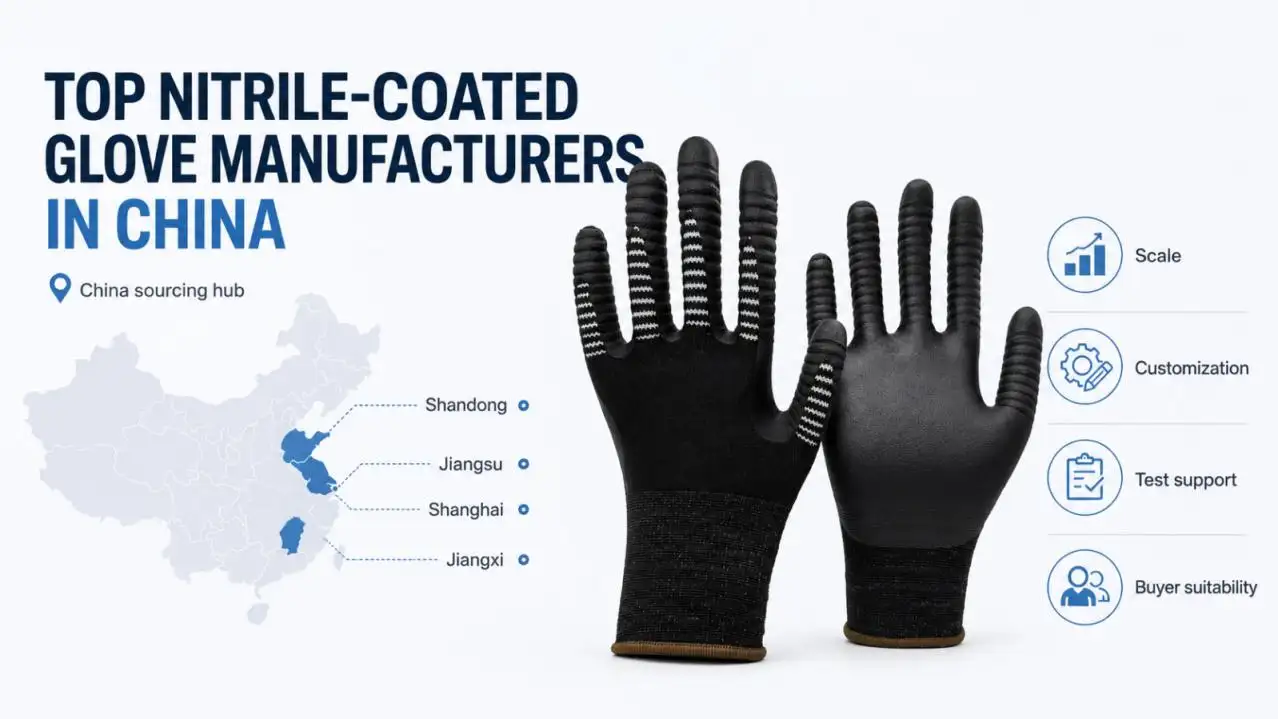
The manufacturers reviewed in this guide are concentrated mainly in Shandong, Jiangsu, Jiangxi, and Shanghai. Buyers can source economical, high-dexterity, cut-resistant, and oil-grip products from the same market. This guide to the top nitrile-coated glove manufacturers in China compares manufacturers by production structure, product coverage, customization, test support, and buyer suitability. It is not an audited quality ranking. Final selection should include factory verification, product-specific certificates, sample testing, and pre-shipment inspection.
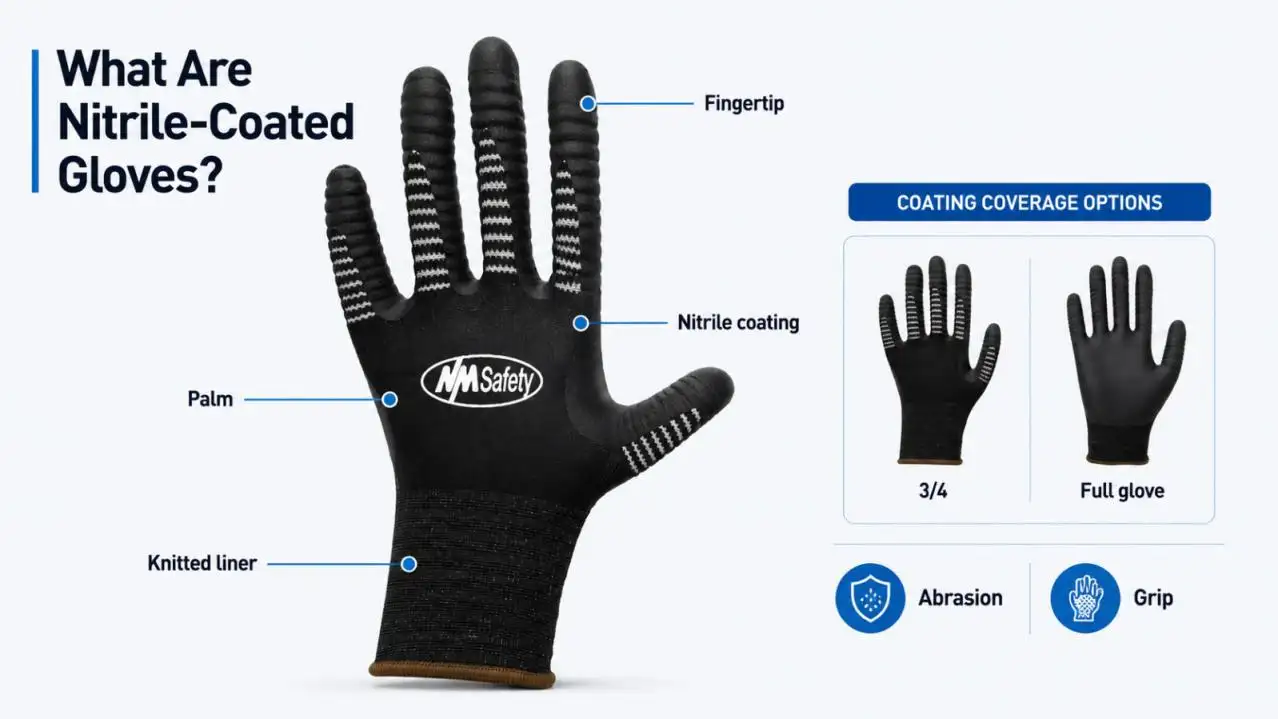
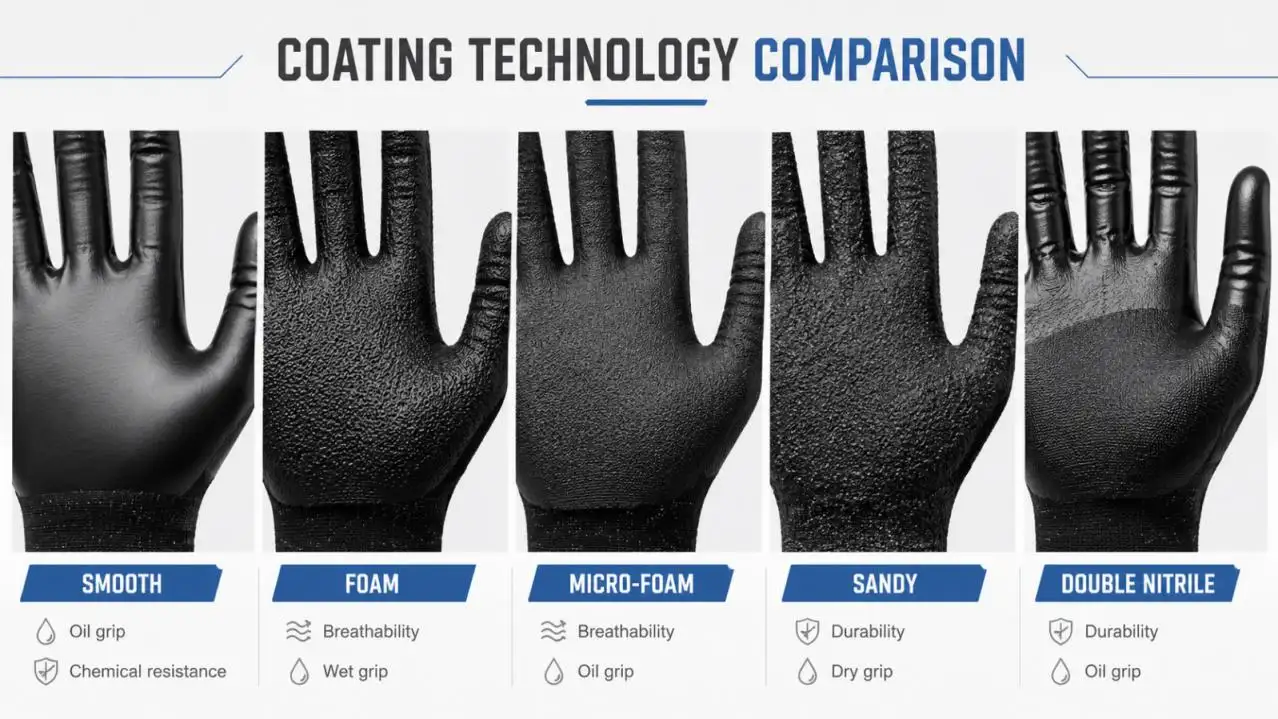
Nitrile-coated gloves combine a knitted liner with a nitrile rubber coating. Coverage may include the fingertips, palm, three-quarters of the hand, or the full glove. Smooth nitrile supports general abrasion resistance. Foam and micro-foam improve flexibility and breathability; sandy nitrile is selected for oily grip; double coating increases coverage and durability.
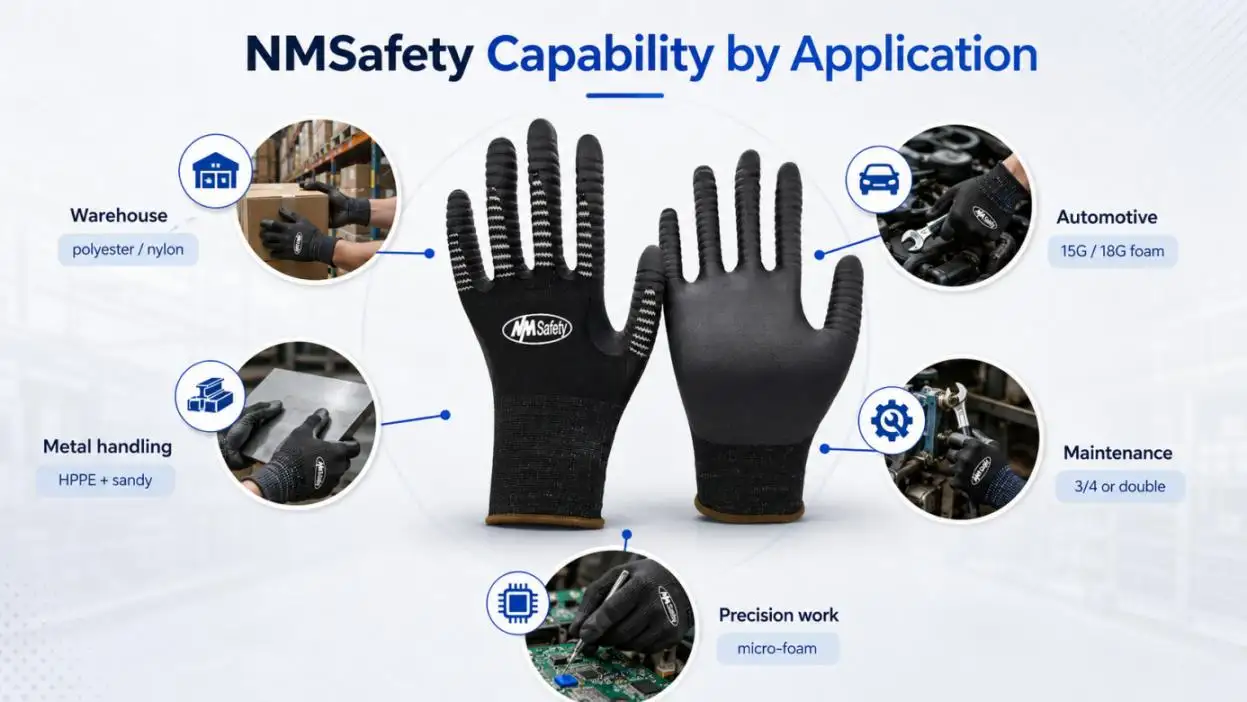
Applications include automotive assembly, metal handling, machinery maintenance, warehousing, construction and general industrial work. However, a lightweight nitrile-dipped glove is not automatically chemical resistant. Chemical exposure requires a glove tested for the specific hazard.
Lower gauges are thicker; higher gauges improve dexterity
Coating
Smooth, foam, micro-foam, sandy, double nitrile
Changes grip, ventilation and durability
Coverage
Fingertip, palm, 3/4, full, double-dipped
Balances breathability and protection
Standards
EN ISO 21420, EN 388, ANSI/ISEA 105, ISO 13997
Supports general, mechanical and cut claims
ISO 21420 covers general glove requirements; EN 388 addresses mechanical risks; ANSI/ISEA 105 classifies hand-protection performance; and ISO 13997 specifies a sharp-object cut test. Buyers should request reports matching the exact liner, coating and product code.
Top Nitrile-Coated Glove Manufacturers In China
1. NMSafety
Established in 1998, NMSafety has a Shanghai headquarters and factories in Jiangxi, Jiangsu and Shandong. Its profile lists 15 production lines, 1,500 knitting machines, 600 employees and monthly capacity above 600,000 dozen pairs. Its range includes general coated and cut-resistant gloves with multiple liner and coating combinations. It suits distributors and PPE brands needing medium-to-large orders and multi-category sourcing.
2. Shandong Xingyu Gloves
Xingyu is a Gaomi-based protective-glove manufacturer focused on R&D, production and sales. Its website reports more than 180 production lines and over 5,000 employees, making it relevant to high-volume industrial programs.
3. HANVO Safety
Based in Nantong, HANVO manufactures a range of gloves, including cut-resistant, oil-resistant, and nitrile gloves, and customizable options. In addition to these, HANVO also provides solutions for light to heavy duty micro-foam nitrile and sandy nitrile mechanical protection and a variety of sandy nitrile gloves.
4. HANDPROTECT
HANDPROTECT features sandy nitrile and micro-foam options as well as 15G, 18G, and 21G constructions and cut-resistant options. This is useful for buyers looking for fine-gauge options and specialty products.
5. EVERPRO Safety
EVERPRO provides rubber-coated work gloves and nitrile, latex, PU and PVC coatings and offers OEM and ODM sourcing. They position their nitrile products to appeal to the industrial market and smaller buyers in the wholesale market.
6. Goodal
Goodal states that its factory was established in 1998 and focuses on coated gloves, including nitrile products. It is suited to importers seeking conventional industrial and economic constructions.
7. UNEED Safety
UNEED supplies coated, leather, impact and disposable gloves, including smooth, micro-foam, 3/4-dipped, and full nitrile styles. It fits buyers building a mixed safety-glove portfolio.
8. Anbu Safety
Anbu supplies nitrile-coated gloves alongside leather, welding, cotton, PU and cut-resistant gloves. It may suit buyers seeking a broader PPE assortment, subject to product-specific test verification.
Manufacturer Comparison
Manufacturer
Main Strength
Suitable Buyer
NMSafety
Multi-factory production and broad combinations
PPE brands and distributors
Xingyu
Large-scale output
High-volume importers
HANVO
Application-focused technical range
Industrial specialists
HANDPROTECT
Fine-gauge and specialty nitrile
Precision and cut buyers
EVERPRO
OEM/ODM coated-glove sourcing
Small-to-medium wholesalers
Goodal
Conventional coated gloves
Price-focused importers
UNEED
Mixed safety-glove portfolio
General PPE distributors
Anbu
Broad industrial assortment
Multi-category buyers
Comparison of Nitrile Coated Glove Types
Level
Typical Construction
Advantage
Limitation
Basic
13G polyester + smooth nitrile
Economical and abrasion-oriented
Moderate oil grip
Standard
15G nylon + foam nitrile
Balanced comfort and flexibility
Limited for heavy oil
Precision
18G nylon + micro-foam
Strong fingertip control
Durability needs validation
Cut-resistant
HPPE blend + foam or sandy nitrile
Cut protection plus grip
Higher cost
Heavy-duty
Robust liner + double nitrile
Oil grip and coverage
Lower breathability
Coating Technology Comparison
Coating
Dry Grip
Oil Grip
Breathability
Typical Use
Smooth
Good
Medium
Medium
General handling
Foam
Good
Good
Good
Assembly
Micro-foam
Very good
Good
Very good
Precision work
Sandy
Very good
Very good
Medium
Oily parts
Double nitrile
Very good
Very good
Low
Heavy maintenance
Coating names alone do not determine performance; thickness, formulation, curing and liner design also matter.
Based on its published manufacturing footprint, NMSafety's practical advantage is the ability to combine multiple knitted liners and coating structures within one sourcing system rather than depending on one flagship glove.
Common Procurement Mistakes
1. Comparing Only Unit Price
A lower quotation may result from reduced liner weight, thinner coating, basic yarn, limited quality inspection or simpler packaging. Buyers should compare total specifications rather than price per pair alone.
2. Treating All Foam Nitrile as the Same
Foam nitrile performance depends on pore structure, coating formulation, thickness and curing quality. Gloves that are described similarly may demonstrate varying levels of oil grip, breathability, and abrasion resistance.
3. Using Gauge as the Sole Indicator of Quality
Gloves with a higher gauge will generally have a liner that is finer, lighter, and more dexterous. It does not automatically provide better cut resistance, abrasion performance or service life.
4. Ignoring Size Distribution
Order quantities are often divided by size. An unusual size ratio may affect the MOQ, unit price, production schedule and availability of packaging materials.
5. Accepting Generic Certificates
A supplier may provide a test report for a similar glove rather than the purchased product. Buyers should ensure that this report corresponds to the specific liner material, coating type and coverage, product code, and the production specification that is currently in effect.
Final Thoughts
The top nitrile-coated glove manufacturers in China differ mainly in scale, liner technology, dipping processes, quality control, customization, and order flexibility. Buyers should define the workplace hazard first, then compare gauge, yarn, coating finish, coverage, and verified standards.
NMSafety is particularly relevant to distributors and brands needing broad product combinations and recurring medium-to-large orders. Before approval, audit the supplier, test production-equivalent samples and agree on measurable inspection criteria. Contact NMSafety to discuss product structures, request production-equivalent samples and establish measurable quality inspection standards for your sourcing program.
FAQs
Q1. What are the nitrile coated gloves requirements?
The requirements often include general requirements EN ISO 21420, mechanical risk EN 388, the performance classification and testing for cut resistance as per ANSI/ISEA 105 and ISO 13997.
Q2. What are the advantages of Chinese nitrile coated gloves?
China has a complete developed supply chain for seamless knitting, nitrile dipping, curing, washing, testing, and packing for export. Manufacturers are more flexible to offer different gauges, liner materials, coating finishes, and OEM.
Q3. What are the main parameters to compare for gloves?
Parameters include ownership of factories, production capacity, coating, liner, testing, QC, and the customization offered as well the MOQ and lead time. Experience in your target market is significant.
Q4. How is foam nitrile different from sandy nitrile?
Generally speaking, foam nitrile is more flexible and breathable. Sandy nitrile, on the other hand, is more breathable, and has a better grip in oily and wet conditions, but can feel thicker.
Q5. What is a good glove gauge for a precision task?
Generally, precision handling and assembly tasks are performed with 15 or 18 gauge gloves. Higher gauge gloves are thinner and more dexterous but can compromise protection and durability.