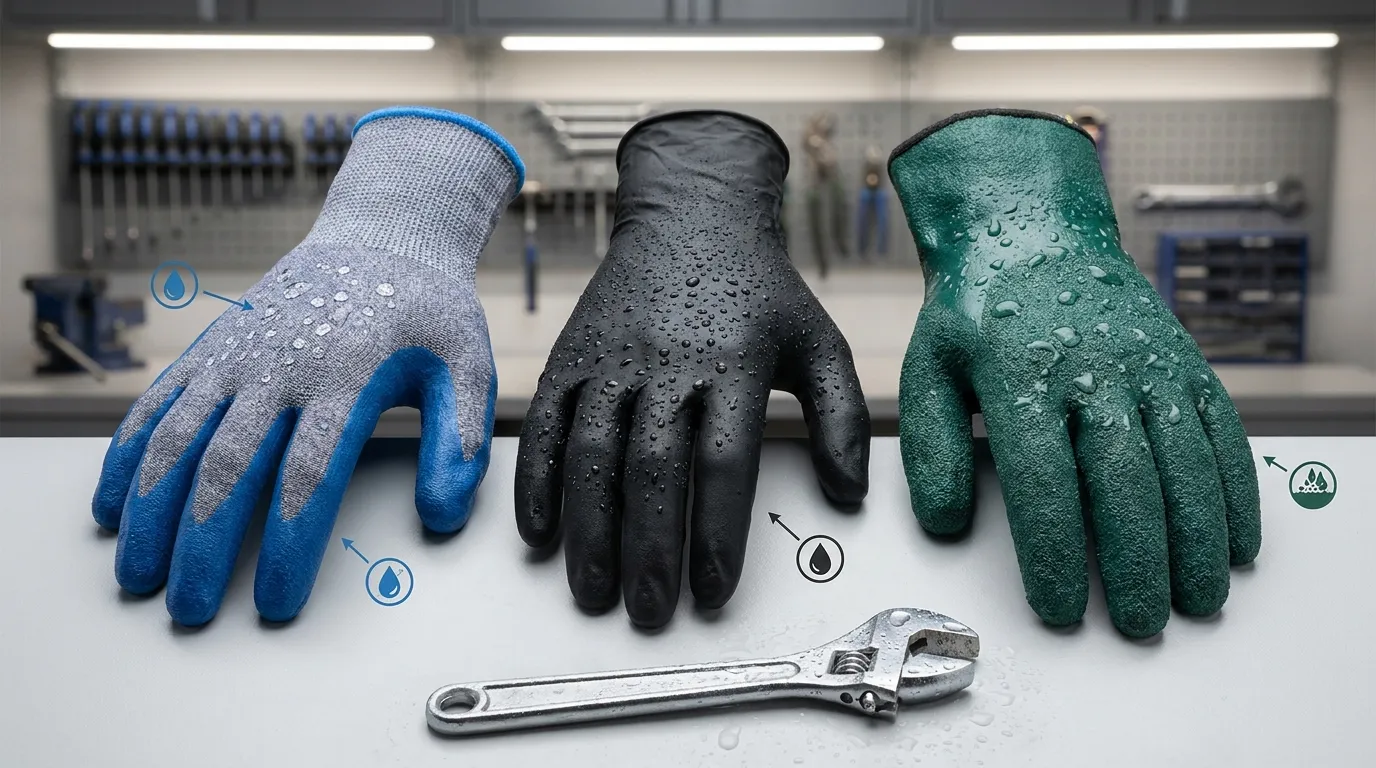
Waterproof nitrile coated gloves are only reliable when the coating or waterproof barrier covers the parts exposed to water. Palm-only nitrile can improve wet grip but still leak through the back, sides, or cuff. For wet and oily outdoor maintenance, choose fully dipped or double-dipped nitrile, then test a sample for leaks, sweat buildup, and cold-weather comfort before bulk buying.
If you’ve bought “waterproof” gloves before and still ended the shift with wet hands, the problem was probably not nitrile itself. It was the glove design. Outdoor maintenance work adds rain, oil, wet tools, cold metal, and wrist movement, so the coating pattern matters as much as the material. The goal is simple: know which claims to trust before you approve a full order.
Are waterproof nitrile coated gloves really waterproof?
Waterproof nitrile coated gloves are only truly waterproof when the coating or barrier covers the full exposure area. Palm-only nitrile improves wet grip, but water can still enter through the back, sides, cuff, or knit shell.
Nitrile is a useful coating for wet and oily work because it resists water, grease, and abrasion better than many light glove finishes. But a nitrile palm does not make the full glove waterproof. The glove stays dry only where the liquid barrier actually covers the hand.
That is why the construction matters. A fully dipped glove, double-dipped glove, or glove with a waterproof barrier is a better match for rain, splash, and wet outdoor tasks. A palm-coated glove can still be a good choice, but it should be treated as a wet-grip glove, not a full waterproof glove.
For broader glove selection beyond waterproofing, use a cut-resistant glove guide to compare cut risk, coating type, liner material, and job hazards. OSHA also says hand protection should match the task, work conditions, exposure time, and hazards, not just one product claim on a label. You can review that rule in OSHA 1910.138.
Where do misleading waterproof claims usually fail?
Most misleading waterproof glove claims fail at the coverage boundary. If nitrile only covers the palm and fingers, the glove may grip wet tools well, but rain, splash, or immersion can still enter through exposed knit zones.
The common mistake is testing only the palm. A glove can keep the palm dry under a faucet and still fail on a jobsite when water hits the back of the hand, runs down the wrist, or enters through the cuff. This is why buyers should inspect the full coating map before trusting the word “waterproof.”
Failure point
Why it leaks
What the buyer should check
Back of hand
Palm-only coatings leave knit exposed
Look for full back-of-hand coverage
Finger sides
Coating may not wrap fully around fingers
Bend fingers and inspect sidewalls
Thumb crotch
This area flexes and wears quickly
Check coating thickness and cracks
Knit cuff
Water can run down the wrist
Test wrist angle during sample review
Worn coating
Abrasion opens weak spots
Inspect after flexing and gripping
Breathable back
Airflow improves comfort but lowers water blocking
Decide if comfort or sealing matters more
Palm-only nitrile is not a bad glove. It works when the job needs wet grip and airflow. But it is the wrong choice when the buyer expects full waterproofing in rain, washdown, drainage, landscaping, or outdoor repair work.
If the main concern is coating texture and wet grip, compare nitrile grip finishes before finalizing the coating style. The finish can change how the glove handles oily tools even when the waterproof claim looks similar.
Which coating design should you trust for wet outdoor maintenance?
For outdoor maintenance, trust the coverage before the word “waterproof.” Fully dipped or double-dipped nitrile is safer for rain, splash, and wet tools, while palm-only nitrile is better treated as wet-grip protection.
The safest way to read a glove spec is to ask one question first: which parts of the hand are sealed? A coating that only covers the palm and fingers may be useful for wet handling, but it should not be treated like full water protection.
A fully coated nitrile glove gives better liquid coverage because the barrier wraps more of the hand. A double-dipped glove can add another layer for grip or durability. Some waterproof work gloves also use a membrane or liner, which can improve comfort if the job involves long wet exposure.
Glove design
Keeps palm dry
Keeps back of hand dry
Wet grip
Breathability
Best use
Buyer warning
Palm-coated nitrile
Yes
No
Good
High
Damp tools, short wet contact
Not full waterproofing
Half-coated nitrile
Often
Partial
Good
Medium
Splash-prone handling
Check where coating stops
Fully dipped nitrile
Yes
Yes
Medium to good
Lower
Rain, splash, wet handling
Can feel warmer or sweatier
Double-dipped nitrile
Yes
Often yes
Strong if textured
Lower
Wet plus oily work
Confirm both coverage and grip layer
Waterproof membrane glove
Yes
Yes
Depends on palm finish
Medium
Longer wet exposure
Check liner bulk and dexterity
Thermal waterproof nitrile
Yes
Yes
Depends on finish
Lower
Cold rain, wet winter tasks
Warmth can reduce fine touch
Superior Glove separates water-resistant gloves from waterproof gloves by the barrier level and exposure type. MCR Safety also treats waterproof, water-resistant, and water-repellent as different levels of protection. That distinction matters when a buyer has already been burned by a vague product listing.
What should you choose for wet and oily work?
In wet and oily work, double-dipped nitrile with a textured palm is usually the safer choice. The first layer blocks liquid better, and the second textured layer helps grip oily tools, hoses, or metal parts.
Wet work and oily work are not the same problem. A smooth nitrile surface may block liquid well, but it can feel slick on oily metal. A sandy nitrile or textured finish gives the glove more bite when the worker handles wrenches, covers, hoses, pipe, or greasy parts.
For a rain cleanup crew, fully dipped nitrile may be enough if the job is mostly wet bins, hoses, and handles. For outdoor machinery repair, a textured double-dipped nitrile glove is usually safer because the worker needs both liquid resistance and grip on oily surfaces.
Work condition
Better choice
Why it fits
Wet tools only
Fully coated nitrile
Better water coverage
Wet and oily tools
Double-dipped textured nitrile
Barrier plus grip
Light damp handling
Palm-coated nitrile
More airflow and dexterity
Greasy metal parts
Sandy nitrile palm
Better traction on slick surfaces
Long warm shift
Task-specific waterproof glove use
Reduces sweat buildup
For parts work, machine repair, or greasy outdoor equipment, the next useful step is reading about oily metal handling. Juba also separates smooth nitrile, foam nitrile, sandy nitrile, and double waterproof nitrile coating by use and finish, which supports checking both barrier and grip.
How can you leak-test a sample before buying a full batch?
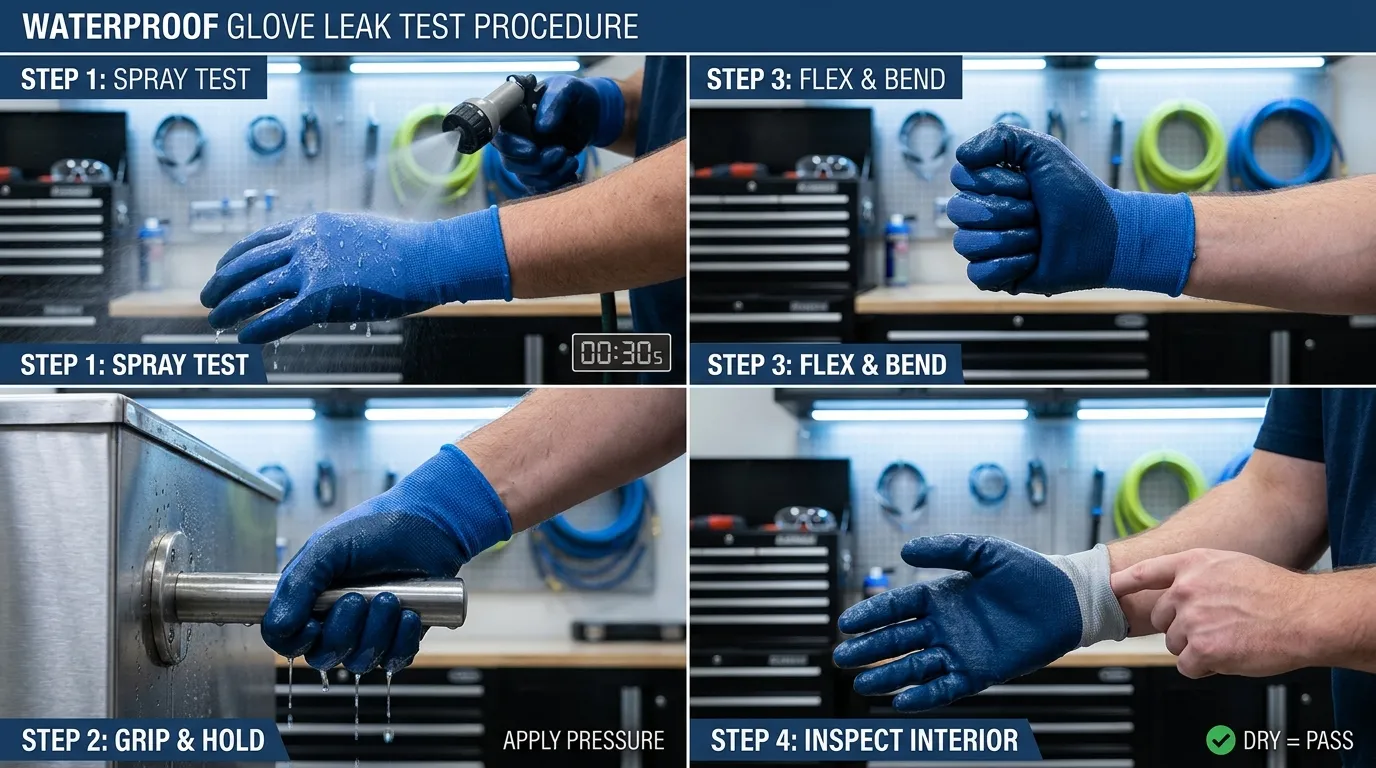
A simple leak test should check the exact failure points: back of hand, sidewalls, thumb crotch, seams, and cuff. Do not test only the palm, because palm-only success can hide real-world leakage.
A sample test does not need to be complicated. It needs to match the job. If workers handle wet bins, spray the glove while gripping a handle. If they work around drains, angle the wrist downward and see whether water enters the cuff. Test the way the glove will actually move.
Leak-test photo sequence to include
Photo step
What to show
What to check
1. Dry inspection
Front, back, sides, cuff
Where coating starts and stops
2. Light spray test
Spray palm and back of hand
Whether water beads or soaks in
3. Grip test
Hold a wet metal handle
Thumb crotch, finger sides, palm grip
4. Wrist-angle test
Let water run toward the cuff
Whether water enters from the cuff
5. Inside check
Turn glove inside out after testing
Wet liner spots, damp seams, hidden leaks
For a palm-only failure test, take a photo after spraying only the palm, then another after spraying the back while the hand is flexed. Many gloves look fine in the first photo and fail in the second. That is the difference between a marketing claim and a field-ready glove.
OSHA’s PPE guidance warns that poor glove selection can create a false sense of protection when hazards can still pass through the glove or reach the worker. That applies well to waterproof claims too, even when the issue is water entry instead of chemical exposure. See OSHA’s hand and body protection guidance.
Will waterproof nitrile gloves make hands sweaty?
Yes, they can. The more a glove blocks water from entering, the more it can also limit airflow. A breathable knit back feels more comfortable, but that same open structure is often where water enters.
Fully dipped nitrile is safer for water exposure, but it is not automatically more comfortable. If the shift is long and warm, condensation can become the new problem. Workers may feel wet inside the glove even when rain never passed through the coating.
Use waterproof nitrile during wet task windows when possible, then rotate pairs if the shift is long. A liner can improve comfort, but it may add bulk and reduce finger feel. For coating comfort and texture differences, compare foam vs sandy nitrile before choosing one finish for every job.
A practical example is a grounds crew working after rain. Fully dipped gloves may keep rain out during cleanup, but hands can sweat after two hours of handling wet tools. In that case, the right answer may be task rotation, spare gloves, or a different glove for dry tasks.
What about cold-weather lined waterproof nitrile gloves?
Choose lined waterproof nitrile gloves when the job combines water exposure with cold air, cold tools, or outdoor winter shifts. A dry but uninsulated glove may still leave fingers stiff, numb, and less controlled.
Cold changes the buying decision. A thin waterproof glove can keep water out, but it may not keep fingers warm when workers handle wet grates, cold tools, hoses, or metal equipment in winter. For cold rain or early morning drain work, a thermal liner often matters.
A lined waterproof nitrile glove should still pass the same coverage check. Look at the coating area, cuff design, palm finish, and liner thickness. Warmth helps comfort, but too much bulk can reduce dexterity when the worker needs to pick up small parts or control tools.
Use this quick checklist before buying cold-weather versions:
Check whether the glove is fully coated or double dipped.
Confirm the liner is built for cold work, not just comfort.
Test grip on wet metal or plastic handles.
Check whether the cuff blocks water running down the sleeve.
Ask workers to test finger control before bulk ordering.
Superior Glove and other glove suppliers separate waterproof needs from winter comfort needs. The buyer should do the same. Waterproofing and warmth are related in cold rain, but they are still two different performance questions.
When should you choose a different glove instead?
Waterproof nitrile is the wrong tool when the main hazard is cut, impact, chemical exposure, or heavy cold. It works best when water, oil, grip, and general abrasion are the main problems.
If the job includes
Choose or check
Why it matters
Sharp sheet metal or blades
Cut-rated glove
Waterproofing does not replace cut protection
Crushing or back-of-hand impact
Impact glove
Nitrile coating does not protect knuckles by itself
Mining, rigs, or heavy tools
Impact-rated work glove
Wet grip may need impact protection too
Chemical exposure
Chemical-compatible glove
Nitrile coating may not match every chemical
Extreme cold
Thermal waterproof PPE
A dry glove may still be too cold
For back-of-hand hazards, learn how to read impact glove ratings. For heavy outdoor environments, mining impact gloves may be a better next question than waterproofing alone.
OSHA’s hand protection standard supports this approach because gloves should be selected by the real hazard, not by one feature. If the task includes cuts, impact, oils, water, and cold, the buyer needs a glove system that covers each risk without pretending one coating solves everything.
Buyer checklist: what to verify on a waterproof nitrile glove spec
A good spec should tell you how the glove is built, not only what it claims. Before approving waterproof nitrile coated gloves for outdoor maintenance, check the coating coverage, dip count, grip texture, liner, cuff, and sample test result.
Use this checklist before a full case order:
Does the coating cover the palm only, half hand, full hand, or full hand plus fingers?
Is the glove fully dipped, double dipped, or membrane backed?
Is the palm smooth, sandy, foam, or another textured finish?
Does the cuff design stop water from running inside?
Does the liner add warmth, sweat control, or both?
Can workers grip wet and oily tools without strain?
Does the sample pass a flex, spray, and wrist-angle test?
Does the glove need cut, impact, or cold protection too?
Is the glove matched to the real work duration and hazard level?
For wider selection, send the buyer to a work glove buying guide rather than repeating every cut level or standard here. This article should help them verify waterproof claims. The pillar should help them compare the full glove category.
What to Do Next
The safest next step is to treat waterproof claims as testable, not automatic. Shortlist fully dipped or double-dipped options, request samples, and run the leak-test photo sequence before a bulk order. If the job is wet and oily, prioritize textured grip. If the job is cold, test lined versions with real tools.
Waterproof nitrile coated gloves can work well for outdoor maintenance, but only when the construction matches the exposure. Check coverage first, then grip, comfort, warmth, and any extra hazards.
Frequently Asked Questions
Are nitrile gloves waterproof?
Nitrile material can resist water, but the whole glove is only waterproof if the coating or barrier covers the exposed areas. A palm-coated glove may still leak through the back, cuff, or uncoated knit shell.
Are nitrile coated gloves waterproof?
Some nitrile coated gloves are waterproof, but not all of them. Fully coated, double-dipped, or membrane-backed gloves are stronger waterproof choices than palm-only coated gloves.
What gloves are best for wet working conditions?
Fully coated or double-dipped nitrile gloves are often best for wet handling when grip and liquid resistance both matter. For oily tools, choose a textured palm such as sandy nitrile over a smooth-only finish.
Are waterproof gloves also suitable for cold weather?
Waterproof gloves can work in cold weather, but cold jobs usually need insulation or a thermal liner too. A waterproof shell keeps water out, but it does not automatically keep fingers warm.
How long do waterproof work gloves last?
Waterproof work gloves last until the coating, seams, cuff, or grip surface starts to fail under the task conditions. Wet and oily work can wear coatings faster, so sample checks and regular inspection matter.
Are nitrile gloves impermeable?
Nitrile gloves are not impermeable forever. Cuts, abrasion, chemical exposure, worn coating, or poor cuff coverage can allow liquid to reach the hand even if the glove performed well at first.
What do nitrile gloves protect against?
Nitrile gloves can help protect against water, oils, grease, abrasion, puncture risk, and some chemicals, depending on the glove design. Buyers still need to match the glove to the actual hazard and exposure time.