Home > BLOG > Industry Blog > Safety Work Gloves Bulk in China: A Technical Guide to Grip, Protection and Bulk Sourcing
Safety Work Gloves Bulk in China: A Technical Guide to Grip, Protection and Bulk Sourcing
05 Aug, 2026
By hqt
Buying Safety Work Gloves Bulk in China requires more than comparing price per pair or choosing the highest cut rating. For distributors, industrial buyers and private-label PPE brands, the real challenge is matching glove construction to the hazard while ensuring that the approved specification can be reproduced consistently across thousands of pairs.
A practical sourcing decision should follow this sequence:
Why Bulk Work Glove Orders Can Fail After Sample Approval
A good sample does not automatically guarantee a stable production order. Small manufacturing variations can change how the glove performs in actual use.
For Safety Work Gloves Bulk in China, buyers should control:
• Yarn composition and liner construction
• Knitting gauge and glove weight
• Coating compound and dipping coverage
• Coating thickness and surface texture
• Cut, abrasion and puncture performance
• Finger length, palm width and overall sizing
• Reinforcement at high-wear areas
• Logo, cuff color and packaging specification
This matters particularly for recurring orders. NMSafety operates three production bases with 15 production lines and approximately 1,500 knitting machines, supporting multiple liner, gauge and coating combinations for volume work-glove programs.
Gauge Is Not a Protection Rating
Glove gauge describes the knitting construction. It should not be interpreted as an EN 388 or ANSI protection level.
Higher-gauge gloves generally use finer yarns and can provide a closer fit, lower bulk and better fingertip control. However, mechanical protection depends on the complete yarn system, not gauge alone.
Typical liner options include:
• Polyester: Economical general handling
• Nylon: Smooth feel and good dexterity
• HPPE-based yarn: High strength-to-weight ratio for cut protection
• Composite engineered yarn: Combines fibers to balance cut performance, comfort and thickness
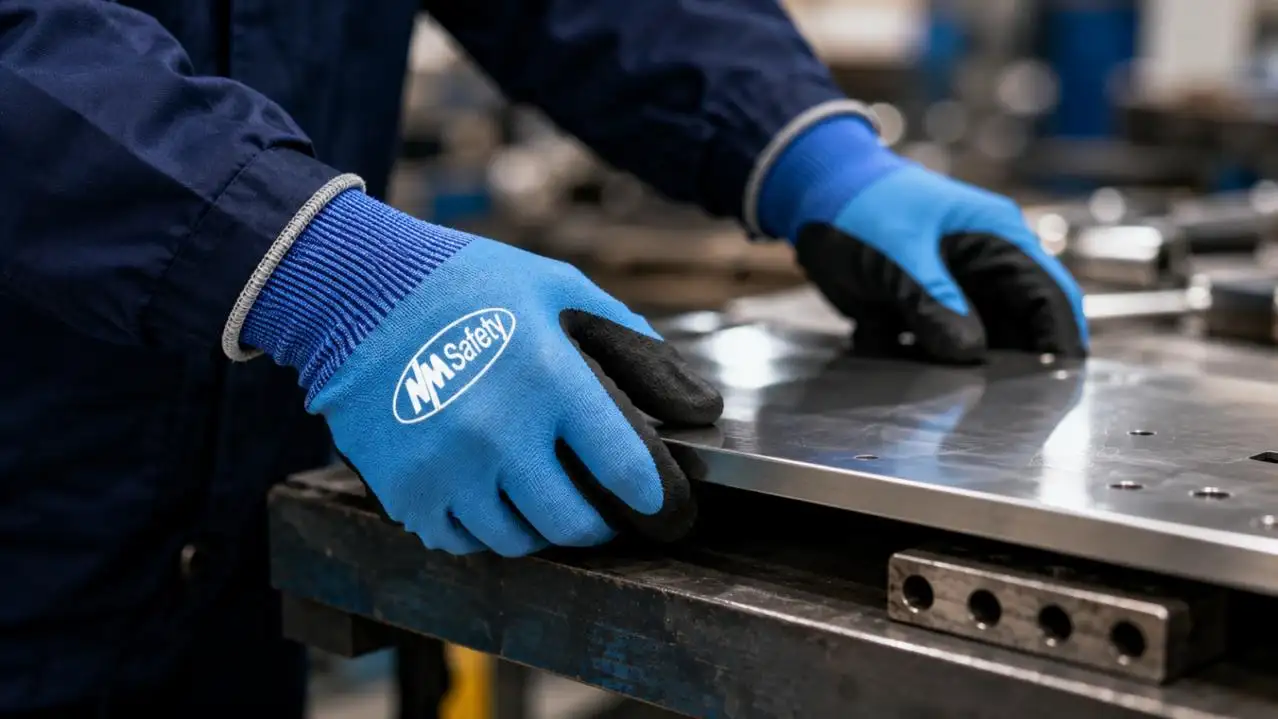
NMSafety offers fine-knit constructions including 18-gauge and 21-gauge gloves, making it possible to develop higher-dexterity options without automatically increasing glove bulk.
Coating Chemistry Changes the Working Surface
When sourcing Safety Work Gloves Bulk in China, specifying only "coated glove" or "nitrile glove" is insufficient. The polymer, finish and coverage all influence field performance.
Coating
Grip Profile
Dexterity
Oil Resistance
Typical Use
PU
Precise dry grip
High
Moderate
Electronics, inspection, assembly
Microfoam Nitrile
Fine dry/light-oil grip
High
Good
Automotive and precision handling
Foam Nitrile
Balanced industrial grip
Medium-High
Good
Machinery and general industry
Sandy Nitrile
Aggressive oily grip
Medium
High
Metal and oily component handling
Latex
Strong textured grip
Medium
Limited
Construction and material handling
PVC
Broad liquid coverage
Lower
Application-dependent
Wet industrial handling
Why Foam and Sandy Nitrile Behave Differently
Foam or microfoam nitrile uses a more porous coating structure. This helps maintain flexibility and can improve handling where light oil is present.
Sandy nitrile has a rougher gripping surface. In heavier oily applications, the textured finish can help maintain friction between the glove and component.
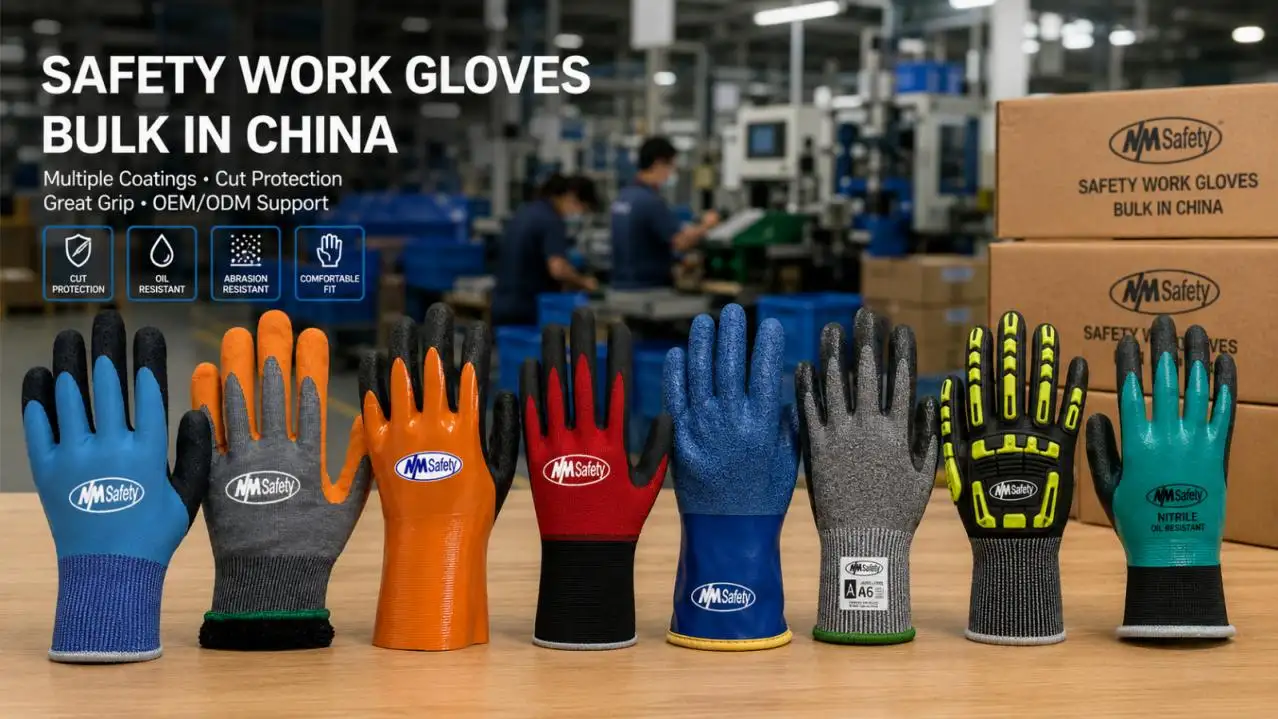
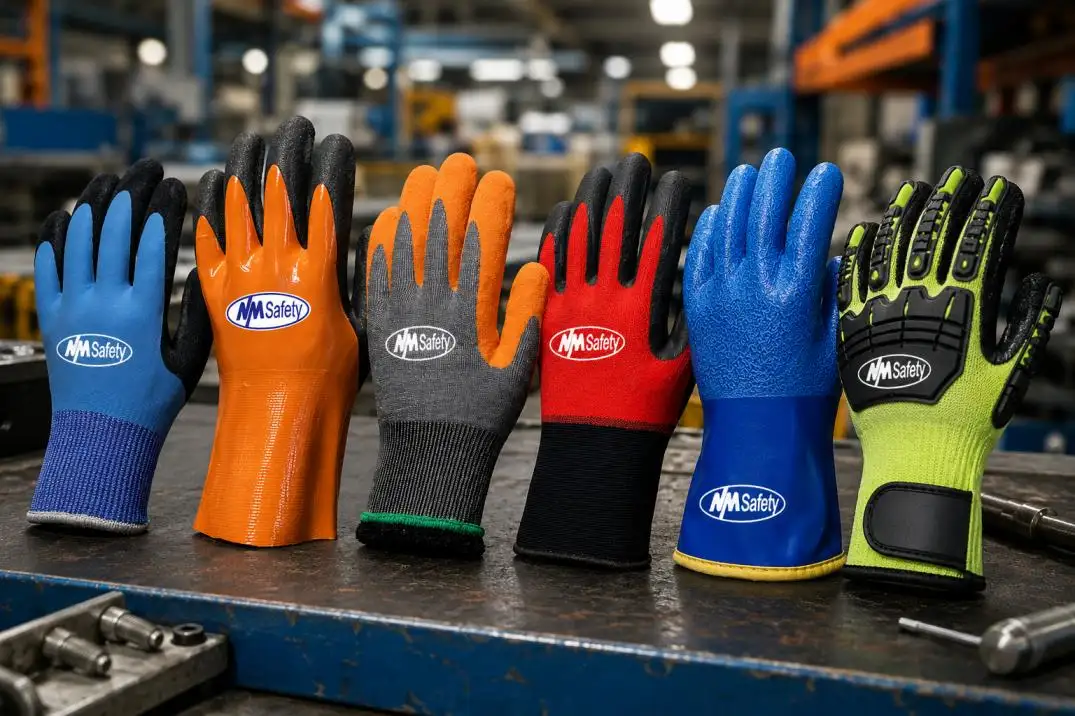
NMSafety manufactures microfoam, foam, sandy, full-coated and double-dipped nitrile structures. This gives buyers sourcing Safety Work Gloves Bulk in China more control over the relationship between grip, coverage and dexterity.
Coating Coverage Must Match Exposure
Coating coverage is another engineering decision.
Palm Coated
Suitable when breathability and hand flexibility are priorities.
3/4 Coated
Adds protection around the fingers and sides while retaining some back-of-hand ventilation.
Fully Coated
Applicable for a wider range of surface coverage in wet, contaminated and oily environments.
Double Coated
Combines a protective base layer with an outer layer that is textured for enhanced grip.
More coatings do not necessarily lead to better performance. Coverage can be increased for better resistance to contamination, but at the expense of increased stiffness, higher heat retention, and increased hand fatigue.
Select Protection as a System
The glove should be specified around the real task rather than one test result.
Application
Main Hazards
Selection Priority
Metal Fabrication
Sharp edges, oil, abrasion
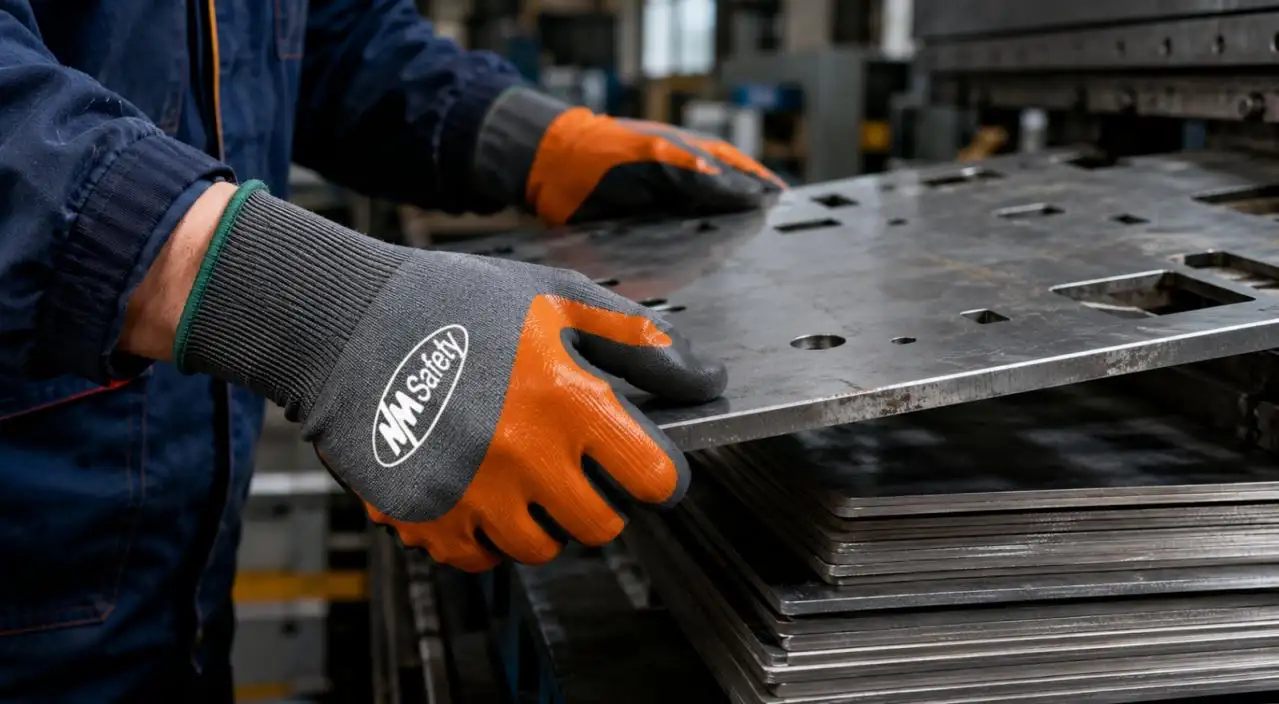
Cut + oily grip + wear resistance
Automotive Assembly
Components, tools, light oil
Dexterity + grip + cut protection
Construction
Rough materials, abrasion
Grip + coating durability
Oil & Gas
Oil, cut, impact
Grip + cut + impact protection
Precision Assembly
Small parts
Thin liner + fingertip sensitivity
A higher cut level is useful only when the application requires it. Excessive glove thickness or stiffness can make workers grip tools harder, reduce tactile feedback and increase fatigue.
Cut resistance should also remain separate from other hazards. A glove with strong cut performance is not automatically:
• Highly puncture resistant
• Needlestick resistant
• Impact resistant
• Chemical resistant
• Heat resistant
Each risk requires the appropriate test method and glove construction.
Test Production-Equivalent Gloves Before Ordering Bulk
Before approving Safety Work Gloves Bulk in China, buyers should evaluate the production-intent specification rather than an unrelated showroom sample.
A useful workplace trial should examine:
• Dry, wet and oily grip
• Finger mobility with actual tools
• Wear at fingertips and thumb crotch
• Coating cracking or delamination
• Comfort during a full work cycle
• Correct sizing across the workforce
• Actual replacement interval
Size allocation also affects bulk purchasing efficiency. Buyers should define the required S/M/L/XL or extended-size ratio before packaging rather than simply ordering equal quantities.
Verify EN 388, ANSI and CE at Product Level
Certification should be linked to the exact glove construction being purchased.
Key standards may include:
• ISO 21420 — general requirements for protective gloves
• EN 388 — mechanical risks including abrasion, cut, tear and puncture
• ANSI/ISEA 105 — U.S. classification for properties including cut, abrasion and puncture
• ANSI/ISEA 138 — back-of-hand impact protection where applicable
Buyers should not directly convert ANSI cut levels into EN ratings. Test methods and rating systems differ.
More importantly, a test report for one liner/coating configuration should not automatically be applied to another glove with different yarn, coating or reinforcement.
Evaluate Cost per Use, Not Only FOB Price
For Safety Work Gloves Bulk in China, unit price is only one purchasing variable.
Consider:
Cost per working day = glove purchase cost ÷ useful service life
A slightly higher-priced glove may reduce total consumption if its grip and abrasion resistance allow longer service.
The final supplier evaluation should therefore combine:
• Required protection
• Worker dexterity and comfort
• Real-world service life
• Batch consistency
• Verified compliance
• Manufacturing capacity
• OEM/ODM requirements
• Repeat-order stability
NMSafety integrates large-scale knitting and coating capacity with multiple glove constructions, including general-purpose, cut-resistant, oil-resistant, impact-resistant and other industrial glove categories. For a Safety Work Gloves Bulk in China project, buyers can submit the working environment, hazard level, preferred liner and coating, target standard, quantities, size ratio and private-label requirements for specification review before volume production.
The goal is not simply to purchase more gloves at a lower unit price. It is to establish a repeatable glove specification that protects workers, fits the actual task and remains commercially practical across recurring bulk orders.
FAQs
Q1. What types of safety work gloves does NMSafety provide?
NMSafety designs industrial safety gloves with a myriad of features for almost all work applications, including: general handling, cut protection, oily environments, impact protection, protection from the elements, winter work, heavy-duty handling, and precision assembly. Users can choose from different liners, coatings, and a variety of protections based on the needs of their work environment.
Q2. Can NMSafety provide Safety Work Gloves in Bulk in China?
Yes. NMSafety has multiple production bases with the capacity for knitting and coating for industrial and wholesale orders. For large volume orders, buyers must confirm the glove specifications, size ratios, desired packing, and the delivery timetable prior to the initiation of the production process.
Q3. What coating options does NMSafety offer?
NMSafety's coating solutions include PU, foam nitrile, microfoam nitrile, sandy nitrile, full nitrile, and double dip structures. The appropriate coating solution is based on exposure to oil, required grip, abrasion, breathability, and dexterity.
Q4. Are high-dexterity safety gloves produced by NMSafety?
Yes. NMSafety offers fine gauge gloves, including an 18-gauge and 21-gauge construction. The finer gauge gloves provide applications for even greater dexterity and fingertip control. The protection still depends on the complete yarn and coating system.
Q5. Does NMSafety provide cut resistant work gloves?
Yes. NMSafety provides cut-resistance glove constructions utilizing engineered yarn systems, including HPPE-based and reinforced fibers. Buyers must provide a targeted comfort level-per the cut level specifications between EN and ANSI- rather than glove selection by material description.