Home > BLOG > Industry Blog > Oil Resistant Gloves Wholesale in China: OEM Customization for Safety Distributors
Oil Resistant Gloves Wholesale in China: OEM Customization for Safety Distributors
12 Sep, 2026
By hqt
For distributors sourcing Oil Resistant Gloves Wholesale in China, a successful OEM program depends on three things: matching gloves to the application, defining a reproducible specification, and maintaining consistency across repeat orders.
At NMSafety, we approach product selection through the relationship between liner, coating, coverage, and working conditions. Branding gives a distributor's range its identity; documented construction and verified performance give customers a reason to reorder.
"Oil Resistant" isn't a performance rating that applies broadly. Buyers should recognize three functions:
• Oil grip: Retaining control of components that are oily.
• Liquid penetration resistance: Limiting the passage of liquids through pores or defects.
• Chemical permeation resistance: Resisting the movement of molecules through the glove.
A texture on the palm might help with oil grip while handling. However, textured palm would do very little to protect you from contact with liquid over time. A full coated glove answers the coverage issue. However, a full coated glove would not necessarily offer chemical compatibility.
For Oil Resistant Gloves Wholesale in China, an OEM brief needs to state the fluid(s) or mixture(s), concentration (if relevant), temperature, contact time, and the exposure condition. It should also state the other mechanical hazards like sharp/metal edges, abrasion, and impact.
"Automotive use" is too broad: handling lightly oiled fasteners and maintaining fluid-filled equipment require different assessments.
Match Construction to the Working Task
Coating and Coverage
Compare complete constructions rather than selecting by material name alone.
Design Variable
Options
Engineering Trade-Off
Validation Priority
Coating material
Nitrile / PVC
Fluid compatibility, flexibility, and wear depend on formulation and construction
Data relevant to the actual fluid and temperature
Surface finish
Smooth / sandy / foam nitrile
Texture and porosity influence handling and liquid behavior
Grip under representative oil loading
Coverage
Palm / three-quarter / full
Greater coverage reduces exposed liner area but can reduce ventilation
Exposure locations and cuff entry
Coating thickness
Thinner / thicker constructions
Tactile sensitivity versus durability and flexibility
Small-part handling and wear trials
Liner
General-purpose / cut-resistant
Fit and dexterity versus required mechanical protection
Task-specific protection and wearer assessment
Liner Gauge and Fit
A higher knitting gauge generally indicates a finer knit, but does not independently establish cut protection, durability, or finished-glove thickness.
To compare sizes, consider:
• Fingertip clearance and finger alignment.
• Palm tension while grasping instruments.
• Cuff retention during repetitive motion.
• Effortless effort with fasteners and small parts.
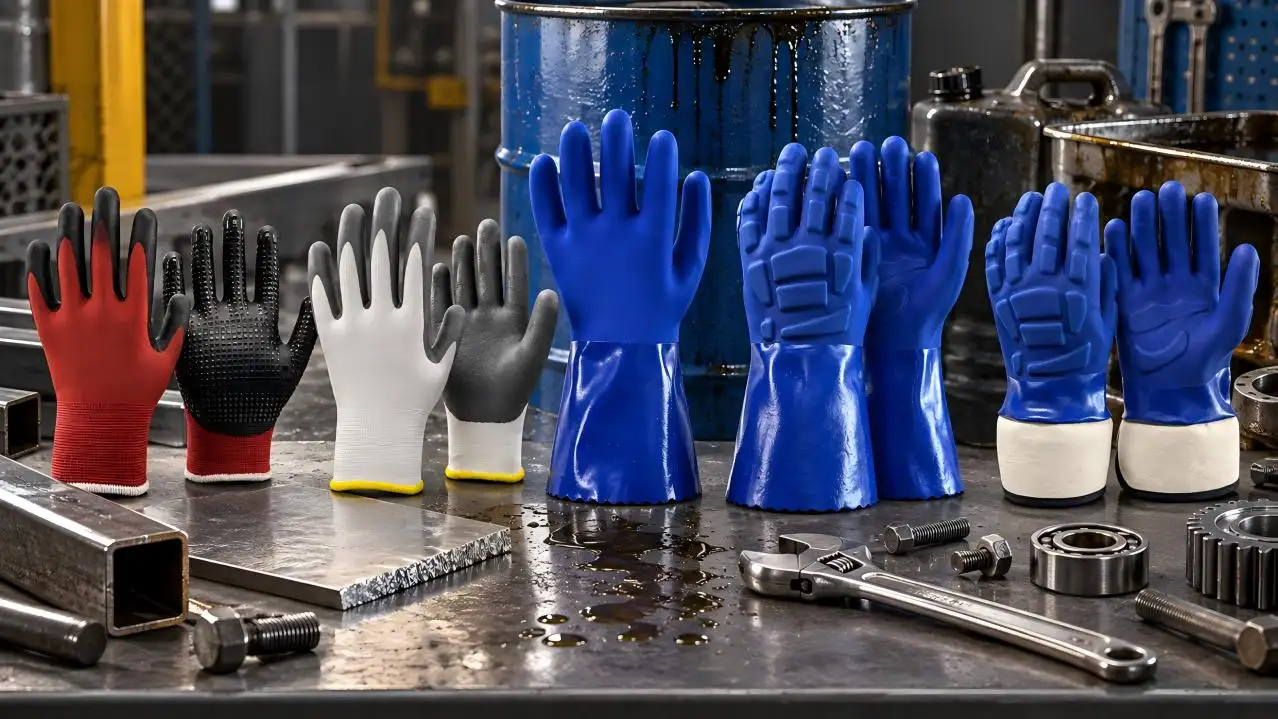
We have a line of oil resistant gloves that come in PVC and nitrile as well as fine gauge liners, and designs with cut, impact, or thermal protection. These are the options available, but all constructions will need to be assessed for the application.
Select the OEM Route That Works Best for Your Forecasted Sales
Level of customization will impact the effort and cost for developing Oil Resistant Gloves Wholesale in China, as well as the stock you will need to carry.
OEM Route
Typical Scope
Best Fit
Buyer Decision
Existing-product private label
Branding, labels, packaging
Establishing a core range
Confirm packaging MOQ and artwork requirements
Existing-design modification
Color, cuff, size, or coverage adjustments
Serving a defined customer segment
Assess feasibility and performance-document implications
Dedicated development
Revised material and structural combinations
Addressing unmet application requirements
Budget for sampling, validation, and forecast volume
Available changes require project confirmation. A different coating, liner, or coverage pattern may change performance; earlier test results should not automatically transfer to the revised product.
For distributors, a focused range with clear application differences is often easier to stock than numerous lightly differentiated variants.
Transform Sample Approval Into a Production Specification
Sample approval does not ensure approval for bulk shipment of Oil Resistant Gloves in China. For approval, the description of subsequent shipments must be provided.
Critical Characteristics of the Drawing
Drawing:
• Composition of the liner, gauge, size, and dimensions.
• Coating material, finish, and scope of coverage and agreed thickness control.
• Documentation to substantiate the performance.
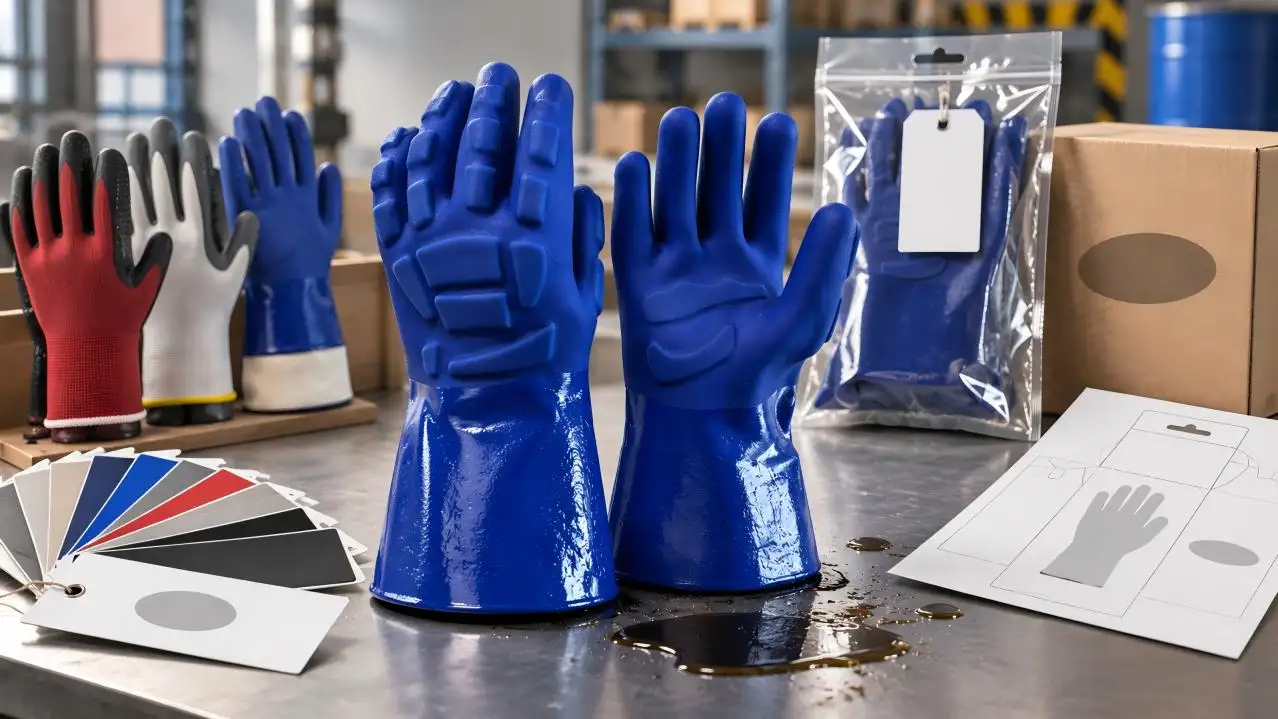
• Position of the logo, content of the label, barcode, and the packing arrangement.
• Inspection method, definition of defects, and acceptance criteria.
Retain an approved reference sample and the drawn specification. The sample allows an assessment of appearance and workmanship; the limits allow an objective assessment.
Performance to be Evaluated Separately
Protective claims will require laboratory evidence, while assessment for practical use in the workplace requires evidence from usage trials. These trials will detail the task, fluid used, duration of use, and the coating sustained damage, along with the reason for replacement.
A liquid leakage test should not be considered a confirmation of the excellence of gloves in resisting the permeation of chemicals. Likewise, a test to assess the protective impact of gloves against mechanical damage should not be considered a test of the gloves compatibility with all lubricants.
It is understood that a substitution of material or construction would require notification and a subsequent assessment.
Control MOQ, Lead Time, and Replenishment Risk
Compare quotations on the same specification and delivery basis. Ask whether minimum quantities apply per construction, color, size, or printed package.
Separate lead time into sampling, artwork approval, material preparation, production, and shipment. Confirm whether repeat orders depend on fresh material or packaging purchases.
A useful purchasing measure is:
Glove cost per usable shift = landed cost per pair ÷ average usable shifts per pair
Use comparable trial conditions and application-specific replacement rules. Also account for slow-moving sizes, defects, and emergency replenishment costs.
NMSafety's Manufacturing Basis for OEM Discussions
NMSafety was established in 1998, with headquarters in Shanghai and factories in Jiangxi, Jiangsu, and Shandong, as detailed in our company profile.
Our company's previous experiences with manufacturing and variety of products allow us to discuss application specifics. For every project we consider ease of construction, degree of customizability, documented quality specifications, and planning for regular orders.
For your next project for Oil Resistant Gloves Wholesale in China, consider browsing NMSafety's range of oil-resistant gloves, specify target applications, and mixing sizes along with an order estimate. We can offer you products and samples based on the brief and on the OEM requirements that we can discuss.
FAQs
Q1. What types of oil-resistant gloves does NMSafety offer?
NMSafety's range includes nitrile and PVC-coated gloves, with options incorporating fine-gauge liners, cut protection, impact protection, and thermal insulation. Choose the construction according to oil exposure, handling tasks, and additional workplace hazards. Explore the NMSafety oil-resistant glove range.
Q2. Where is NMSafety located, and when was it established?
NMSafety was established in 1998. Its headquarters are in Shanghai, with factories in Jiangxi, Jiangsu, and Shandong, according to the NMSafety company profile.
Q3. How should distributors start an OEM glove project with NMSafety?
Provide the target industry, exact fluids handled, exposure duration, mechanical hazards, preferred construction, size distribution, and estimated order quantity. Include branding and packaging requirements so the proposed product and commercial conditions can be assessed together.
Q4. Can distributors request private-label oil-resistant gloves from NMSafety?
Distributors can discuss private-label requirements with NMSafety, including logos, labels, and packaging. Confirm available options, artwork requirements, minimum quantities, and whether the project uses an existing construction or requires product modifications.
Q5. How can buyers choose between NMSafety's nitrile and PVC-coated gloves?
Compare the specific products against the fluid, temperature, exposure pattern, flexibility, and abrasion requirements. Material names alone do not establish suitability. Request relevant product information and evaluate samples under representative working conditions.