Home > BLOG > Industry Blog > Impact-Resistant Gloves Wholesale in China: Standards, Materials and Sourcing Tips
Impact-Resistant Gloves Wholesale in China: Standards, Materials and Sourcing Tips
23 Jul, 2026
By hqt
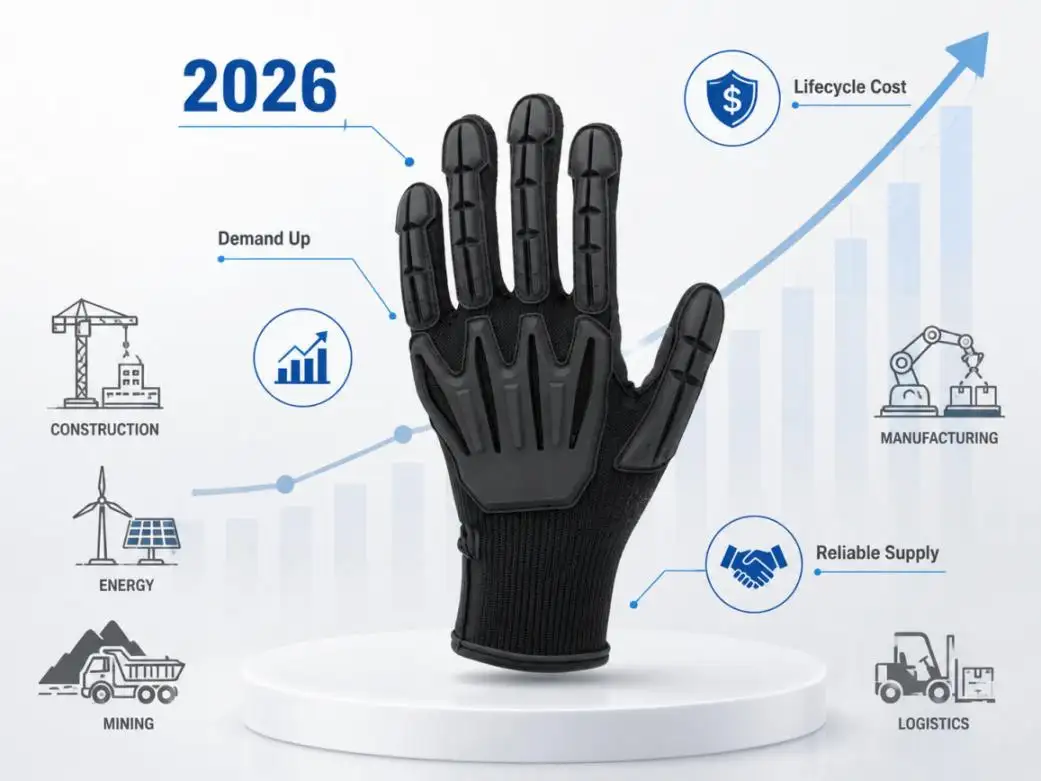
2026 will be an important year for buyers looking at impact-resistant gloves wholesale from China. Depending on what studies focus on, most estimations on the markets differ because some studies only look at impact gloves and some look at industrial hand protection as a whole. One estimate values the impact-resistant glove market at approximately USD 979 million in 2026 and projects USD 1.51 billion by 2035. The wider industrial safety glove market was estimated at USD 12.44 billion in 2025 and is forecast to reach USD 19.07 billion by 2031.
Demand comes from construction, energy, mining, manufacturing, and logistics, where hands face crushing, pinching, and back-of-hand hazards. Procurement is also moving beyond the lowest quotation toward service life, wearer acceptance, certification, replacement frequency, and delivery reliability.
For importers and PPE distributors, impact-resistant gloves wholesale in China therefore need to be evaluated through total lifecycle cost rather than unit price alone.
Impact-resistant gloves protect the fingers, thumb, knuckles, and back of the hand against blunt-force hazards such as dropped tools, moving chains, pipe handling, pinch points, and contact with equipment in confined spaces. ISEA identifies offshore oil and gas, construction, mining, manufacturing, warehousing, and transport as high-exposure industries.
They are different from cut-resistant gloves. Cut protection addresses sharp-edge hazards and is classified under ANSI/ISEA 105 or EN ISO 13997. Impact protection measures how effectively dorsal padding reduces force transmitted to the hand.
Most designs use molded or sewn thermoplastic rubber, or TPR, across the fingers and knuckles. Segmented TPR spreads impact energy while allowing flexion. Palm constructions may also add nitrile grip, thumb reinforcement or cushioning.
However, vibration padding should not be treated as a complete HAVS control. The UK HSE states that anti-vibration gloves are not an effective substitute for reducing vibration at the tool or process level.
International Standards Buyers Should Understand
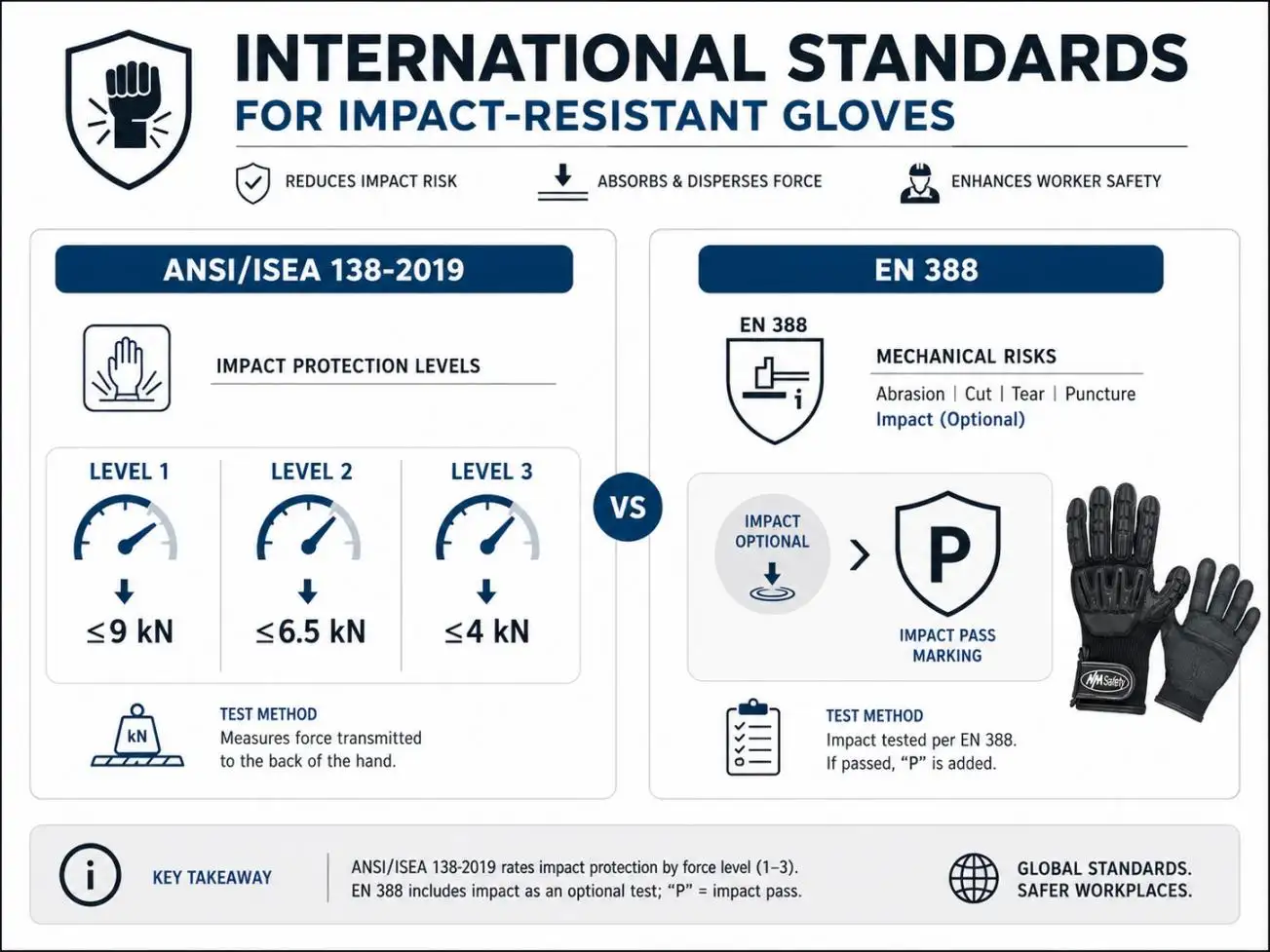
ANSI/ISEA 138-2019
ANSI/ISEA 138-2019 is the dedicated North American standard for impact-resistant gloves. It evaluates both the knuckles and fingers/thumb, with the final rating based on the weaker tested region.
Rating
Mean Transmitted Force
Relative Protection
Level 1
≤9 kN
Basic
Level 2
≤6.5 kN
Medium
Level 3
≤4 kN
Highest
Lower transmitted force means more impact energy is dispersed by the glove. Compared with EN 388, ANSI/ISEA 138 uses more impact locations and provides a more detailed three-level classification.
EN 388:2016+A1:2018
EN 388 evaluates abrasion, blade cut, tear, puncture and ISO cut resistance. Impact testing is optional and follows a 5-joule method derived from EN 13594.
A successful impact result is marked with "P." A failed test is not marked as P, while "X" indicates that the property was not tested where applicable.
For North American programs, buyers should prioritize ANSI/ISEA 138. For European or multi-region distribution, EN 388 documentation should also be requested. Dual-standard testing can reduce SKU duplication and support cross-border procurement programs.
Impact Resistant Gloves Wholesale in China: Manufacturing Landscape
China is a major sourcing base because knitting, coating, TPR molding, sewing, packaging and export services are available across several industrial clusters.
Manufacturer
Location
Publicly Stated Focus
NMSafety
Shanghai; factories in Jiangxi, Jiangsu and Shandong
Multi-factory impact, cut and coated-glove production
Xiamen PRI Industrial
Xiamen, Fujian
Work, oil-and-gas and mechanic gloves; two factories
Foshan Welldo
Foshan, Guangdong
TPR impact-resistant mechanic gloves
Qingdao Blue Shield
Qingdao, Shandong
Impact-resistant, cut-resistant and coated gloves
Qingdao Snell
Qingdao, Shandong
Gloves for construction, machinery, automotive and logistics
These are publicly presented capabilities rather than a manufacturer ranking. Buyers considering Impact Resistant Gloves Wholesale in China should independently verify factory ownership, production scope, audit status and available capacity.
From Heavy Protection to Ergonomic Protection
Earlier impact gloves often relied on thick foam, large TPR blocks and heavy liners. These designs may lead to problems such as rigidity of the fingers, retention of heat, and heightened fatigue in the user as the shift progresses.
Current programs for wholesale impact-resistant gloves in China integrate protection with:
• Greater dexterity: 15-gauge and 18-gauge and some 18-gauge to 21-gauge options for low bulk.
• Low-profile TPR: Protection is segmented to follow the joints of the fingers and is concentrated at the zones of impact.
• Coatings for task-related controls: Nitrile foams that are sandy or other textured variants assist grip in oily, wet, and dry situations.
• Pre-curved shaping: Reduces resistance when closing the hand.
• Multi-hazard designs: Impact protection can be combined with cut, water, heat or thumb-crotch protection.
Design Factor
Traditional Construction
Modern Construction
TPR design
Thick, continuous blocks
Segmented and joint-aligned
Liner
Coarse and bulky
Finer-gauge engineered yarn
Dexterity
Restricted
Improved finger movement
Breathability
Lower
Lighter, ventilated structures
Worker acceptance
Often inconsistent
Better when fit is validated
The development is not simply toward thinner gloves. It is toward placing protection around actual impact zones while retaining grip, fit and natural hand movement.
Modern Cut-Resistant Glove Material Comparison
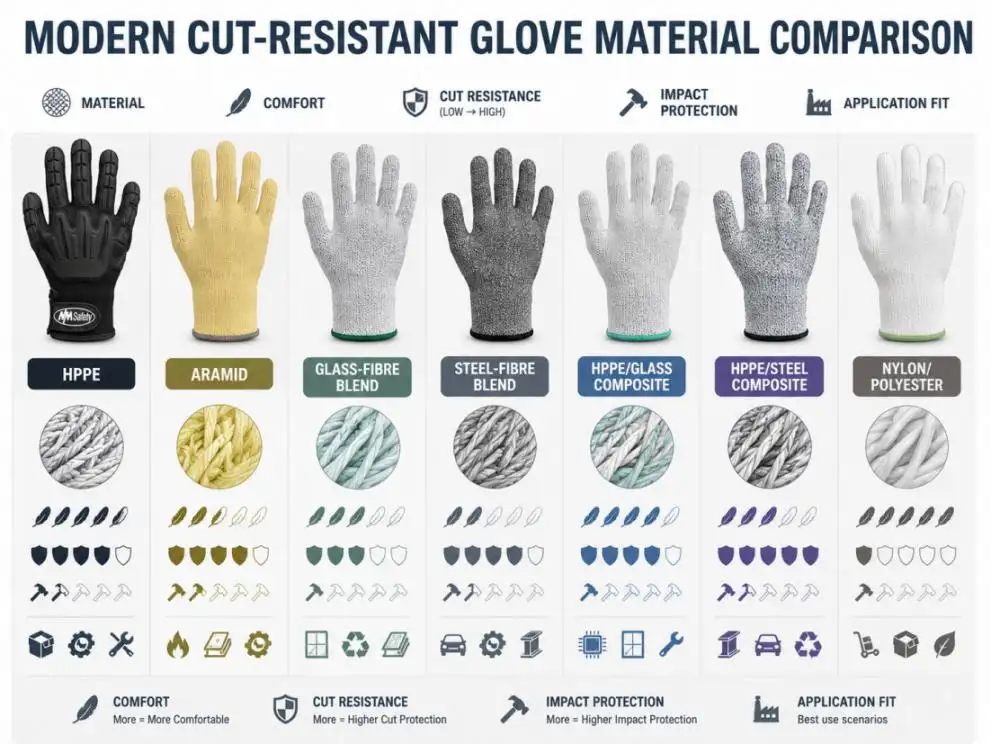
The liner material directly affects cut resistance, flexibility, heat performance, weight and cost. Buyers should select materials according to the workplace hazard rather than relying only on the stated cut level.
Material
Cut Protection Potential
Dexterity
Heat Resistance
Weight and Comfort
Main Limitations
Typical Applications
HPPE
Medium to high
Excellent
Low to moderate
Lightweight, cool and comfortable
Can soften under high heat
Assembly, glass handling, warehousing and general metalwork
Aramid Fibre
Medium to high
Good
Excellent
Lightweight but slightly warmer than HPPE
Lower resistance to UV exposure and some chemicals
Welding support, automotive, heat handling and metal fabrication
Glass-Fibre Blend
High
Moderate to good
Moderate
Adds cut protection without excessive bulk
Fibres may cause discomfort if poorly covered by other yarns
Sheet metal, glass, machinery and construction
Steel-Fibre Blend
Very high
Moderate
High
Heavier and less flexible
Higher weight and possible conductivity concerns
Heavy metal processing, recycling and sharp-edge handling
HPPE/Glass Composite
High
Good to excellent
Moderate
Balanced protection, weight and flexibility
Performance depends on yarn ratio and knitting quality
Automotive, appliance manufacturing and metal component handling
HPPE/Steel Composite
Very high
Moderate to good
Moderate to high
Strong protection with lower bulk than traditional steel mesh
Higher material cost
Heavy fabrication, stamping and sharp metal handling
Nylon or Polyester
Low when used alone
Excellent
Low
Soft, breathable and economical
Requires reinforcement for meaningful cut protection
Light assembly, logistics and coating-carrier liners
A higher cut rating does not automatically indicate a better glove. HPPE-based constructions are often suitable when dexterity and prolonged wear are priorities, while aramid and steel-fiber blends are more appropriate for heat exposure or severe sharp-edge hazards. The final selection should also consider coating type, liner gauge, impact protection, grip conditions and worker acceptance.
China NMSafety's Manufacturing Advantages
Established in 1998, NMSafety manufactures safety gloves for distributors, PPE brands and buyers sourcing impact-resistant gloves wholesale in China. The company operates three production bases in Jiangxi, Jiangsu and Shandong, supported by its Shanghai headquarters.
The multistage production construction supports around 15 production lines, 1500+ knitting machines, and 600+ employees with a monthly manufacturing capacity that exceeds 600,000 dozen gloves. Production planning is streamlined and is able to process normal wholesale orders of medium to large volumes.
Highlights include:
• Manufacturing Merger: Combined operations for knitting, coating, TPR, finishing, inspection, and packing.
By combining impact protection, grip, dexterity and wearer comfort, NMSafety helps wholesale buyers consolidate multiple glove categories under one manufacturing program.
Conclusion: Source Impact-Resistant Gloves with Confidence
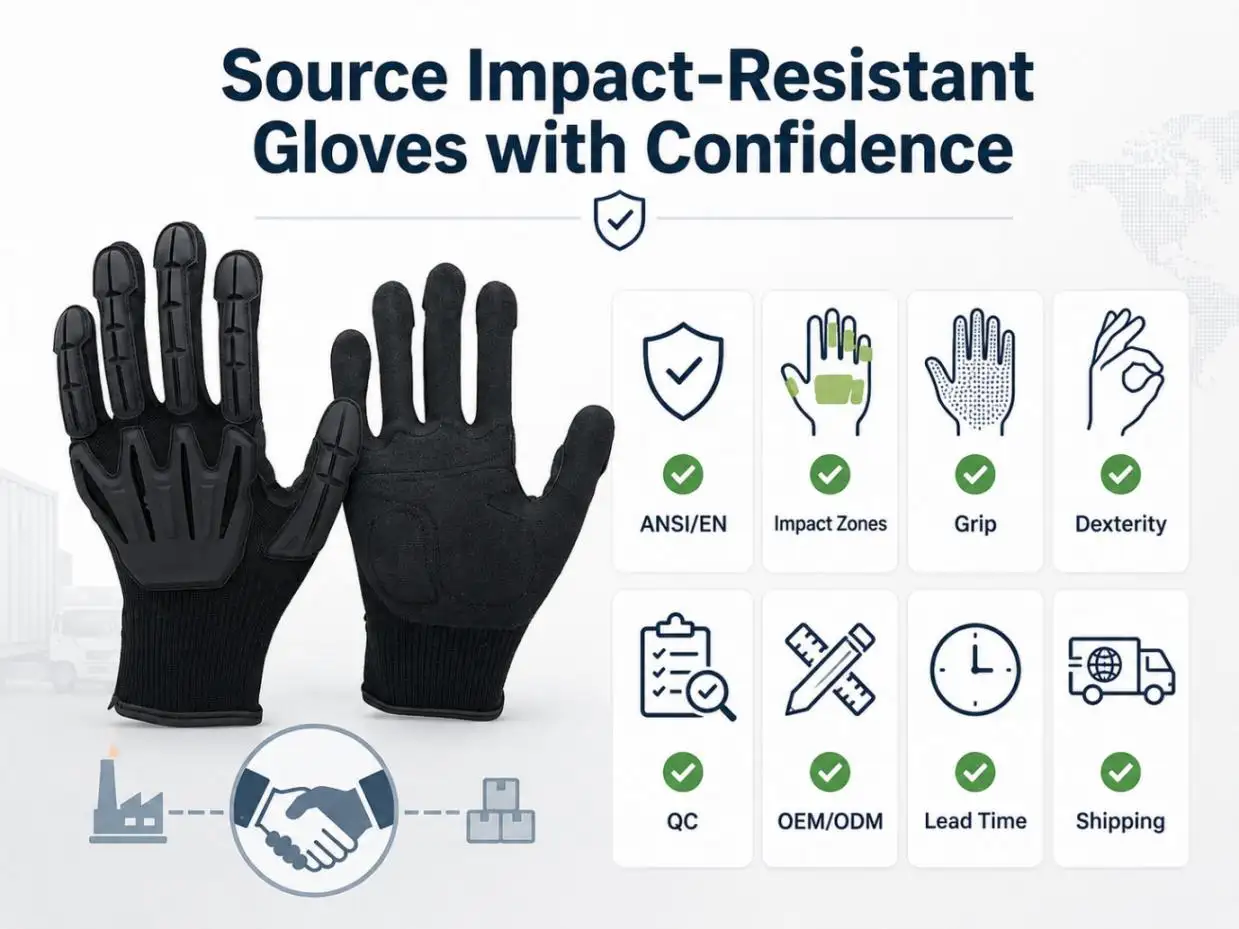
Are you looking for impact-resistant gloves wholesale in China? You need to look beyond the prices. Understand the verified protection against impacts, ergonomic designs, quality, manufacturing, compliance documentation, and reliable shipping.
NMSafety provides distributors and industrial purchasers adjustable manufacturing and multi-risk glove solutions with OEM/ODM services.
Contact NMSafety to discuss your target standards, applications, and order requirements and develop an impact-resistant glove program built for wearer comfort, repeatable quality, and long-term supply.
FAQs
Q1. What do impact-resistant gloves protect against?
These gloves protect the back of the hand, the fingers and knuckles against blunt-force impact injuries from tools, equipment, and other workplace hazards.
Q2. What is the standard for impact-resistant gloves?
ANSI/ISEA 138 has Levels 1–3 of impact protection. EN 388 has an optional "P" marking for impact testing.
Q3. What is the highest protection of the ANSI/ISEA 138 standard?
Level 3 is the highest and means that a max of 4 kN has been tested.
Q4. What is the construction of an impact protection glove?
Most impact protection gloves utilize a construction of TPR or rubber that is flexible and segmented across the fingers, knuckles and the back of the hand.
Q5. Can gloves be both impact and cut protective?
Yes. It is possible to have combination cut and impact protection with a liner of either HPPE, aramid, glass-fiber, or steel-fiber as well as resistance to cuts in the A2 to A8 range of the ANSI standard.