Home > BLOG > Industry Blog > Needle Resistant Gloves Wholesale in China: Bulk Purchasing and Customization Guide
Needle Resistant Gloves Wholesale in China: Bulk Purchasing and Customization Guide
24 Jul, 2026
By hqt
China provides scalable manufacturing options, along with OEM services, for needle-resistant gloves from palm-reinforced to multi-layered protection systems. Buyers in need of wholesale needle-resistant gloves from China must distinguish between puncture resistance and hypodermic-needle resistance. The choice of the appropriate design depends on the nature of the threat, the area requiring protection, the method of testing, the required dexterity, and the consistency of production.
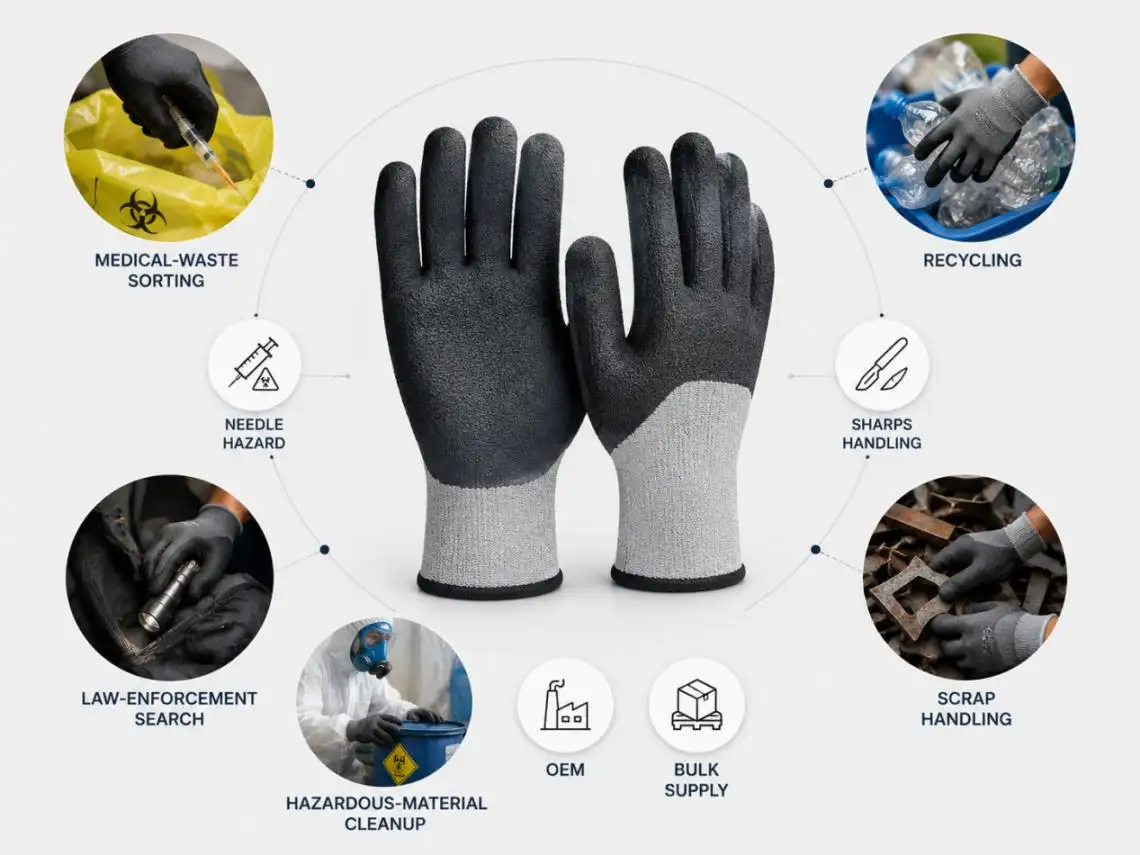
Needle hazards are common in medical-waste sorting, recycling, law-enforcement searches, prison work, scrap handling, and hazardous-material cleanup. In these environments, a glove selected only by price or a general puncture rating may leave important hand areas insufficiently protected.
Needle-resistant gloves reduce penetration risks from fine, sharp objects such as syringe needles, thin wires and concealed sharps. Unlike standard industrial puncture-resistant gloves, they normally combine several materials and protection mechanisms rather than relying on one thick liner.
Needle Resistance vs. General Puncture Resistance
Protection type
Typical hazard
Performance focus
Common applications
Needle resistance
Syringe needles, fine wire and small sharps
Force required for a fine needle to penetrate
Medical waste, searches and recycling
General puncture resistance
Nails, rigid points and coarse metal edges
Resistance to a broader puncture probe
Construction, maintenance and metalwork
Cut resistance
Blades, glass and sheet metal
Resistance to cutting by sharp edges
Glass handling, fabrication and assembly
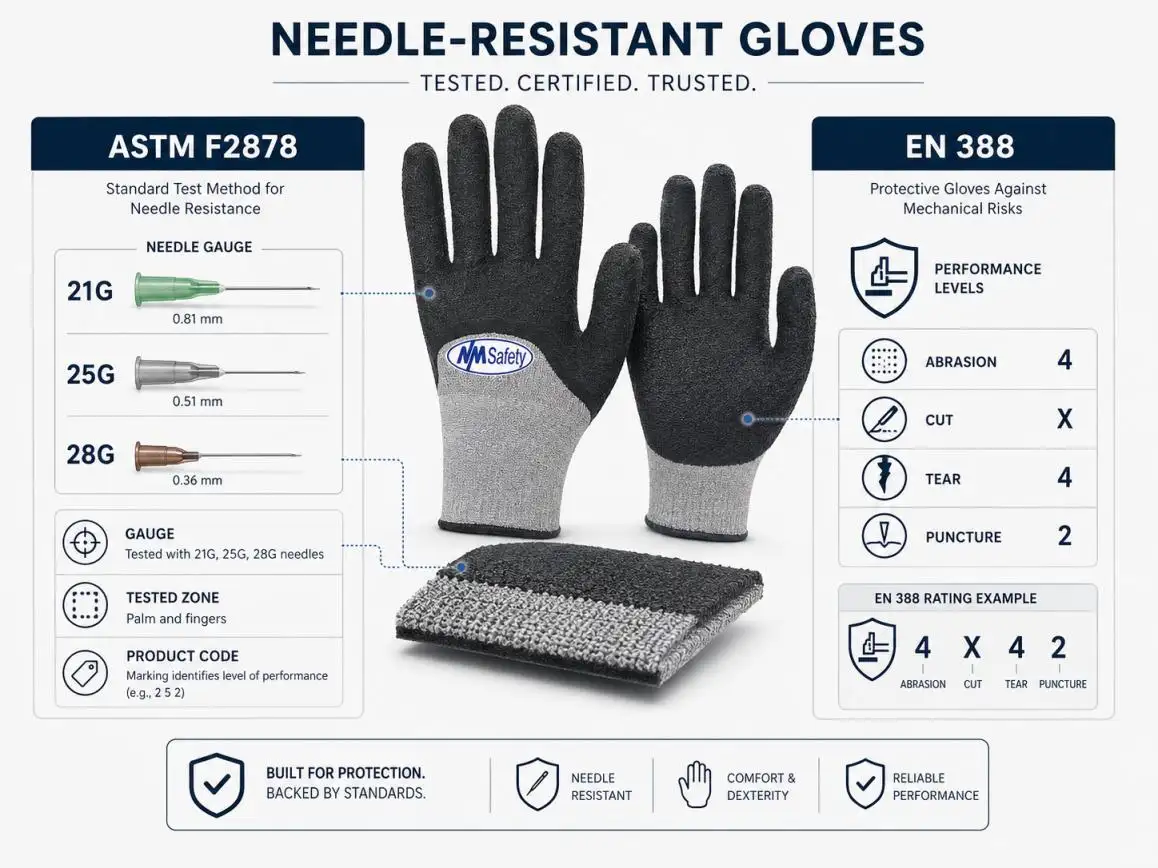
A high EN 388 puncture score does not automatically demonstrate strong hypodermic-needle protection. EN 388 covers mechanical risks including abrasion, blade cut, tear and puncture, while needle penetration requires a more specific evaluation.
How Needle-Resistant Gloves Work
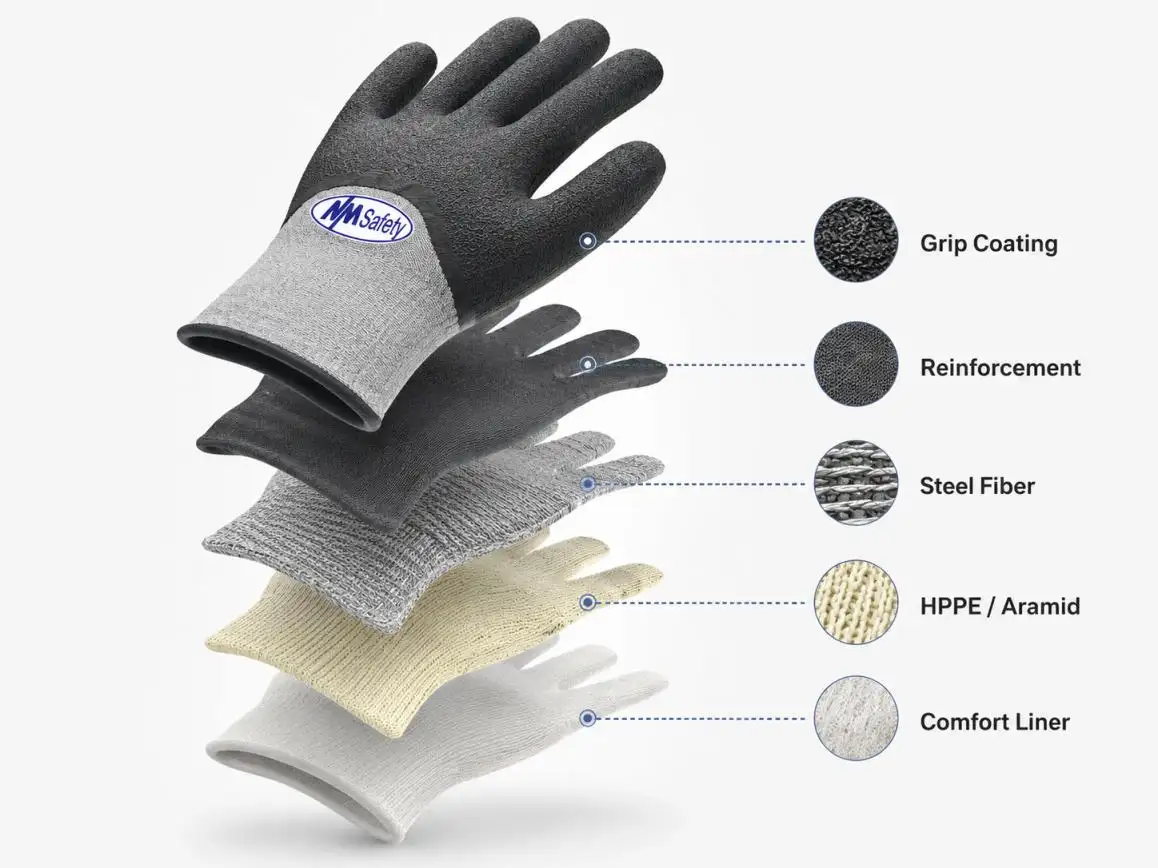
Common constructions include multi-layer textile barriers, palm or fingertip reinforcement, aramid or HPPE combinations, overlapping protection layers, grip coatings and softer comfort liners.
More layers may improve resistance but can also increase weight and reduce finger movement. The objective is not maximum thickness; it is suitable protection with acceptable wearer compliance.
Which Standards Matter?
ASTM F2878 Needle Puncture Testing
ASTM F2878 measures the force required for a hypodermic needle to penetrate protective clothing material. The current ASTM listing covers 21-, 25- and 28-gauge needles and notes that the method does not reproduce every possible use condition.
When evaluating ASTM F2878 tested gloves, buyers should confirm:
• The needle gauge used
• Whether the finished glove or only a material sample was tested
• The specific glove zones covered by the test
• The product code and construction identified in the report
• Whether production uses the tested layer sequence
A generic material certificate should not replace a product-specific report, particularly where reinforcement differs across the palm, fingertips and hand back.
EN 388 Mechanical Protection
EN 388 evaluates abrasion, cut, tear and conventional puncture performance. ISO 13997 also supports cut-resistance assessment for sharp-edge hazards. These results are complementary data, not proof of hypodermic-needle protection.
Buyers should also review the technical data sheet, material specification, size chart, protection-zone map, batch inspection criteria and factory quality documents.
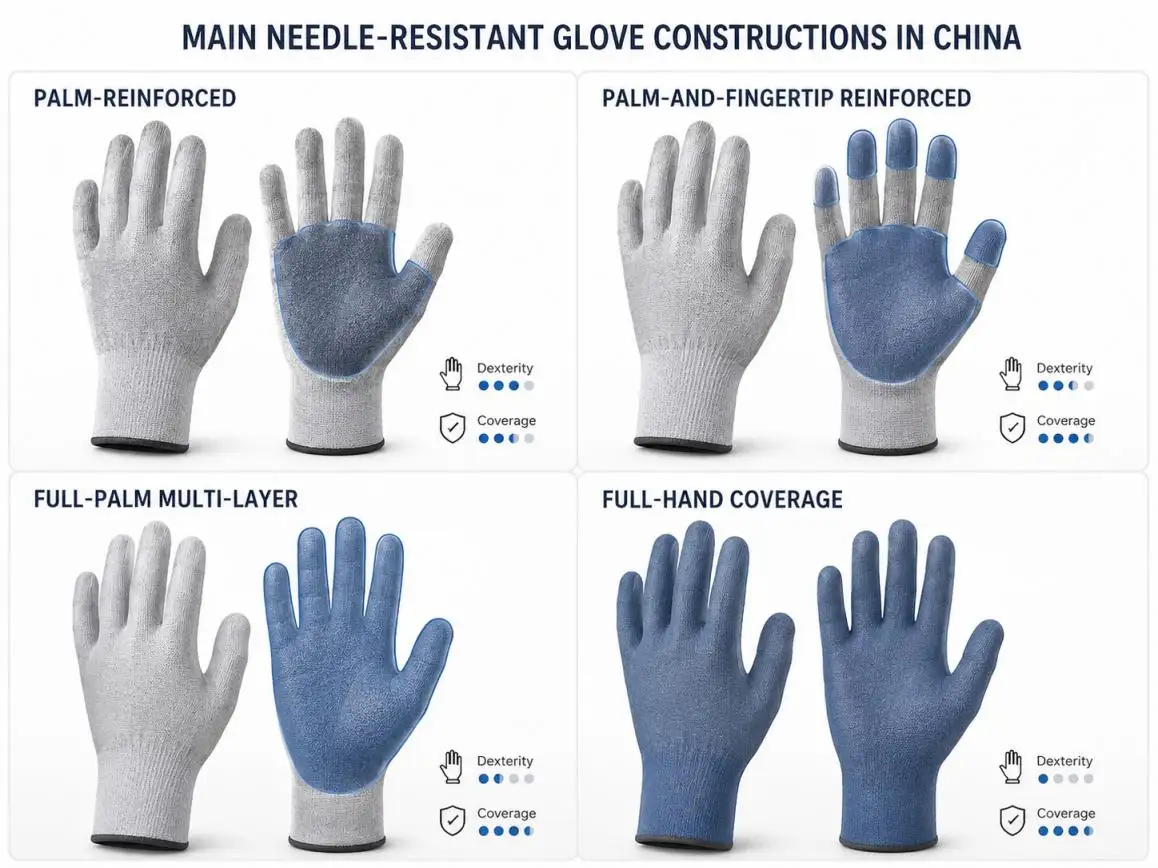
Main Needle-Resistant Glove Constructions in China
Construction
Protected area
Dexterity
Grip potential
Typical use
Palm-reinforced
Palm
High
Good
Waste sorting and recycling
Palm-and-fingertip reinforced
Palm and fingertips
Medium
Medium
Searches and sharps handling
Full-palm multi-layer
Entire palm side
Medium-low
Outer-layer dependent
Medical waste and cleanup
Full-hand coverage
Palm, fingers and hand back
Low
More limited
Specialized high-risk tasks
Needle-and-cut combination
Defined reinforced zones
Medium
Customizable
Metal, glass and mixed waste
For Needle-Resistant Gloves Wholesale in China, products should not be ranked simply as good, better and best. Buyers should compare protection coverage, needle gauge, penetration force, cut level, thickness, grip, abrasion resistance, comfort, cleaning requirements and cost per use.
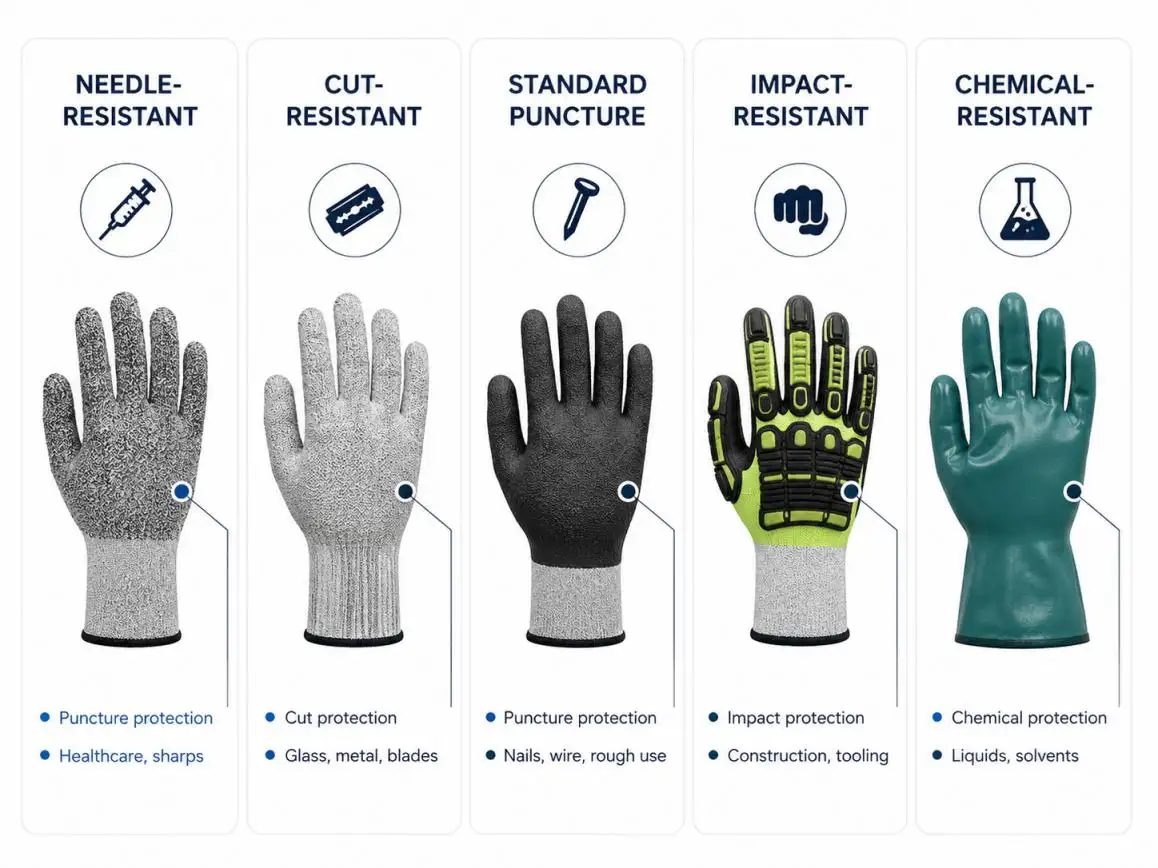
Similar Protective Glove Comparison
Glove category
Primary protection
Needle protection
Dexterity
Suitable environments
Needle-resistant gloves
Fine needles and concealed sharps
Medium to high, depending on tested structure
Medium
Waste, searches and sharps handling
Cut-resistant gloves
Blades and sharp edges
Usually limited unless reinforced
High
Glass and metalwork
Standard puncture gloves
Nails and coarse points
Unconfirmed without needle testing
Medium
Construction and maintenance
Impact-resistant gloves
Knuckle and hand-back impact
Usually limited
Medium
Oil, gas and heavy industry
Chemical-resistant gloves
Liquid and chemical contact
Usually low
Material-dependent
Chemical handling and cleaning
No single glove controls every hazard. Buyers may need a combined structure incorporating needle, cut, abrasion, liquid or impact protection. Each function should be justified by the task because unnecessary layers can reduce flexibility and increase cost.
Entry-Level to High-Coverage Protection Comparison
Factor
Basic reinforced
Multi-layer composite
High-coverage professional
Protection area
Local palm zones
Palm and fingertips
Full palm or full hand
Needle performance
Basic
Medium-high
Higher, subject to testing
Dexterity
Better
Medium
Lower
Weight
Light
Medium
Heavy
Typical duty
Intermittent work
Frequent daily handling
High-risk tasks
Purchasing cost
Lower
Medium
Higher
The highest resistance value is not automatically the best decision. Increased coverage may reduce bending, tactile feedback and worker acceptance. The practical target is a balance between verified resistance, hand function and consistent use.
NMSafety Needle-Resistant Gloves
NMSafety's 18-gauge needle-resistant glove combines a nylon, HPPE and steel-fiber liner with steel-fabric reinforcement across the palm and fingers. It provides ANSI A9 cut resistance and ANSI Level 5 needle-puncture resistance, positioning it for high-risk glass, steel, waste-handling and manufacturing applications.
Comparison dimension
Typical entry-level product
Typical mid-range product
NMSafety glove positioning
Relative level
Needle-puncture resistance
ANSI Level 2–3
ANSI Level 3–4
ANSI Level 5
High
Cut resistance
ANSI A4–A6
ANSI A6–A8
ANSI A9
Very high
Protection coverage
Palm only
Palm and partial fingers
Palm and fingers
Above average
Liner fineness
10–15 gauge
13–15 gauge
18 gauge
High
Dexterity
Low–medium
Medium
Medium–high for its protection class
Above average
Reinforcement structure
Thick textile or local patch
Multi-layer palm reinforcement
Steel-fabric palm and finger reinforcement
High
Dry grip
Basic or smooth coating
Foam or textured coating
Crinkle latex coating
High
Wet/oily grip
Limited
Product-dependent
Not the main strength
Medium–low
Weight and flexibility
Heavy
Medium-heavy
Relatively balanced
Above average
Secondary hazard protection
Usually single-purpose
Cut and puncture combination
A9 cut plus Level 5 needle protection
Very high
Size availability
Usually 3–4 sizes
4–5 sizes
M–3XL
Medium
OEM suitability
Limited
Available
Logo, colour and packaging
High
Overall, the glove is positioned in the upper segment of palm-and-finger needle-resistant gloves. Its strongest advantages are Level 5 needle protection, ANSI A9 cut resistance and an 18-gauge liner that provides comparatively good dexterity.
Common Procurement Mistakes
❌ Confusing cut and needle resistance: A high cut level does not prove resistance to syringe needles.
❌ Comparing only the highest value: Check the test method, needle gauge, protected zone and exact product construction.
❌ Ignoring coverage maps: A tested palm does not mean the fingertips, finger sides or hand back provides equal protection.
❌ Selecting excessive thickness: Additional material may decrease dexterity and dissuade ongoing use.
❌ Approving showroom samples only: Tested, approved and production samples should use the same materials, reinforcement placement and layer sequence.
Conclusion: Build a Verifiable Wholesale Specification
Successful needle-resistant glove wholesale in China begins with hazard assessment, not quotation comparison. Buyers should define the needle type, required protection zones, secondary hazards, test method, dexterity target and batch acceptance criteria before approving a supplier.
NMSafety provides manufacturers with an attainable solution for distributors and brands with a need for composite protection, OEM customization, and continual wholesale supply. Production networks suit manufacturing endeavors for projects requiring a combination of needlestick and cut protection, abrasion, and various grip types.
Contact NMSafety to discuss your specific requirements for hazard profiles, target standards, protection reinforcement zones, order quantities, and required customizations.
FAQs
Q1. What protection areas should buyers define?
Buyers should specify whether protection is required on the palm, fingertips, sides of the fingers, back of the hand or on the entire hand. Different areas may require different levels of protection.
Q2. Is there a difference between needle resistant and puncture resistant gloves?
Yes. Puncture resistant gloves are generally tested for resistance against larger probing objects, while needle resistant gloves have to protect against very small and sharp hypodermic needles.
Q3. What is the applicable standard for needle puncture protection?
Needle puncture protection is often tested by measuring the amount of force that causes a hypodermic needle to penetrate a protective barrier by the ASTM F2878 standard. Buyers should confirm the needle gauge used for testing and the configuration of the product.
Q4. Does EN 388 prove resistance to needle puncture?
EN 388 evaluates resistance to general mechanical hazards and conventional punctures, but does not evaluate resistance to fine needle punctures, such as those caused by syringe needles.
Q5. What are the typical component materials of needle resistant gloves?
Common component materials may include HPPE, aramid, and steel fibers, reinforced fabrics, composite materials and other barriers. Additional coatings may be applied to the gloves for enhanced grip and abrasion resistance.