Home > Uncategorized > Combined Cut & Impact Gloves: When You Need Both
Combined Cut & Impact Gloves: When You Need Both
06 May, 2026
By arafatshuvo509
Cut and impact resistant gloves are worth buying when the same task exposes workers to sharp edges and back-of-hand impact, crush, or pinch hazards. They usually combine an HPPE or composite cut-resistant shell with TPR impact protection. Procurement should not use them everywhere. Compare task risk, dexterity loss, wear life, and price-per-wear before replacing separate cut and impact glove SKUs.
Buying more protection sounds safe, but it can create a new problem: gloves that workers dislike, remove, or replace too often. For procurement teams, the real question is not “Which glove has the most protection?” It is “Which jobs need both protections at the same time?” Start with the worksite, then decide whether one combined glove can reduce risk and SKU count.
Do you really need cut and impact resistant gloves?
Cut and impact resistant gloves make sense when the same worker handles sharp materials and faces crush, pinch, or back-of-hand impact risk during the same task. If only one hazard is present, a single-purpose glove may fit better and cost less.
A combined glove should solve a real overlap problem. OSHA’s hand protection standard says employers must choose hand protection based on the task, conditions, duration, hazards, and glove performance. That means the buying decision starts with the job, not the product name or highest rating on the label.
If your team is still mapping basic cut risks, start with a broader cut glove selection process first. This article focuses on the narrower question: when a cut-resistant liner and impact protection should be built into the same glove.
Combined protection is not automatically better. It is better only when cut and impact hazards overlap in the same task. If they do not overlap, a dual-protection glove can add cost, stiffness, and worker complaints without adding useful protection.
What is the worksite test for deciding who needs both protections?
The best test is task overlap: if the same hand movement exposes workers to sharp edges and impact or pinch points, specify both protections. If cut and impact risks happen in separate departments, separate SKUs may be smarter.
Run the test by task group, not job title. A “maintenance worker” may handle sharp sheet metal in one job and small electrical parts in another. One glove may not fit both tasks well. The table below gives procurement a quick way to separate true dual-risk work from over-specified use.
Worksite check
What to look for
Best glove direction
Sharp-edge exposure
Sheet metal, glass, blades, burrs, scrap, wire
Cut-resistant glove
Back-of-hand impact
Tools, heavy parts, swinging objects, tight frames
Impact-resistant glove
Both risks in one task
Sharp material plus pinch, crush, or tool strike risk
Combined cut + impact glove
High finger control
Small parts, assembly, inspection, picking
Lighter cut-only or task-specific glove
Rough handling with low cut risk
Pallets, cartons, general material movement
Impact or general-purpose glove
This test also points buyers toward better next steps. If the main issue is blunt force or pinch risk, review impact glove selection before adding cut resistance. If both risks show up in the same hand movement, a combined glove pilot makes sense.
Which jobs need both cut and impact protection?
Combined gloves fit jobs where workers handle sharp materials while also working around tools, heavy parts, pinch points, or moving equipment. They are strongest for mixed-risk tasks, not for clean assembly, light packaging, or blade-only work.
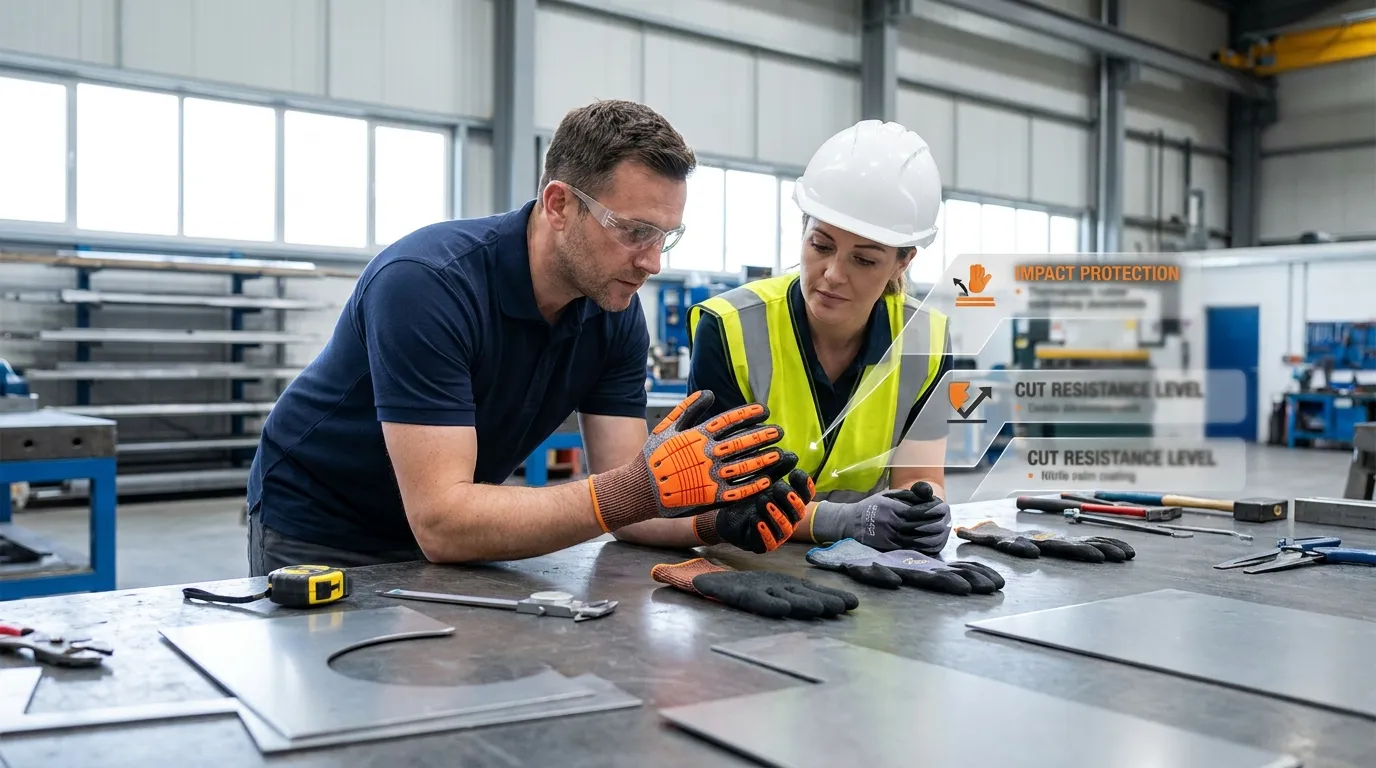
The strongest candidates are jobs where workers cannot switch gloves between hazards. A sheet metal crew may carry sharp panels, then bolt them inside a tight frame where knuckles hit brackets. An oilfield crew may handle pipe with burrs, then work around pinch points and heavy tools.
ISEA lists industries such as oil and gas, construction, mining, manufacturing, warehousing, and transport as impact-prone hand protection environments. That does not mean every worker in those industries needs one glove type. It means procurement should test hazards at the task level.
Which buyers are over-specifying dual-protection gloves?
Over-specification happens when buyers assign dual-protection gloves to workers who only face cut risk, only face light abrasion, or need high finger control. In those jobs, extra TPR can reduce comfort without adding meaningful protection.
A clean assembly line is a good example. Workers may need a thin cut-resistant liner for minor sharp edges, but raised back-of-hand impact guards can make small-part handling harder. If workers remove the glove for fine handling, the site has paid more and protected less.
Over-specification often shows up in these cases:
Workers handle sharp parts but have little back-of-hand impact exposure.
Workers face occasional bumps, but no real cut hazard.
The task needs fingertip feel, small-part control, or frequent tool handling.
A premium glove is issued to the whole department instead of the high-risk task group.
The glove rating looks strong, but replacement rate and worker complaints rise.
Ansell’s glove selection guidance points to practical factors such as dexterity, grip, and whether padding is needed. That fits the real buying decision. For cut-only roles, material choice matters more than impact padding, so compare HPPE vs Kevlar before moving to a bulkier dual-protection SKU.
How are combined cut and impact gloves built?
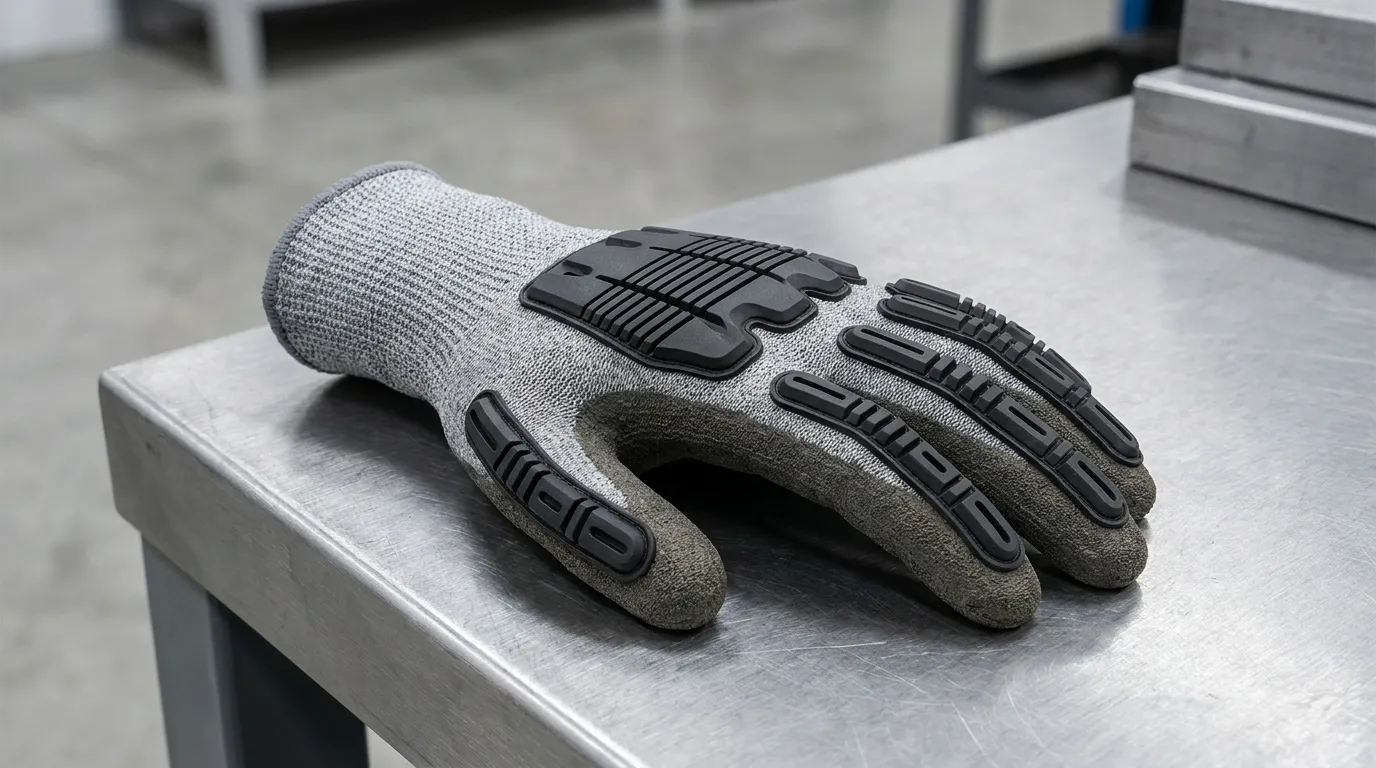
Combined gloves usually combine a cut-resistant liner with back-of-hand impact guards. The cut layer handles sharp-edge risk, and the raised impact layer helps reduce force from bumps, crush points, and tool strikes.
NMSafety’s own product specifications show this stack in practice: a knitted liner using nylon, HPPE, and steel fiber, plus sandy nitrile palm coating, sewn TPR on the back, anti-vibration palm padding, thumb-index reinforcement, and a Velcro cuff. That is the kind of construction procurement should read closely before approving a SKU.
What does the HPPE shell do?
HPPE stands for high-performance polyethylene. It is a common cut-resistant yarn used in gloves that need strength without extreme weight. Cut-resistant liners may also use aramid, Kevlar, Dyneema, glass fiber, basalt, stainless steel, graphene, or blended yarns, depending on the target cut level and comfort needs.
The shell is not the only factor. Gauge, coating, reinforcement, and yarn blend all affect feel and wear life. If the spec sheet lists several cut-resistant yarns, procurement should ask what each material adds to the glove.
What does the TPR overlay do?
TPR means thermoplastic rubber. It is commonly used on the back of impact gloves because it can absorb and spread force before it reaches the hand. Superior Glove explains that impact materials work by slowing and reducing the force transferred to the hand.
Glove layer
Main job
Buyer check
HPPE or composite liner
Cut resistance
Match cut level to task risk
Steel or glass reinforcement
Higher cut performance
Check stiffness and comfort
TPR back overlay
Impact protection
Check finger bend and coverage
Sandy nitrile coating
Grip and abrasion support
Match to dry, wet, or oily work
Thumb saddle
Wear resistance
Useful in high-friction handling
Cuff style
Fit and retention
Match to safety and comfort needs
What dexterity tradeoff should procurement expect?
Combined gloves usually trade some dexterity for broader protection. The goal is not the thickest glove, but the lightest glove that covers the task’s cut level, back-of-hand impact risk, grip need, and expected wear life.
Dexterity loss usually comes from a mix of TPR coverage, coating thickness, liner weight, palm padding, and cuff design. A glove can have the right ratings and still fail if workers cannot bend their fingers, grip tools, or handle parts at normal speed.
Droppe notes that ergonomic design and flexibility help impact gloves maintain dexterity. Ansell also points out that thinner gloves may be better when workers handle small components. For procurement, that means the trial should measure comfort and task speed, not only protection labels.
Feature
Protection benefit
Possible tradeoff
Buying note
Full TPR back
More back-of-hand coverage
Less finger flexibility
Best for high impact exposure
Segmented TPR
Better bending
May leave small gaps
Good for mixed handling tasks
Thick palm coating
Grip and abrasion resistance
Less tactile feel
Match to surface conditions
Higher cut liner
More cut resistance
Can feel stiffer
Avoid over-rating light tasks
Palm padding
Vibration or shock support
More bulk
Use only where needed
The safest buying process is not choosing the highest rating. It is choosing the lightest acceptable glove that matches the real hazard, lasts long enough, and does not slow the task.
How do ANSI cut and impact ratings affect the spec?
ANSI ratings help buyers verify that the glove protects against the hazard they are buying for. For combined gloves, check both the cut rating and the impact rating. A glove name can sound protective, but the ratings tell you what was tested.
ANSI/ISEA 105-2024 covers classification for cut, puncture, and abrasion protection. ANSI/ISEA 138-2019 covers back-of-hand impact protection, including testing, classification, and labeling. ANSI explains that impact gloves are rated from level 1 to level 3, with level 3 offering the highest impact protection.
Use this quick rating check before approving a combined glove:
Does the glove list an ANSI cut level?
Does the glove list an ANSI impact level?
Is the cut level matched to the actual sharp-edge task?
Is the impact level needed for the back-of-hand hazard?
Does the glove still allow the worker to grip, bend, and finish the job safely?
If impact standards are new to your team, send technical buyers to the dedicated guide on ANSI impact ratings. Keep this article focused on the buying choice: one combined SKU or separate gloves by task.
Is one combined glove cheaper than two separate SKUs?
One combined glove is cheaper only when it replaces two frequently used SKUs without lowering worker acceptance or wear life. If most workers need only cut protection, a premium dual-protection rollout can increase total cost.
A premium dual-protection glove can reduce SKU count, but it can also hide a poor spec. If workers remove it for fine handling, the cheaper glove is not the cut-only option. The cheaper glove is the one workers actually keep on.
Use price-per-wear instead of unit price alone. The formula is simple:
Price-per-wear = glove unit cost ÷ average wear days
SKU option
Example unit cost
Example wear life
Price-per-wear
Best-fit task
Cut-only glove
$4
5 days
$0.80 per day
Sharp-edge work with low impact risk
Impact-only glove
$6
10 days
$0.60 per day
Blunt force or pinch risk with low cut risk
Combined cut + impact glove
$8
12 days
$0.67 per day
Same task has both cut and impact exposure
In this example, the combined glove can beat a cut-only glove on daily cost if it lasts longer. It may also reduce inventory friction if it replaces two SKUs for the same crew. But it loses if issued to clean assembly workers who only need a light cut glove.
Procurement should run this with real site data. Use actual unit price, replacement rate, worker count, and task group. Do not approve a combined glove only because it looks like a simpler catalog choice.
How should procurement test before consolidating SKUs?
Run a 2 to 4 week pilot by task group before consolidating SKUs. Track wear life, replacement rate, worker feedback, grip performance, and whether the glove actually covers both hazards in daily work.
A short pilot protects the budget and the workers. OSHA’s hand protection rule points buyers back to task conditions and hazard exposure, so test the glove in the same environment where it will be used. Do not judge it from a desk sample alone.
Use this pilot checklist:
Select one mixed-risk task group first.
Record the current cut-only and impact-only SKUs used by that group.
Measure average replacement rate before the pilot.
Test grip, bending, heat comfort, and tool handling.
Ask workers when they remove the glove and why.
Compare wear life against the current SKU.
Keep separate SKUs where hazards do not overlap.
A sheet metal maintenance crew may be a strong first pilot group because sharp panels and knuckle impact can happen in the same task. A warehouse carton team may not need the same glove. If your pilot shows the risk is mostly impact, go back to the impact glove guide before adding cut resistance.
Getting the Next Step Right
Cut and impact resistant gloves are a smart choice when the same task creates both sharp-edge and back-of-hand impact risk. They are a poor fit when procurement uses them as a blanket upgrade. Start with the worksite test, then check the construction stack, ANSI ratings, dexterity tradeoff, and price-per-wear.
For the next purchase round, choose one high-risk task group and run a short pilot. If the combined glove improves protection, lasts longer, and workers keep it on, SKU consolidation can make sense. If not, keep the glove spec more focused.
Frequently Asked Questions
Can impact-resistant gloves protect against cuts and punctures?
Some impact-resistant gloves can protect against cuts, but only if they include a rated cut-resistant liner. Impact padding alone does not equal cut protection, so buyers should check both the cut rating and the impact rating before approving a combined glove.
Do impact-resistant gloves affect dexterity?
Yes, impact-resistant gloves can reduce dexterity when TPR coverage, palm padding, or thick coatings limit finger movement. The best choice is the lightest combined glove that still matches the site’s cut, impact, grip, and wear requirements.
What is the difference between impact gloves and cut-resistant gloves?
Cut-resistant gloves protect mainly against sharp edges, blades, glass, and sheet metal. Impact gloves protect mainly against blunt force, crush, pinch, and back-of-hand strike hazards.
Is there a glove that can provide both cut protection and impact resistance?
Yes, combined gloves use a cut-resistant liner plus back-of-hand impact protection, usually TPR. They are best for tasks where sharp material handling and impact or pinch exposure happen together.
What does level 5 cut resistant mean?
In the ANSI cut scale, A5 means the glove material requires 2,200 to 2,999 grams of force to cut during testing. It is generally used for medium to heavy cut hazards, not light-duty work.
What are cut-resistant gloves made of?
Cut-resistant gloves can use HPPE, aramid, Kevlar, Dyneema, glass fiber, basalt, stainless steel, graphene, or blended yarns. The right material depends on cut level, comfort, heat exposure, grip, and dexterity needs.