Home > Uncategorized > Cut-Resistant Winter Gloves: ANSI A4+ in Cold
Cut-Resistant Winter Gloves: ANSI A4+ in Cold
04 May, 2026
By arafatshuvo509
Cut resistant winter gloves should be chosen by construction path, not cut level alone. A thermal-lined HPPE shell usually gives better dexterity and simpler issuing, and a cut-resistant insert inside a winter shell can improve warmth, hygiene rotation, or replaceability. For ANSI A4+ cold work, compare cut level, insulation, coating, fit, washability, and the exact task.
Cold work changes how cut protection performs on the floor. A glove that looks strong on paper can fail in daily use if it’s too stiff, too wet inside, or too bulky for tools and small parts. For safety leads in sheet metal, freezer processing, cold warehouses, and outdoor handling, the best choice starts with the task, then the glove structure.
Do you need cut-resistant winter gloves, or just warmer cut gloves?
Cut-resistant winter gloves make sense when the job combines sharp-edge contact with cold exposure. If workers handle sheet metal, glass, blades, frozen packaging, or meat in low temperatures, select for cut rating, insulation, grip, and fit together.
A warmer glove is not enough if the worker touches sharp edges. A cut glove is not enough if cold hands lead to poor grip or glove removal. OSHA’s hand protection rule says employers must select hand protection based on the task, conditions, duration, and hazards involved, which fits this exact decision point.
Use cut-resistant winter gloves when the work includes both cold exposure and laceration risk. OSHA’s cold-stress guidance also points to insulated gloves and water-resistant protection where conditions require it.
Is there contact with sheet metal, blades, glass, banding, frozen packaging, or sharp tools?
Are workers exposed to cold rooms, freezers, wet docks, rain, snow, or outdoor wind?
Do workers remove current gloves for better feel?
Do gloves stay wet, cold, or hard to dry after use?
If most answers are yes, start with a dual-hazard glove instead of adding a liner to a standard cut glove. For broader warmth-only selection, use NM Safety’s guide to winter glove selection.
What does ANSI A4+ actually mean for cold-side cut protection?
ANSI A4+ means the glove should start at ANSI A4 and move higher when the edge, force, or exposure frequency increases. A4 can fit medium cut risk, and A5 or A6 is safer for heavier metal, glass, or blade-heavy work.
ANSI/ISEA cut levels run from A1 to A9. The ANSI Blog describes A4 to A6 as medium cut protection and A7 to A9 as heavy cut protection under the ANSI/ISEA 105 system. For cold work, the right level depends on edge sharpness, hand force, task speed, and how often the worker contacts the hazard.
Cut level range
Simple meaning
Cold-work use case
ANSI A4
Medium cut protection
Moderate sheet edges, cartons, light metal handling
ANSI A5
Medium cut protection with more margin
Repeated metal handling, frozen packaging, general knife exposure
ANSI A6
Higher cut protection
Heavier sharp edges, more force, more repeated blade risk
Do not treat cut and puncture as the same hazard. A glove can resist slicing but still perform differently against nails, wire ends, or needles. If the job has sharp-point hazards, review puncture rating basics before finalizing the glove.
Also avoid mixing up labels. ANSI/ISEA 105 and EN388 are different marking systems, even when both appear on the same glove. For the full cut-level background, send readers to NM Safety’s cut-resistant glove guide instead of repeating a full pillar inside this article.
Which design path is better: thermal-lined HPPE shell or cut-mesh insert?
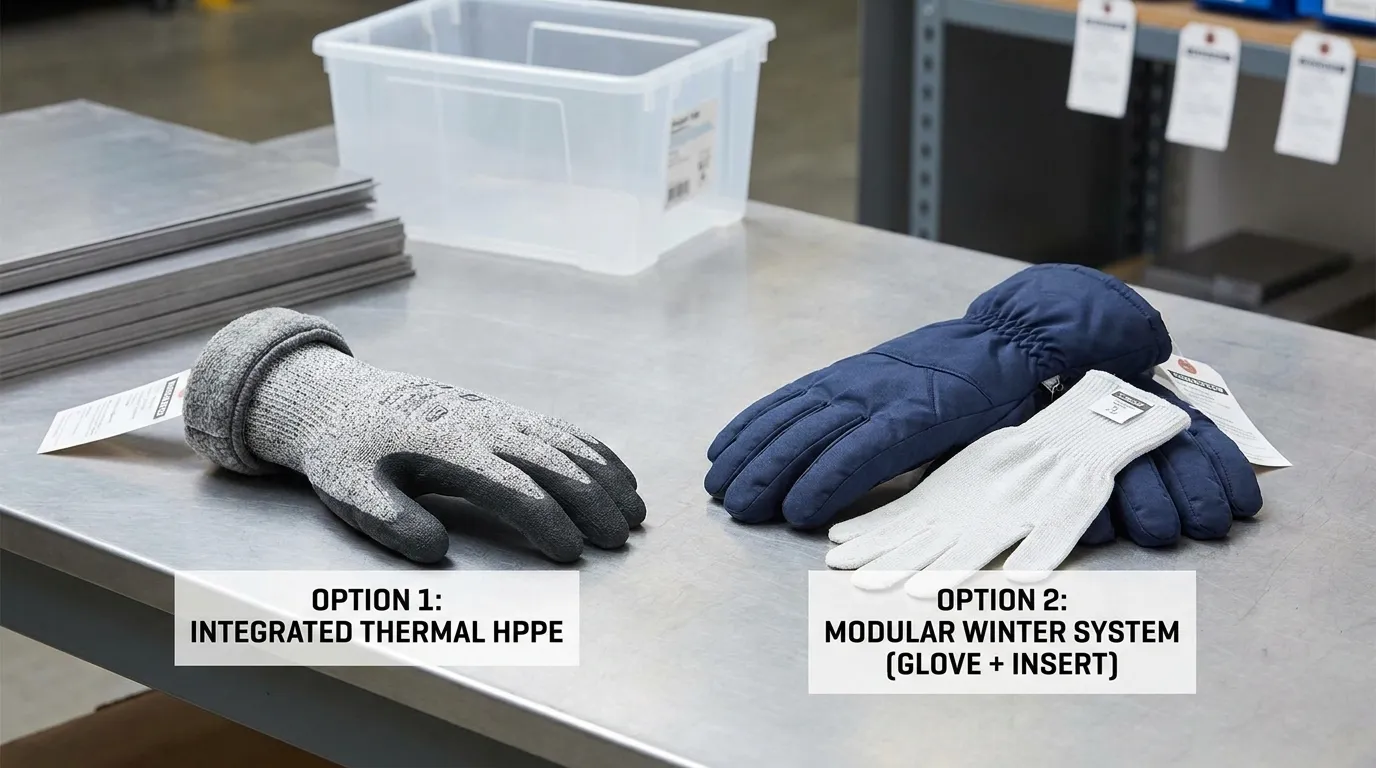
Choose a thermal-lined HPPE shell when dexterity, consistent fit, and simpler issuing matter most. Choose a cut-resistant insert inside a winter shell when warmth, replaceable layers, or separate hygiene control matters more than the thinnest hand feel.
This is the main buying choice. Both paths can work, but they solve different problems. A thermal-lined HPPE shell builds cut resistance and warmth into one glove. A cut-resistant insert adds a protective layer inside a winter shell, which can help when teams need more warmth or separate replacement.
Thermal-lined HPPE shell
HPPE means high-performance polyethylene, a common cut-resistant fiber. In a winter glove, HPPE can be blended with other yarns and paired with a thermal liner such as acrylic terry or fleece. This design keeps the glove as one unit, so issuing, sizing, and worker compliance are usually easier.
The tradeoff is care and drying. Since the shell, coating, and liner are joined together, the whole glove must be washed and dried as one item. If the liner holds moisture or dries slowly, comfort can drop across the shift.
Cut-resistant insert inside a winter shell
A cut-mesh or cut-resistant insert gives teams more layer control. It can support warmth, rotation, and replacement when the outer winter glove wears faster than the cut layer. This can help in cold-side processing where hygiene and glove rotation matter.
The risk is fit. If the insert shifts, bunches, or changes finger feel, workers lose control. That matters around blades, sheet edges, and fasteners.
Buyer factor
Thermal-lined HPPE shell
Cut-resistant insert in winter shell
Buyer note
Warmth
Good for moderate cold
Often better for deeper cold
Test in the real work area
Dexterity
Usually better
Can feel bulky
Watch small-part handling
Washability
One-piece care
Separate care may be possible
Confirm supplier instructions
Moisture control
Depends on liner and coating
Depends on both layers
Slow drying creates problems
Liner shift risk
Low
Higher
Fit testing matters
Replacement
Replace full glove
May replace one layer
Track actual wear
Worker compliance
Simple
More steps
Simpler often gets worn
Best fit
Metal, tools, mixed handling
Freezer, hygiene rotation, deep cold
Match the task first
Which option gives better warmth without ruining dexterity?
The warmest glove is not automatically the safest glove. If insulation makes workers lose grip, miss small parts, or remove gloves for precision tasks, a slightly thinner integrated cut shell can be safer than a bulky winter shell.
Warmth comes from liner thickness, fiber type, coating coverage, moisture control, and time in the cold. Dexterity comes from fit, gauge, finger shape, coating feel, and how much material sits between the hand and the object. These two needs often pull in opposite directions.
A higher cut level is not always the better choice. It works when sharpness and force justify it, but it can backfire if the glove becomes so bulky that workers remove it for detail tasks. Ansell’s cut-resistance guidance also points out that lighter cut-resistant gloves can help when workers need dexterity and glove retention.
If the task looks like this
Better starting point
Why
Fastening, tool use, small metal parts
Thermal-lined HPPE shell
Better finger control
Long freezer exposure with larger objects
Insert inside winter shell
More warmth margin
Wet outdoor work with sharp edges
Thermal shell with strong grip coating
Less layer shift
Blade handling in cold processing
Fit-tested insert or integrated shell
Control matters near knives
Workers keep removing gloves
Thinner, better-fitting option
Worn protection beats ignored protection
Fit must be checked with real motions. Ask workers to pick up fasteners, grip tools, handle packaging, and complete their normal task. A glove that passes the spec sheet but fails hand movement is the wrong glove.
Which coating works best in cold, wet, oily, or freezer handling?
The best coating depends on the surface: wet metal, oily parts, dry frozen packaging, or clean processing work. For many cold cut applications, sandy nitrile or foam nitrile is a strong starting point because it can support grip without making the glove too stiff.
Latex can grip well in dry or wet handling, but it may not suit oily work or allergy-sensitive teams. PU coating gives good feel in many light-duty cut gloves, but it is usually not the first choice for wet winter handling. Full coating can block more liquid, but it can also reduce breathability.
Work condition
Coating direction
Watch-out
Wet sheet metal
Sandy nitrile or textured nitrile
Test grip when cold
Oily metal parts
Nitrile coating
Avoid coatings that slip in oil
Dry freezer cartons
Foam nitrile or textured palm
Check cracking and stiffness
Rain or snow handling
Full or 3/4 coating
Sweat buildup can chill hands
Detail assembly in cold
Thinner palm coating
Too much coating reduces feel
Waterproof is not automatically better than water-resistant. Full coating helps in wet cold work, but if sweat cannot escape, workers may still end up with cold hands. For broader coating choices, use NM Safety’s nitrile coating guide or its coated glove options.
A cold warehouse carton team may not need the heaviest coating. If workers mainly cut straps and handle cold boxes, ANSI A4 may be enough when edge severity is moderate. In that case, grip and moisture control may matter more than moving to the thickest glove.
Which path is easier to wash, dry, and replace?
For washability, inserts usually win when teams need separate cleaning, faster replacement, or hygiene rotation. Integrated thermal-lined gloves win when fewer loose parts and simpler worker compliance matter more than separate laundering.
Many cut-resistant gloves can be washed, but only according to the manufacturer’s care instructions. Thermal liners, coatings, and inserts may dry at different speeds. That matters because a glove that stays damp can feel colder, smell worse, and lose worker acceptance.
A cut-resistant insert is not a shortcut to safety. It works when the insert stays aligned and is controlled through washing and replacement, but an integrated shell is usually cleaner for issuing and compliance.
Ask for written wash and dry instructions.
Confirm whether heat drying is allowed.
Check if coating performance changes after washing.
Sample gloves after several wash cycles.
Track drying time between shifts.
Decide whether liners or inserts are issued by person or by station.
Set a replacement trigger for holes, coating wear, liner damage, or poor fit.
For freezer meat or cold-side food work, hygiene control may push teams toward a system with better rotation. Still, do not assume the glove is suitable for food contact unless the product documentation confirms it.
What should a sheet-metal crew choose for winter outdoor work?
For winter sheet-metal work, start with ANSI A4 or A5, then upgrade if edges are sharp, handling is repetitive, or force is high. A thermal-lined HPPE shell with durable nitrile grip often balances cut protection, wet grip, and tool control.
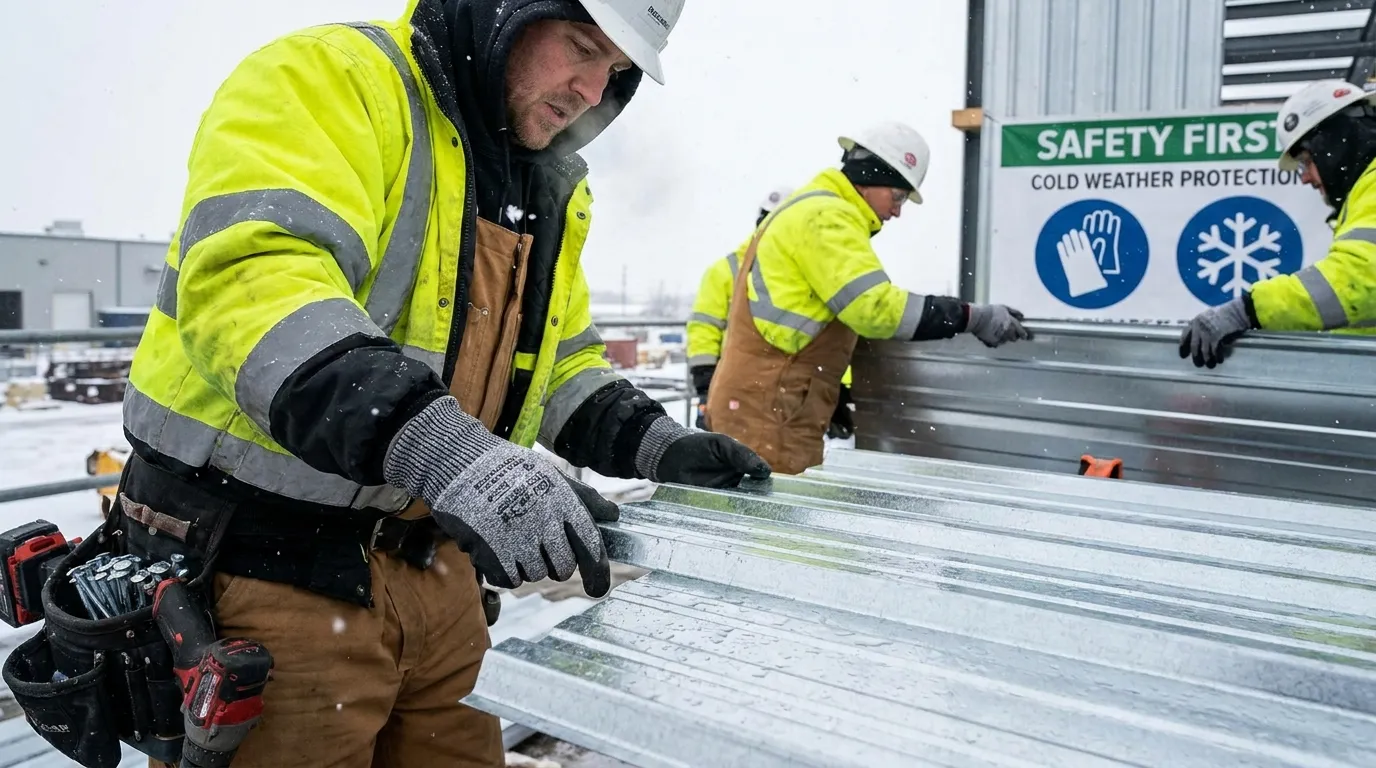
Picture an outdoor crew handling galvanized panels in January. They deal with burrs, cold tools, wet racks, fasteners, and wind. If they choose a glove only for warmth, sharp edges stay underprotected. If they choose a glove only for cut level, workers may lose the feel needed for fastening.
For this crew, an integrated thermal-lined HPPE shell is often the cleaner first sample. It keeps the cut layer in place, reduces layer shift, and gives workers a better chance of keeping gloves on during tool use. Use ANSI A4 for moderate cut exposure and test A5 or A6 when edges are sharper or force is higher.
Grip matters as much as the cut rating. A wet outdoor metal rack team may benefit from a full or 3/4 coated glove, but only if the glove does not trap too much sweat. If back-of-hand strikes are common, review NM Safety’s impact glove guide before final approval.
What should a freezer-meat-cutting team choose?
A freezer-meat-cutting team should start with cut level, hygiene, fit, and thermal comfort together. Around knives, the glove must support control first. If the glove feels clumsy, the worker may grip harder, move slower, or remove the glove during detail work.
For repeated knife exposure, A5 or higher may be a better sampling point than A4, depending on blade contact and task force. The team should also decide whether a one-piece thermal cut glove or an insert system is easier to clean, issue, and replace across shifts.
Can workers hold knives with normal grip pressure?
Does the glove keep finger control after 30 to 60 minutes in the freezer?
Can the glove or insert be washed and dried between shifts?
Does the liner stay in place during repeated hand movement?
Is food-contact suitability documented where needed?
For teams handling frozen product plus sharp packaging, a cut-resistant insert may help hygiene rotation. For tight trimming tasks, a better-fitting integrated shell may be safer because it gives more predictable hand control.
What specs should go into your RFQ or supplier checklist?
A supplier RFQ should describe the real hazard, not just the glove name. Ask for cut level, winter lining, coating, standards, sizing, wash guidance, and sample testing details in one clear request.
The OSHA rule on hand protection covers hazards such as cuts, lacerations, punctures, severe abrasions, thermal burns, and harmful temperature extremes. ISEA also links hand protection selection to the OSHA hand protection standard and explains ANSI cut-level groupings. That means your RFQ should describe each hazard separately.
Required ANSI cut level: A4, A5, A6, or higher.
EN388 and EN511 markings, if required by your market.
Liner type: acrylic terry, fleece, thermal yarn, or insert.
The right cut resistant winter gloves come from task testing, not from the highest cut level alone. Start with the two-path choice: integrated thermal-lined HPPE shell or cut-resistant insert inside a winter shell. Then test grip, warmth, dexterity, washability, and worker acceptance in the real job.
For most safety leads, the best next step is simple. Shortlist two or three glove builds, issue samples to the highest-risk tasks, and record what fails first: cold, grip, cut risk, fit, drying time, or worker compliance.
Frequently Asked Questions
What are cut resistant gloves made of?
Cut-resistant gloves are commonly made with high-performance fibers such as HPPE, aramid, glass fiber, steel fiber, or engineered composite yarns. Winter versions add acrylic, terry, fleece, or other thermal layers for warmth.
What are the levels of cut resistant gloves?
ANSI/ISEA cut levels run from A1 to A9, with A4 to A6 generally treated as medium cut protection and A7 to A9 as heavy protection. For winter metal or blade work, start at A4 and increase based on edge sharpness and force.
Can you wash cut resistant gloves?
Many cut-resistant gloves can be washed, but only according to the manufacturer’s care instructions. Thermal liners, coatings, and inserts may dry at different speeds, so confirm washing method, drying limits, and replacement rules before bulk ordering.
Are the ANSI/ISEA 105 and EN 388 cut standards the same?
No, ANSI/ISEA 105 and EN388 are not the same label system, even when related test methods are used. Buyers should read the actual ANSI A-level and EN388 markings instead of assuming old Level 5, EN388 E, and ANSI A5 are identical.
Does insulated lining affect flexibility?
Yes, insulation can reduce flexibility when it adds bulk or shifts inside the glove. The best choice is not always the thickest glove, because workers still need grip, fingertip control, and confidence to keep gloves on during the task.
How warm are cut resistant winter gloves?
Warmth depends on liner material, glove construction, moisture control, coating coverage, and exposure time. Do not rely on temperature claims alone. Sample gloves in the actual freezer, yard, loading dock, or metal-handling task before standardizing.