Home > BLOG > Industry Blog > Anti Static Gloves Wholesale in China: A Sourcing Guide for Electronics Manufacturers
Anti Static Gloves Wholesale in China: A Sourcing Guide for Electronics Manufacturers
14 Sep, 2026
By hqt
Buying Anti Static Gloves Wholesale in China requires a specification that connects electrical performance with real assembly conditions. A glove may provide acceptable resistance during testing yet perform poorly when operators handle small connectors, work in dry conditions, or wear through the coating.
At NMSafety, we offer different knitted liners and coating configurations because electronics workstations have different requirements. Our sourcing approach centers on three decisions: selecting the right construction, verifying performance under relevant conditions, and maintaining the approved specification through bulk production.
Establish Workstation Requirements Before Comparing Prices
For electronics manufacturers sourcing Anti Static Gloves Wholesale in China, the first document should be a workstation requirement sheet.
Component Sensitivity and Personnel Grounding
Determine what components are exposed to ESD-sensitivity and what ESD controls the factory employs. Review the sensitivity of the components along with how they are handled and the personnel grounding system.
Gloves are an integral part of the system. According to the ESD Association, when testing gloves along with personnel, gloves as a system cannot be evaluated by a single yarn resistance figure.
Handling, Contamination and Operator Fit
Record:
• Surface Contact: Fingertips vs Full Palm. Surface condition: Dry vs. Contaminated
• Cleanliness Requirements: Acceptable Levels of Particle Shedding and Surface Residues.
• Operating Conditions: Humidity, Wearing Time and Frequency of Cleaning.
• Fit Requirements: Length of Finger, Slack in Tip, Effort of Fingertip Grip.
These gloves do not meet the requirements for cleanroom use, nor do they offer electrical insulation for work that involves exposure to energized circuits.
Compare Construction by Task and Trade-Off
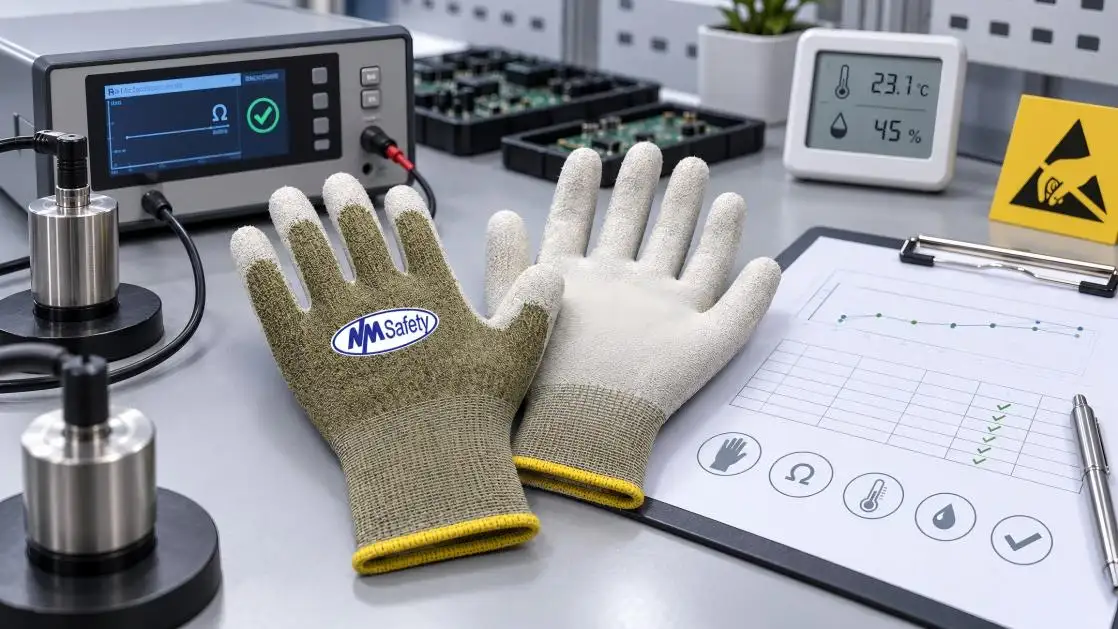
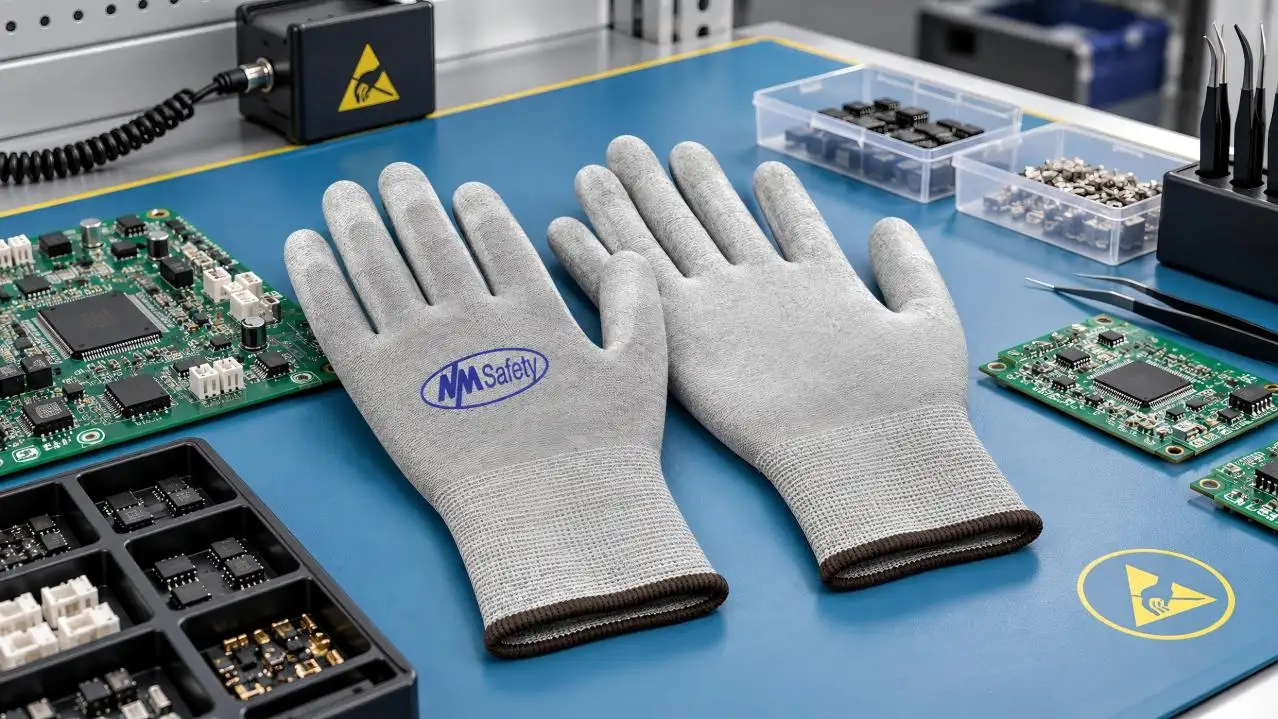
Our anti-static range includes uncoated knitted, PU fingertip-coated, PU palm-coated, and cut-resistant ESD gloves with PU or nitrile coatings. These constructions offer different starting points for evaluation. NMSafety product range
Mechanical protection versus thickness and tactile control
Separate cut-performance and ESD evidence
When comparing PU and nitrile, assess the finished product. Formulation, coating thickness, texture, and coverage influence performance; the coating name alone cannot establish suitability.
Likewise, additional coating coverage does not automatically improve ESD control. The relevant question is whether the glove performs correctly at its actual contact points.
Read Test Reports Beyond the Resistance Number
Technical verification is essential when comparing Anti Static Gloves Wholesale in China.
Confirm What Was Measured
Distinguish between:
• Surface resistance: Measured between electrodes on a surface.
• Through-thickness resistance: Measured across the material thickness.
• Personnel–glove system resistance: Includes interfaces relevant to the selected test arrangement.
These measurements answer different questions and should not be treated as interchangeable.
Check Conditions and Product Identity
Request the test method, electrode configuration, applied voltage, conditioning time, temperature, and relative humidity. Compare suppliers using equivalent procedures and conditions.
Also confirm that the report matches the proposed liner, coating, and product version. A report for another construction provides limited evidence for the order under review.
Acceptance limits should follow the buyer's ESD control plan. Lower resistance alone is not a complete selection criterion.
For reusable gloves, agree on cleaning instructions and performance checks after representative washing and wear. Validate touchscreen operation and contamination requirements separately.
Translate Sample Approval into Production Controls
NMSafety operates manufacturing facilities in Jiangxi, Nantong, and Shandong. Our OEM services cover design, manufacturing, and delivery. These capabilities provide a basis for discussing product configuration and order planning.
Rationale for sampling:
• Materials: Liner composition, and arrangement of the conductive yarn.
• Construction: Type of coating and degree of coverage by the coating.
• Dimensions: Size within tolerance and fit at fingertips.
• Traceability: bBatches identified, inspection records documented.
• Change control: Notification prior to changes in materials or construction.
Retain an approved sample alongside the written specification. Define visual and dimensional acceptance separately from electrical-performance checks.
Plan MOQ, Customization, and Usage Cost
Our PU fingertip-coated product provides a practical purchasing reference:
Specification
Procurement Implication
13-gauge nylon-and-carbon liner; PU fingertips
Trial for fit, contact control, and workstation suitability
Sizes 6/XS–12/3XL
Establish an operator-based size distribution
MOQ: 6,000/12,000 pairs
Confirm allocation across colors and sizes
Lead time: 60–120 days
Confirm the starting milestone and allow for transport
Logo, color, and packaging customization
Approve details before production
These are product-specific published details, subject to order confirmation. Product specifications
When considering cost versus usable shift, review the price of the pair. This analysis includes the cost of replacement, cleaning, verification, freight, and inventory. Evaluate performance when customization alters the materials or the functional contact area.
Sampling Before Mass Production
Test samples on representative users of the intended task. Evaluate small part pickup, grip, fingertip slack, shedding, and comfort as well as any required touchscreen and ESD use. Establish factory ESD use criteria and document the recommendations for replacement and orders.
For Wholesale Anti Static Gloves in China, this integrates product design with repeatable buying decisions. Check out the line of NMSafety anti static gloves. Let us know your workstation and needs, and we can suggest designs that would be most appropriate for your situation and offer sampling.
FAQs
Q1. What Types of Anti-Static Gloves Does NMSafety Offer?
NMSafety offers uncoated knitted anti-static gloves, PU fingertip-coated gloves, PU palm-coated gloves, and cut-resistant ESD designs with PU or nitrile coatings. Selection depends on handling tasks, mechanical hazards, and workstation ESD requirements.
Q2. How Can I Choose NMSafety Gloves for Electronics Assembly?
Start with component sensitivity, contact surfaces, contamination requirements, and operator fit. Fingertip-coated designs are candidates for small-part handling, while palm-coated designs provide a larger coated contact area. Validate the selected construction through workstation trials.
Q3. What Materials Are Used in NMSafety's PU Fingertip-Coated Anti-Static Gloves?
The construction combines a 13-gauge nylon-and-carbon knitted liner with PU-coated fingertips. The conductive-fiber construction supports static control, while the fingertip coating provides localized grip. Confirm electrical suitability within your facility's ESD program.
Q4. What Sizes Are Available for NMSafety Anti-Static Gloves?
NMSafety's PU fingertip-coated product lists sizes 6/XS, 7/S, 8/M, 9/L, 10/XL, 11/2XL, and 12/3XL. Availability may differ by product. Trial representative sizes to check finger length, fingertip slack, and comfort before ordering.
Q5. What Is NMSafety's MOQ for Anti-Static Gloves?
The MOQ for NMSafety's PU fingertip-coated anti-static product is 12,000 pairs. Confirm whether this applies per design or color and whether mixed sizes are permitted. Other constructions may have different ordering requirements.