Home > Uncategorized > PVC vs Nitrile for Chemical-Resistant Work Gloves
PVC vs Nitrile for Chemical-Resistant Work Gloves
10 May, 2026
By arafatshuvo509
PVC chemical resistant gloves are usually the better starting point for acids, bases, salts, water-based chemicals, and some mild caustic splash tasks. Nitrile is often better for oil, grease, and many shop-floor handling jobs that need grip and dexterity. For acetone, MEK, and unknown mixtures, do not choose by material name alone. Use the exact glove’s breakthrough, degradation, and EN ISO 374 data.
Choosing between PVC and nitrile sounds simple until real plant chemicals enter the picture. A glove that works around motor oil may fail too quickly around a solvent wipe station. A glove that covers caustic splash may feel too stiff for fittings, valves, or small containers. The right choice starts with the chemical, the contact time, and the task, then moves into glove construction.
Is PVC or nitrile better for chemical-resistant work gloves?
PVC chemical resistant gloves are better when exposure is mainly acids, bases, salts, water solutions, and some mild caustics. Nitrile is usually stronger for oil, grease, and many hydrocarbon tasks, but the final choice depends on tested breakthrough data.
PVC is not an upgrade over nitrile. It is a different risk tradeoff. PVC can make more sense for chemical splash and longer cuff coverage, especially when the work involves acids, bases, salts, or water-based cleaners.
Nitrile often makes more sense when workers handle oily parts, greasy tools, light abrasion, or maintenance tasks that need better finger feel. The mistake is treating either material as a universal chemical glove. OSHA hand protection rules focus on the task, conditions, duration, hazards, and glove performance.
Use this as the first screen:
Start with PVC for acids, bases, salts, water solutions, and mild caustic splash.
Start with nitrile for oil, grease, many maintenance tasks, and better dexterity.
Pause the decision for acetone, MEK, unknown mixtures, or long contact time.
What does each material resist best?
PVC and nitrile resist different chemical families, so the material name should only start the selection. The safer path is to match the glove to the chemical, concentration, contact time, and real task.
A Lab Manager chemical glove guide positions PVC for acids, bases, salts, and water solutions. It positions nitrile for many non-halogenated organic solvents, oils, and related shop tasks. That does not mean every PVC or nitrile glove performs the same.
Chemical or task family
PVC starting point
Nitrile starting point
Buyer note
Acids
Often a good starting point
Check exact chart
Confirm concentration and cuff need
Bases and mild caustics
Often a good starting point
Check exact chart
Look for splash and degradation data
Salts and water solutions
Often suitable
Sometimes suitable
Match glove thickness to contact time
Motor oil and grease
Possible, but grip may vary
Often a strong starting point
Check texture and abrasion needs
Acetone
Do not assume
Do not assume
Require exact breakthrough data
MEK
Do not assume
Do not assume
Consider specialty materials if data is weak
Why material name alone is not enough
Two gloves can both say “PVC” and perform differently because of thickness, liner, coating formula, cuff length, and test method. The same is true for nitrile. A thin disposable nitrile glove is not the same product as a supported nitrile-coated work glove.
For plant approval, ask for the exact glove’s chemical chart. Look for breakthrough time, degradation behavior, and the tested chemical name. A broad label like “chemical resistant” is not enough for acetone, MEK, or mixed cleaning chemicals.
How should you read the permeation chart for acetone, MEK, motor oil, and mild caustics?
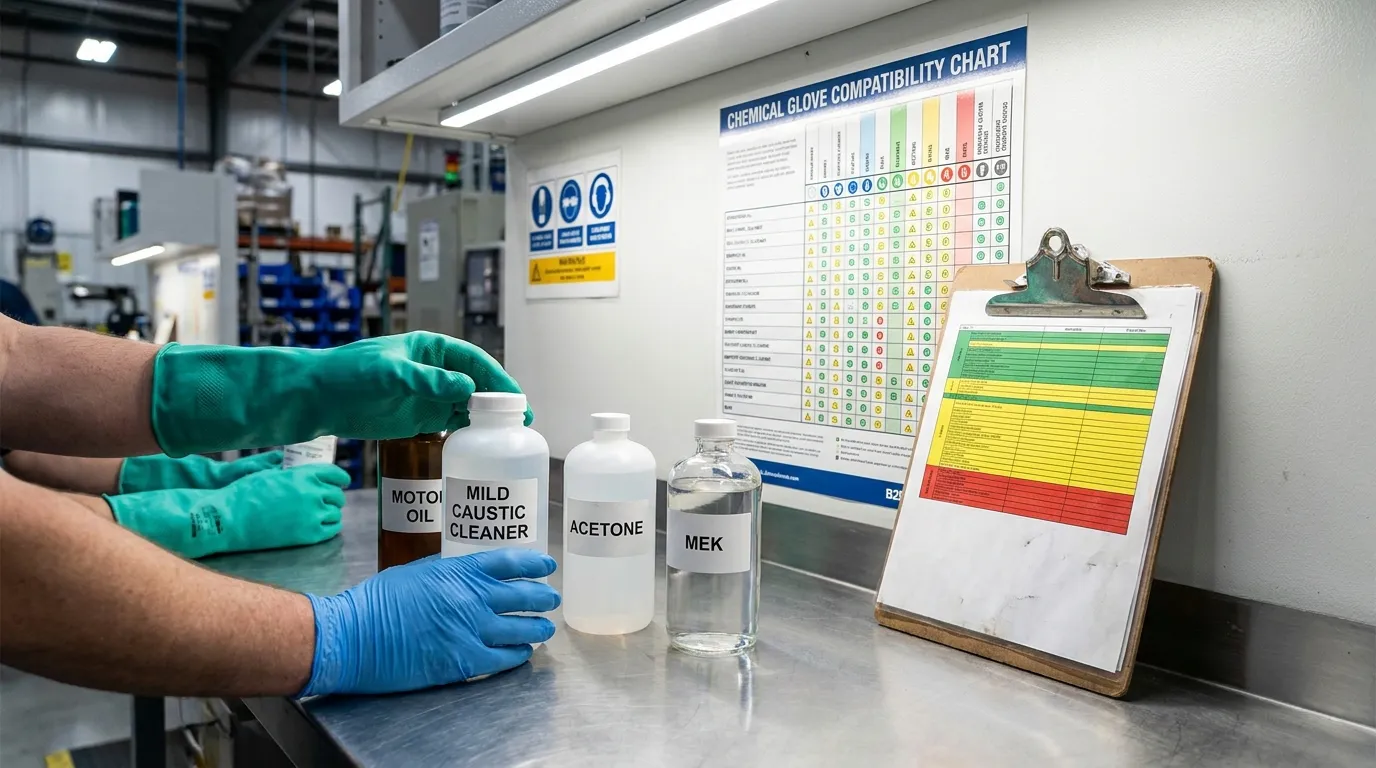
For acetone and MEK, treat generic PVC and nitrile as unproven until the exact glove has breakthrough data. For motor oil and mild caustics, the comparison is more useful: nitrile often suits oils, while PVC often suits acids, bases, and salts.
Permeation means a chemical passes through the glove material at a molecular level. Degradation means the glove material changes, such as swelling, cracking, hardening, softening, or getting sticky. Both matter because a glove can look fine at first and still become unsafe during use.
Shop-floor chemical or task
PVC glove screen
Nitrile glove screen
Red flag
Required proof before approval
Acetone wipe-down
Do not approve by material name
Do not approve by material name
Fast solvent action
Exact breakthrough and degradation data
MEK adhesive cleanup
Do not approve by material name
Do not approve by material name
Aggressive ketone exposure
Manufacturer chart or specialty glove review
Motor oil handling
Possible, but check grip
Often a strong starting point
Slips and abrasion
Oil grip test and wear check
Mild caustic cleaner transfer
Often a good starting point
Check exact chart
Splash to wrist or sleeve gap
Caustic data, cuff length, field trial
Acid wash splash
Often a good starting point
Check exact chart
Wrong concentration
Tested acid, concentration, and contact time
Salt or water solution
Often suitable
Sometimes suitable
Long wet contact
Waterproofing, liner comfort, change-out rule
For motor oil tasks, nitrile often deserves the first sample test because grip and abrasion matter. If the team handles oily castings, fittings, or containers, the next question is usually oily parts handling.
For a mild caustic cleaner transfer, start with a tested PVC gauntlet or another chemical glove with verified caustic data. If the worker transfers liquid from a drum to a smaller container for 10 to 15 minutes, cuff length and splash coverage matter as much as palm grip.
Where does PVC beat nitrile, and where does nitrile win?
PVC wins when liquid splash protection and inorganic chemical resistance matter more than fingertip feel. Nitrile wins when grip, puncture resistance, and oily parts handling matter more than caustic splash coverage.
This is the practical decision point. PVC is often the better sample when the exposure is wet, splash-based, and tied to acids, bases, salts, or water-based chemicals. Nitrile is often the better sample when the task is oily, abrasive, or maintenance-heavy.
If the work looks like this
Better first sample
Why
Diluted caustic cleaner handling
PVC
Better starting point for bases and splash coverage
Acid or salt solution splash
PVC
Better fit for many inorganic chemicals
Oily metal parts and tools
Nitrile
Better grip and oil handling in many tasks
Fine maintenance work
Nitrile
Usually better dexterity
Mixed solvent cleanup
Neither by default
Needs exact chemical data
Unknown chemical exposure
Neither by default
SDS and supplier data must come first
For nitrile choices, coating texture matters. Foam and sandy finishes can feel very different in oil, water, and mixed shop tasks. If the buyer is leaning toward nitrile after chemical screening, compare nitrile grip finishes before placing a bulk order.
What dexterity penalty comes with PVC chemical gloves?
PVC chemical gloves can reduce fingertip feel when they use a thick coating, supported liner, or long gauntlet cuff. That tradeoff may be acceptable for splash handling, but it can slow workers down during small-part handling or adjustment work.
The penalty is not only thickness. A glove with a long cuff can protect the wrist better, but it can also feel bulky during valve work, fittings, container caps, or tool use. A cotton liner can improve comfort, yet it may also make the glove feel less precise.
Use this field checklist before approval:
Can the worker grip wet containers without slipping?
Can the worker open caps, clamps, valves, and fittings?
Does the cuff cover the splash zone?
Does the liner stay comfortable during the full task?
Does the glove cause workers to remove it for “quick” fine work?
If the work is wet but still needs more hand feel, review waterproof nitrile options after the chemical chart is checked. Dexterity is useful only when the glove still matches the chemical exposure.
How do EN ISO 374 Type A, B, and C labels work?
The EN ISO 374 mark tells you which listed chemicals a glove resisted in standardized testing and whether it reached Type A, B, or C performance. It does not automatically prove protection against every shop-floor solvent.
EN ISO 374 is useful because it gives buyers a shared language for chemical glove testing. The standard covers gloves that protect against dangerous chemicals and microorganisms, but the label still needs careful reading. The code letters matter because they point to tested chemicals, not every chemical in your plant.
Label item
What it tells you
What it does not tell you
Chemical pictogram
The glove was tested for chemical protection
It does not cover every chemical
Type A
Higher listed chemical performance group
It still applies only to tested chemicals
Type B
Mid-level listed chemical performance group
It may not fit your solvent
Type C
Lower listed chemical performance group
It needs closer task review
Code letters
Which standard chemicals were tested
It may not match your exact mixture
Breakthrough level
Time category under test conditions
It is not the same as every real task
Degradation result
Material change after exposure
It may not predict every use condition
The ISO 374-1 document sample defines requirements for gloves protecting against dangerous chemicals and microorganisms. EN 374 guidance from MAPA Professional also shows how Type A, Type B, and Type C relate to permeation performance across listed chemicals.
What the code letters do not tell you
The code letters do not prove that a glove is safe for acetone, MEK, a plant-specific cleaner, or a mixed solvent blend unless that exact chemical data is available. They are a filter, not the final buying decision.
Use EN ISO 374 to narrow the shortlist. Then check the SDS, concentration, splash duration, glove thickness, and manufacturer chart. For acetone and MEK, the honest answer may be neither generic PVC nor generic nitrile.
What glove spec should a chemical-plant safety lead write?
A good glove spec should name the chemical, concentration, contact type, contact time, and glove construction. Do not send purchasing a material name alone. “PVC glove” or “nitrile glove” leaves too much room for the wrong product.
OSHA’s PPE guidance says chemical protective glove selection should consider the chemicals encountered, chemical resistance, and the glove’s physical properties. The OSHA PPE booklet is a useful reminder that selection is a task decision, not a catalog shortcut.
Use this procurement checklist:
Chemical name from the SDS
Concentration or dilution
Splash, immersion, wipe, or handling contact
Expected contact time per task
Required breakthrough and degradation data
Cuff length and wrist coverage
Supported or unsupported construction
Grip texture for wet or oily work
Thickness and dexterity requirement
Size range and worker fit
Change-out triggers
Sample approval before bulk order
If the same task includes sharp sheet metal, glass, or cut edges, chemical resistance is only part of the spec. Hand off cut-level selection to a broader cut-resistant glove selection guide instead of forcing this article to cover full cut protection.
When should you reject both PVC and nitrile?
Reject both PVC and nitrile when the SDS, concentration, or task duration points to aggressive ketones, aldehydes, esters, strong oxidizers, or unknown mixtures. In those cases, request manufacturer data or evaluate specialty materials such as butyl, laminate, or Viton.
This is where safety leads need to be firm. If the chemical is unknown, the concentration is unclear, or the task involves long contact time, the material shortcut has to stop. A glove that survives a splash may not survive repeated contact.
Use these red flags:
The SDS lists acetone, MEK, or another aggressive ketone.
The cleaner is a blend and the exact ingredients are unclear.
The glove chart does not list the chemical.
The chart lists poor degradation or very short breakthrough time.
Workers report swelling, stiffness, stickiness, cracking, or loss of grip.
The task involves repeated wet contact for long periods.
For an acetone wipe-down station, do not approve PVC or nitrile by material name. For MEK adhesive cleanup, require exact breakthrough data or move to a specialty glove review. If the data is missing, the glove is not ready for approval.
What should buyers test before approving a bulk order?
Buyers should test the exact glove in the real secondary-handling task before approving a bulk order. Chemical data narrows the choice, but field testing shows whether workers can grip, move, pour, clean, and remove the glove safely.
A sample test does not need to be complicated. Pick two or three glove options that pass the chemical screen, then ask workers to perform the actual task under supervision. Watch for grip, cuff coverage, sweat, donning, doffing, and hand fatigue.
Use this approval process:
Review the SDS and chemical chart.
Confirm breakthrough and degradation data.
Test container grip and tool control.
Check cuff coverage during splash movement.
Ask workers about heat, sweat, and dexterity.
Inspect the glove after contact.
Set a change-out rule.
Approve the smallest safe order before scaling.
For maintenance teams, some tasks may move toward mechanics nitrile gloves after the chemical risk is screened. That can make sense for oil, grease, and tool work, but only when the chemical exposure stays inside the glove’s tested range.
Getting the Next Step Right
PVC chemical resistant gloves can be the right choice for acids, bases, salts, water-based chemicals, and mild caustic splash tasks. Nitrile can be the better choice for oil, grease, grip, and maintenance work. The safest buyer decision comes from matching the glove to the SDS, contact time, EN ISO 374 label, and field test.
Before approving a bulk order, ask for the exact glove data and run a sample trial in the real task. If acetone, MEK, or unknown mixtures are involved, slow down and require proof before workers use the glove.
Frequently Asked Questions
Why is chemical resistance important for PVC gloves?
Chemical resistance matters because PVC gloves are often used where liquids can contact the hand during cleaning, handling, or transfer tasks. The glove must resist the specific chemical long enough for the real task, not just carry a general “chemical resistant” label.
What protective advantages do PVC gloves offer?
PVC gloves can offer useful protection against acids, bases, salts, water solutions, and liquid splash tasks when the exact glove is tested for the chemical. Supported PVC styles may also provide longer cuffs and better coverage than thin disposable gloves.
Can nitrile gloves offer better protection?
Yes, nitrile can be the better choice for oil, grease, abrasion, and many handling tasks where dexterity matters. It should not be treated as automatically better for every solvent, caustic, or mixed chemical exposure.
What’s a drawback of using PVC gloves for fine tasks?
PVC gloves can reduce fingertip feel when the glove is thick, supported, or built with a long protective cuff. That tradeoff may be acceptable for splash handling but frustrating for small parts, fittings, or delicate maintenance work.
How do I determine which glove material is best for my work?
Start with the SDS, chemical concentration, contact time, and task type, then check the exact glove’s breakthrough and degradation data. OSHA selection logic also requires matching hand protection to hazards, task conditions, and duration.
What should I do if my chemical gloves show signs of degradation?
Remove and replace the glove immediately if it swells, cracks, stiffens, softens, becomes sticky, or loses grip after chemical contact. Those signs mean the material may no longer block the chemical reliably.