Home > BLOG > Industry Blog > Needle Resistant Gloves OEM in China: Level 5 Protection Without Sacrificing Dexterity
Needle Resistant Gloves OEM in China: Level 5 Protection Without Sacrificing Dexterity
25 May, 2026
By hqt
For procurement managers, one question repeatedly emerges: “how can a glove that stops hypodermic needles also allow workers to feel what they are handling?” The answer lies in pairing the right materials with precision engineering. When sourcing Needle Resistant Gloves OEM in China, the trade-off between protection and flexibility has long frustrated safety directors across waste management, law enforcement, glass handling, and recycling operations. Yet recent advances in 18-gauge knitting technology and composite fiber construction have quietly eliminated that compromise.
Needlestick and sharps injuries remain among the most frequent occupational hazards worldwide. Research estimates that approximately three million needlestick injuries occur each year across a global healthcare workforce of 35 million, exposing individuals to serious bloodborne infections. Nearly half of all surgeons receive at least one needlestick injury during their careers, yet it becomes even more obvious the vast majority of them go unreported. Outside of the healthcare sector, workers in recycling, waste collection, sanitation, law enforcement, and industrial cleaning also work at similar risks daily from disposably found syringes, broken glass, and sharp metal.
Some American Standards: F2878 vs. ASTM Blunt Puncture Testing
•A defining element: EN388 testing, the ASTM Standard, uses a blunt 4 mm probe, which measures the resistance to force against screws and nails, and does not classify the protection given against hypodermic needles.
•The needlestick-specific standard: ASTM F2878 drives a 25-gauge hypodermic needle into the material at a 90° angle at 500mm/min, measuring the force required for penetration. This standard produces a 1-to-5 rating scale under ANSI/ISEA 105, with Level 5 requiring a minimum of 10 Newtons of resistance.
Why this matters: A glove may score well on EN388 puncture but fail catastrophically against a fine-gauge needle. For buyers purchasing Needle Resistant Gloves OEM in China, verifying ASTM F2878 certification is the only reliable safeguard.
18 Gauge Construction: Where High Protection Meets High Sensitivity
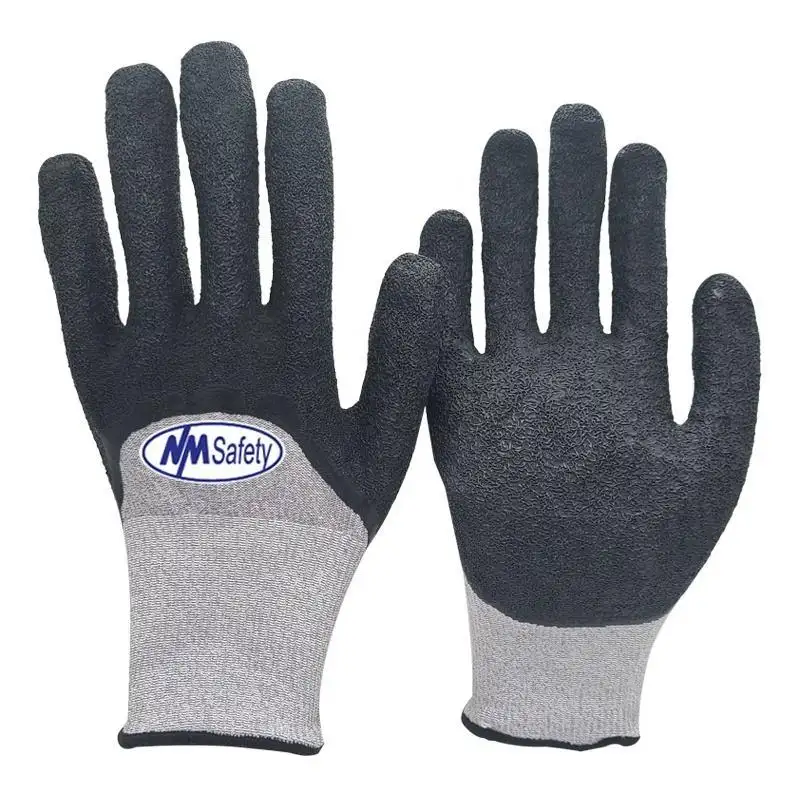
Historically, needle-resistant liners relied on thick, bulky materials that restricted finger articulation and caused hand fatigue during extended wear. The DY1850NM/NR model addresses this through a lightweight 18-gauge seamless knit liner — a significantly finer weave than the 13-gauge or 10-gauge used in many industrial puncture gloves. The 18-gauge construction improves flexibility and fingertip sensitivity while maintaining structural integrity.
•The liner: Nylon, HPPE (high-performance polyethylene), and steel fiber are interlocked into a dense yet breathable barrier. HPPE contributes cut resistance without adding stiffness, while steel fiber provides the rigid backing that deflects needle points.
•ANSI Cut Resistance Level A9: With the top ANSI cut rating, this glove guards against the heaviest slashes from broken glass, shards of stamped metal, bottles, and many other things that accompany needle risks.
•ANSI Needle Puncture Resistance Level 5: This rating means the glove can withstand a 25-gauge hypodermic needle at 10N of force or more, as verified by the cut level test ASTM F2878.
Crinkle Latex Coating and Palm Reinforcement: Grip Without Bulk
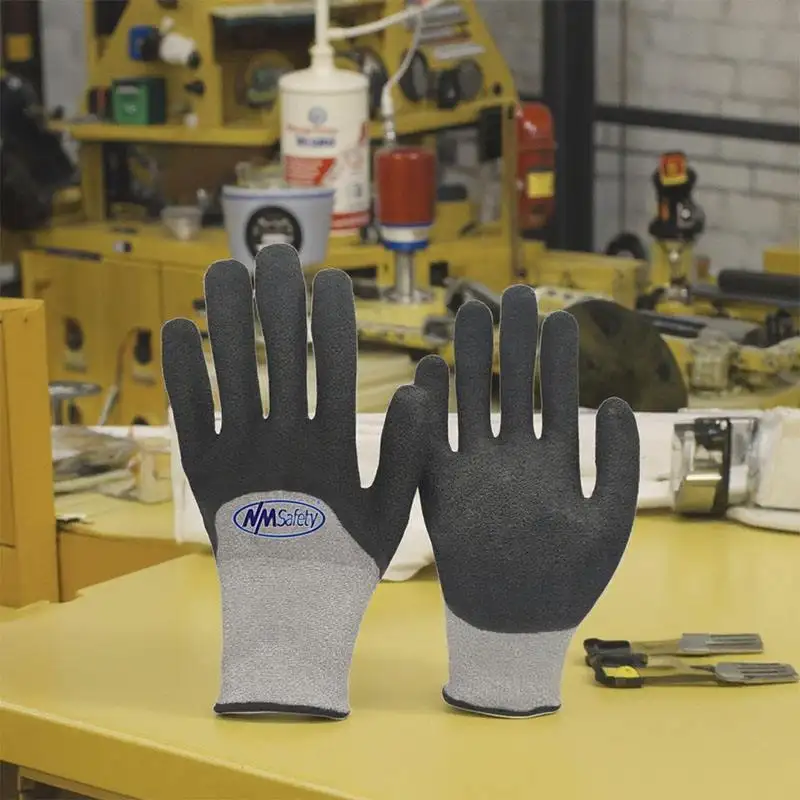
The half-coated crinkle latex palm provides excellent grip in dry conditions without covering the entire glove — this keeps the back of the hand breathable and reduces sweating during long shifts.
Targeted steel fabric reinforcement on the palm and fingers adds an extra layer of mechanical defense precisely where hand contact with sharps is most likely, without limiting finger articulation.
Certifications That Back Every Shipment
Procurement teams across North America and Europe increasingly require complete certification chains for compliance audits. NMSafety’s DY1850NM/NR gloves are certified for:
•CAT II per General Standard for Protective Gloves EN ISO 21420
•Test data are made available for every production batch for the customer’s reference.
Ordering the OEM for Needle Resistant Gloves in China from a manufacturer who keeps and openly shares concerning their certification documentation/disclosures will decrease the buyer's compliance burden and minimize their liability risk.
NMSafety OEM Capabilities for International Distributors
NMSafety, founded in 1998, has 3 plants: Jiangxi, Jiangsu, and Shandong, with a total of 15 production lines running 1,500 knitting machines and 600 sewing machines, manufacturing a total of 600,000 dozens of gloves per month, giving them the ability to accept large orders and eliminating the need to purchase through a trading company.
We also provide:
•Logo (embossed or screen-printed) on glove backs or cuffs
•An array of glove colors
•A range of unique packaging
•A range of glove sizes from small to 3XL
•Lead time: 60 to 120 days
•Minimum order: 1,200 pairs
Since 2023, customer insight:
With buyers consolidating glove supply to address consumers’ need for all-in-one, cut, puncture, and abrasion protection, they are looking for fewer SKUs per glove line to cater to various hazards.
✅ Elimination of the Middleman
To reduce costs and increase supply chain efficiency, buyers plan to purchase directly from the manufacturer, bypassing their distributors.
Certification-driven selection: Compliance audits and workplace liability concerns have moved certification checks from a formality to a primary selection criterion, making validated test reports non-negotiable.
Practical Fit for Real-World Workflows
When a worker needs to search a waste bag for a hidden hypodermic needle or reach into a tight machine cavity where glass shards have accumulated, a glove must allow tactile feedback. The combination of 18-gauge construction, HPPE flexibility, and steel fiber reinforcement creates a barrier that stops penetration without turning the hand into a stiff, insulated block. This is the difference between a worker wearing the glove voluntarily — and leaving it in the locker.
For safety managers and procurement officers evaluating Needle Resistant Gloves OEM in China, NMSafety provides a supplier-direct solution that pairs certified Level 5 needle protection with genuine, field-tested hand mobility. Contact the NMSafety OEM team to request samples or discuss volume orders for 2026 delivery.
FAQs
Q: What is the difference between EN388 puncture and ASTM F2878 needlestick testing?
A: EN388 tests with a blunt 4mm probe and has no concern with hypodermic needles. ASTM F2878 applies a 25-gauge hypodermic needle to test, and thus is a better standard for needlestick issues.
Q: Are wet and oily conditions suitable for the DY1850NM/NR?
A: For drier settings, we recommend our crinkle latex coating. For wet and oily conditions, other NMSafety coatings are available including nitrile and foam latex.
Q: What's the minimum order requirement for OEM?
A: The minimum order quantity is about 1,200 pairs, with lead times of 60 to 120 days depending on the logo, color, and packing.
Q: Are the gloves ever washed/re-used?
A: The gloves may be able to be edited, as long as they are not soiled or damaged. Also, needlestick incident gloves are to be disposed of immediately.
Q: NMSafety shares the test report for each batch ordered. Do you offer the same?
A: Yes. We provide batch test compliance audits, as well as our ANSI and EN certification reports.