Home > Uncategorized > ESD Gloves for Semiconductor & Wafer Handling
ESD Gloves for Semiconductor & Wafer Handling
13 May, 2026
By arafatshuvo509
ESD gloves for semiconductor manufacturing should combine documented static dissipation, low particle release, and cleanroom-compatible packaging. For wafer and back-end handling, specify 10^6 to 10^9 ohms, ISO Class 5/6 suitability where required, low-lint construction, traceable packaging, and supplier test data. Choose glove style by station, not by one generic “anti-static” label.
Semiconductor gloves have to protect the part, the process, and the operator’s workflow at the same time. A glove can feel comfortable and still fail a fab review if it sheds fibers, traps charge, or arrives in weak packaging. For wafer handling, final test, and back-end packing, the best choice starts with a clear glove spec.
What makes ESD gloves different in semiconductor and wafer handling?
ESD gloves for semiconductor manufacturing must dissipate charge while limiting contamination from fibers, skin oils, and particles. The right glove supports the fab’s ESD control program instead of acting as an insulator or particle source.
Electrostatic discharge can affect devices during manufacturing, assembly, and handling, especially when sensitive parts move through many contact points. Semiconductor ESD testing often looks at device tolerance to discharge models such as HBM and CDM, which makes hand protection part of a wider control plan, not a simple PPE choice. You can review the basic device-side risk in this Toshiba semiconductor ESD testing explanation.
The glove also has to protect the clean process. Bare hands add oils and particles. Ordinary cotton or rubber gloves may reduce direct touch, but they don’t prove controlled charge behavior. For PCB-focused lines, NM Safety’s guide to PCB ESD gloves gives a related view, but wafer handling needs stricter cleanliness and packaging review.
Use this simple rule: don’t approve a glove because the catalog says “anti-static.” Ask whether the glove has resistance data, cleanroom support data, and packaging that fits your fab area.
Which surface resistance range should a fab specify?
For wafer and semiconductor handling, specify ESD gloves with documented resistance in the 10^6 to 10^9 ohm range, plus the test method and conditions used. A number without the test method is not enough for fab approval.
A practical fab spec should name the resistance range, then ask how it was tested. For this article’s wafer and back-end use case, the target range is 10^6 to 10^9 ohms. That range helps avoid plain insulating gloves, but the data still needs context.
Conductive vs static dissipative gloves
Conductive gloves move charge more easily. Static dissipative gloves release charge in a more controlled way. Semiconductor teams usually care about controlled dissipation, because sudden discharge into a device is the risk they are trying to reduce.
ANSI/ESD STM15.1 covers glove and finger cot resistance measurement procedures, including surface and volume resistance references. Ask suppliers to identify whether their report follows ANSI/ESD STM15.1 or another accepted method.
Fab ESD glove specification table
Specification item
Recommended requirement
What to ask supplier
Reject if
Surface resistance
10^6 to 10^9 ohms
Test report with method and conditions
Only “anti-static” is stated
Test method
Named method, such as ANSI/ESD STM15.1
Sample size, voltage, humidity, date
No method is listed
ESD program fit
Compatible with facility ESD controls
S20.20 support data where available
Treated as a standalone fix
Cleanroom class
ISO Class 5/6 suitability where needed
Particle and residue data
“Cleanroom” has no proof
Packaging
Cleanroom-compatible bags
Lot number and COA
Loose bulk packaging
Construction
Low-lint yarn, stable coating, suitable cuff
Material and coating declaration
Fibers shed during handling
How should gloves control particles, fibers, and residues in ISO Class 5/6 areas?
ISO Class 5/6 glove compatibility should be proven with cleanliness data, not marketing language. Ask for particle release, extractables, ionic residue, packaging, and processing information that matches the fab’s cleanroom class.
ISO 14644-1 classifies cleanrooms and clean zones by airborne particle concentration. That does not automatically certify a glove, but it gives the facility a basis for matching gloves to the room, process risk, and local cleanroom rules. Use the ISO 14644-1 cleanroom classification document as the cleanroom reference point.
Particle-shed targets should come from your process requirement, not from a generic blog number. For ISO Class 5 or ISO Class 6 wafer areas, ask the supplier for tested particle release data, extractables, ionic residue information, and packaging details. If they cannot provide those, don’t treat the glove as fab-ready.
Particle-shed target note for buyers
For a wafer inspection station, the glove should not be approved only because it passes resistance review. The buyer should ask: does the glove shed fibers under normal movement, does the coating flake, and does the bag keep the glove clean until gowning?
A strong approval checklist should include:
Particle release data tied to a test method
Extractables or ionic residue information where required
Low-lint yarn and stable coating details
Cleanroom bagging and lot traceability
Processing or laundering information for reusable gloves
Size and cuff fit that avoid glove adjustment during work
Top-fit, palm-fit, or disposable nitrile: which glove style fits each station?
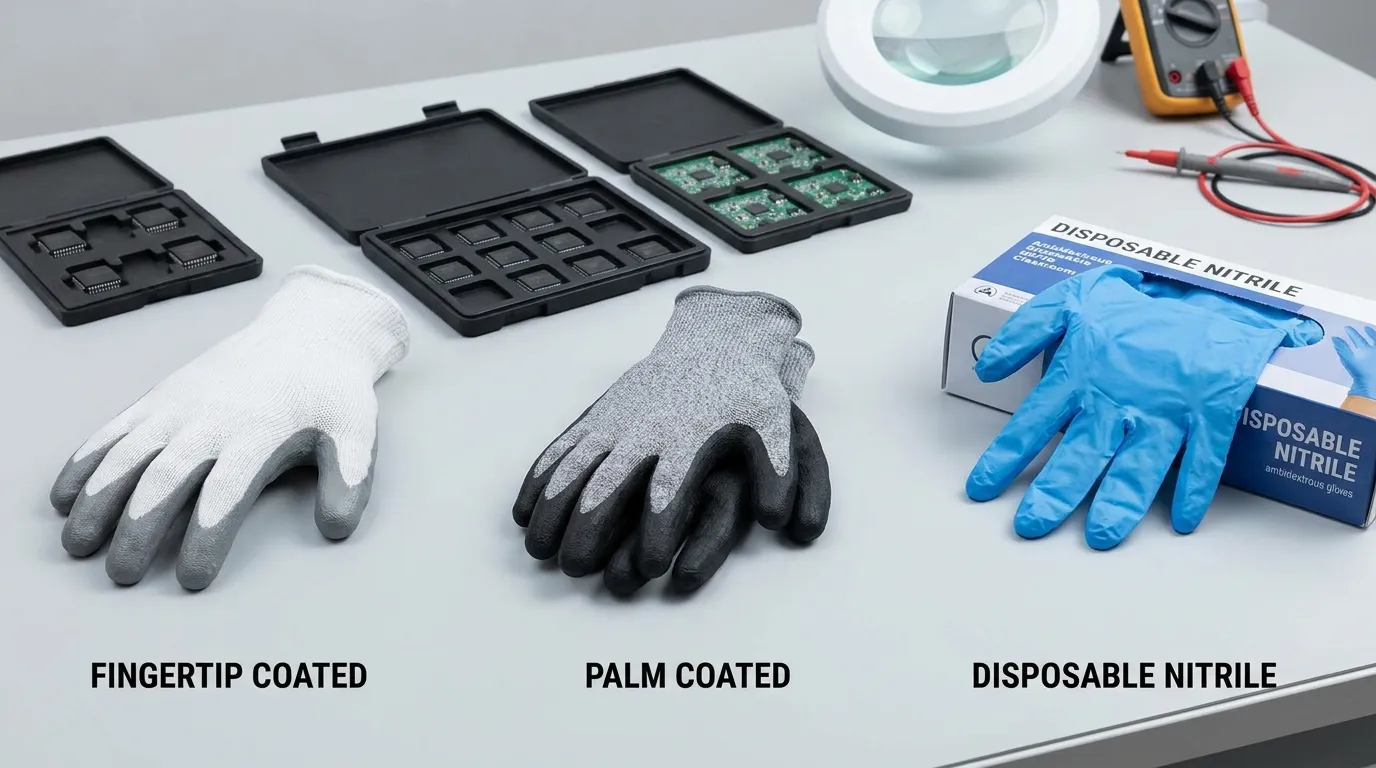
Choose ESD gloves by contact zone. Top-fit gloves suit fine fingertip handling, palm-fit gloves suit high-contact assembly and packing, and ESD nitrile gloves suit disposable cleanroom tasks where contamination control is the main concern.
Top-fit gloves are not always the best ESD glove. They work well when the fingertips do the critical task, such as wafer inspection or micro-component placement. Palm-fit gloves are safer when the whole hand contacts trays, boards, packing materials, or test fixtures for long shifts.
A multi-station facility should not force one glove across every line. Wafer inspection, SMT inspection, final test, packing, and HMI work each create different contact points. The decision should start with the station, then move to coating, cleanliness, and resistance data.
Station or task
Main risk
Better glove style
What to verify
Caution
Wafer inspection
Fingertip contact, particle risk
Top-fit ESD glove
10^6 to 10^9 ohms and cleanroom data
Avoid loose fibers
Wafer transfer
Grip, particle control
Top-fit or cleanroom ESD nitrile
Coating stability and packaging
Check touch pressure
SMT inspection
ESD-sensitive boards
Palm-fit ESD glove
Resistance and dexterity
Don’t overcoat if fine touch matters
Final test
Device handling and tools
Palm-fit or top-fit
Grounding program fit
Avoid insulating layers
Back-end packing
Trays, packs, labels
Palm-fit ESD glove
Grip and wear life
Full-hand contact matters
HMI or tablet work
Glove removal risk
Touch-compatible ESD glove
Touch response and ESD data
Keep wafer-contact rules separate
Disposable cleanroom use
Contamination control
ESD nitrile glove
Particle and residue data
Check chemical compatibility
For example, a wafer inspection operator under magnification may need fingertip feel more than palm grip. A back-end packaging operator handling carriers for eight hours may need a palm-fit glove because grip and coating wear become the bigger risk.
What should the bonded-seam, cuff, and packaging spec include?
The glove spec should cover seam construction, cuff design, cleanroom packaging, lot traceability, and COA requirements. These details stop a glove from passing ESD review but failing gowning, contamination, or incoming inspection checks.
Bonded or sealed construction matters when the glove design includes seams that could shed, rub, or open under repeated movement. The spec should state whether seams are bonded, sealed, or otherwise controlled. It should also state whether the cuff is knit, extended, elastic, or designed for cleanroom gowning.
Packaging needs the same attention. For ISO Class 5/6 areas, request cleanroom-compatible inner and outer bags where your process requires them. The label should show size, material, lot number, and shelf-life or expiration details if provided.
Add this note to the purchasing spec:
Bonded or controlled seam construction where seams are present
Cuff design that stays stable under gowning
Cleanroom-compatible inner bag and outer bag if required
Lot number on each pack or case
Certificate of analysis or test report by lot
Material and coating declaration
Change-control notice for yarn, coating, packaging, or processing updates
A glove with the right resistance range can still be the wrong fab glove. If it sheds particles, lacks cleanroom packaging, or has no lot traceability, it can pass ESD review and still fail process approval.
How do ESD gloves fit inside the full ESD control program?
ESD gloves are one part of the fab’s ESD control system. They should support grounding and controlled charge dissipation, but they do not replace wrist straps, ESD flooring, garments, tools, work surfaces, or compliance verification.
The glove works inside an ESD Protected Area, often called an EPA. That area may include grounded work surfaces, wrist straps, footwear, flooring, garments, carts, packaging, and handling tools. ANSI/ESD S20.20 gives requirements for setting up and maintaining an ESD control program for electronic parts and assemblies, as described in this ANSI overview of ANSI/ESD S20.20.
IEC 61340-5-1 also covers ESD control program requirements for organizations that handle electrical or electronic parts, assemblies, and equipment. The IEC 61340-5-1 standard page gives the official scope. For the writer or buyer, the lesson is simple: gloves help, but the system has to work together.
If this happens
What it may mean
Buyer action
Glove passes resistance but operator is ungrounded
Charge may not dissipate correctly
Review wrist strap, footwear, and floor controls
Glove feels clean but sheds fibers
Cleanroom risk remains
Ask for particle data
Glove works at one station but fails another
Contact zone changed
Split specs by task
Humidity changes handling behavior
Charge generation may change
Check facility controls and retest needs
Operators remove gloves for touchscreens
Process control breaks
Review touch-compatible options
The glove should never be sold internally as the only ESD fix. Treat it as one controlled part of the line.
What documentation should buyers ask from suppliers before approval?
Buyers should ask for test data, cleanliness data, material details, packaging details, and traceability before approving a semiconductor ESD glove. If the supplier can only provide a product photo and a general claim, the glove is not ready for fab review.
For an incoming lot approval, imagine QA receives gloves with “anti-static” printed on the bag. The lot should be held until the supplier provides resistance data, test method, lot traceability, cleanroom support data, and a COA if your process requires it.
Ask for this approval packet:
Resistance test report with method, conditions, and sample size
ANSI/ESD STM15.1 reference where applicable
Cleanroom particle data for ISO Class 5/6 areas
Extractables or ionic residue data if your process needs it
Material, yarn, and coating declaration
Packaging specification with inner and outer bag details
Lot number and COA
Shelf-life or storage guidance
Change-control notice for material, coating, processing, or packaging changes
Sample trial record from the target station
Anti-static wording is not enough. It can help you shortlist a product, but a fab should not approve the glove until the data matches the station risk.
How should facilities test, store, and replace ESD gloves during use?
Facilities should treat ESD gloves as controlled consumables. Receiving checks, storage rules, wear inspection, and replacement triggers should be written before the glove goes live on the floor.
Start at receiving. Check the carton, bag seal, size, lot number, and COA against the purchase spec. If the packaging is damaged or the lot number does not match the paperwork, hold the gloves before they enter a controlled area.
Use a simple process checklist:
Inspect packaging at receiving.
Confirm lot number, size, and supplier documents.
Store sealed gloves away from dust, moisture, and uncontrolled handling.
Train operators on donning, doffing, and station use.
Inspect coating wear, holes, contamination, and cuff damage.
Remove gloves that fail visual checks or resistance checks.
Retest reusable gloves after defined wash cycles or time intervals.
Record rejected lots and repeated failures.
For a reusable glove program, define the maximum wash cycles before launch. A glove that worked on day one may not keep the same coating, fit, or resistance after repeated laundering. Retest rules keep the program honest.
When are ESD gloves not enough for semiconductor work?
ESD gloves are not enough when the task adds mechanical, chemical, touchscreen, or handling risks beyond static control. In those cases, choose the base ESD requirement first, then add the extra protection only where the station needs it.
If operators handle sharp trays, blades, ceramic carriers, or metal edges, add cut risk review. Do not turn a wafer glove into a bulky glove by default. Use a separate cut-protection decision, then connect broader glove coating choices to NM Safety’s coated glove selection guide.
Use these station checks:
Sharp carrier edges: review cut resistance before approval.
HMI or tablet use: test touch response without glove removal.
Chemical exposure: review material compatibility before use.
Heavy fixtures: review grip and fatigue risk.
Ultra-clean contact: prioritize particle and packaging data.
For operators who need screen use and cut protection in non-wafer contact tasks, touchscreen cut gloves may help compare the next layer of protection. Keep that separate from the wafer-contact glove spec.
What to Do Next
To choose ESD gloves for semiconductor manufacturing, start with the station map. List where the glove touches wafers, trays, boards, tools, packaging, or screens. Then request resistance data, cleanroom support data, packaging details, and lot traceability from the supplier.
Don’t approve one glove for every station just because it has an anti-static label. Build a short trial with operators, QA, EHS, and process engineering. The right glove should pass the spec, feel usable, and stay controlled after receiving, storage, and daily use.
Frequently Asked Questions
What are antistatic gloves or ESD gloves?
ESD gloves are gloves designed to reduce static risk when handling sensitive electronics or semiconductor parts. They use conductive or dissipative materials so charge can move away in a controlled way instead of discharging into a device.
Do rubber gloves work as anti-static?
Standard rubber gloves are not a safe default for ESD-sensitive semiconductor handling. They may behave as insulators and trap charge unless they are specifically tested and documented for ESD performance.
What ANSI/ESD standard should ESD gloves meet?
Buyers should ask for glove resistance data tied to ANSI/ESD STM15.1 where applicable, and confirm the glove fits the facility’s ANSI/ESD S20.20 control program. The standard name alone is not enough without test data.
What is the difference between conductive and static dissipative gloves?
Conductive gloves move charge quickly, and static dissipative gloves release charge in a more controlled range. For semiconductor handling, the safer choice depends on the ESD control program, grounding setup, and device sensitivity.
Are ESD gloves required in cleanrooms?
ESD gloves are required when the cleanroom process handles ESD-sensitive devices or materials. The glove also needs cleanroom suitability, because static control alone does not prove low particle release or low residue.
Do ESD gloves also help with contamination control?
Cleanroom ESD gloves can help reduce skin oils, fibers, and particle transfer, but only if they are designed and processed for cleanroom use. Ask for particle, extractable, and packaging data before approval.
Can one ESD glove work for every semiconductor station?
One ESD glove should not be assumed suitable for every station. Wafer inspection, SMT, final test, packing, and cleanroom gowning may require different coating coverage, cleanliness data, grip, and documentation.