Home > Uncategorized > Cut-Resistant Gloves for Food Processing Plants
Cut-Resistant Gloves for Food Processing Plants
02 May, 2026
By arafatshuvo509
TL;DR
Cut resistant gloves for food processing plants should be chosen by task risk, food-contact proof, cleanability, and zone control, not by cut level alone. Use A4-A6 for moderate knife and packaging hazards, A7-A9 or metal mesh for high-risk deboning, and require FDA or EU food-contact documentation. For reusable programs, build a color-coded HACCP map, wash-and-inspect SOP, and a short trial before conversion.
Food plants usually switch to reusable cut gloves for one reason: disposable gloves don’t stop serious cuts. But reusable gloves create new questions for safety, QA, and procurement. Can the glove touch food? Will workers lose dexterity? Can it survive wash cycles? The right answer starts with the job, not the catalog. First, identify the stations where cut protection is actually needed.
When does a food plant actually need cut-resistant gloves?
Cut-resistant gloves are needed where food workers face credible laceration hazards from knives, blades, slicers, deboning tools, or sharp packaging edges. They should be selected by hazard assessment, not issued as a generic plant-wide glove.
A food plant does not need the same cut glove at every workstation. A worker trimming meat, filleting fish, deboning poultry, or handling sharp tray edges has a different risk profile than someone doing light inspection or packing sealed items. Start with the task, blade exposure, hand position, and shift length.
OSHA’s hand-protection rule says employers must select suitable hand protection when workers face hazards such as severe cuts, and the choice should fit the task conditions and hazards. Use that logic before choosing a glove style or cut level. For broad cut-glove basics, send the team to this cut glove buying guide.
Use cut-resistant gloves when workers handle:
Hand knives, trimming knives, boning knives, or filleting knives
Slicers, blades, cutters, or exposed sharp machine areas
Fish bones, meat bones, shellfish tools, or sharp poultry bones
Metal clips, staples, carton edges, or sharp packaging components
Cleaning tasks where blades or sharp machine parts may be exposed
Cut-resistant does not mean cut-proof. A glove reduces risk when it fits the job, but it can still fail under high force, wrong sizing, damaged fibers, or unsafe hand position.
Which cut level fits boning, trimming, slicing, and packaging tasks?
Choose cut level by task severity, not by the highest number available. Moderate trimming and packaging may fit mid-level protection, while deboning, filleting, and repeated knife contact usually need higher cut resistance or metal mesh on the exposed hand.
The highest cut level is not always the best plant-wide choice. It works for high-risk knife exposure, but a lower-bulk glove is often safer for fast trimming or packaging when dexterity drives worker compliance. If workers remove the glove because it feels stiff, the protection plan fails.
ANSI/ISEA 105 uses A1-A9 cut classifications, with higher levels showing higher cut resistance under the test method. For a deeper comparison, use the A4 vs A5 gloves guide during your internal review.
Food plant task
Main hazard
Dexterity need
Practical cut-level direction
Selection note
Light packing and inspection
Tray edges, cartons, film cutters
High
Lower to mid cut level
Keep glove thin enough for speed
Vegetable prep
Knives, peelers, slicers
High
Mid cut level
Wet grip and fit matter
Meat trimming
Knife contact, fat, bone edges
Medium
Mid to higher cut level
Trial palm grip and off-hand control
Deboning
Repeated knife exposure
Medium
Higher cut level or metal mesh
Protect the non-knife hand first
Fish filleting
Slime, wet blades, fine control
High
Mid to higher cut level
Wet-slip control is critical
Poultry trimming
Repetitive cuts, wet fat, speed
High
Mid to higher cut level
Choose washable grip and zone color
High-risk oyster or shell work
Knife slips, puncture-like contact
Medium
Higher cut level or metal mesh
Test by task, not by guesswork
Metal mesh is not a default glove for every food-processing task. It is useful for high-risk off-hand knife exposure, but it can be unnecessary or inefficient for lighter repetitive work.
What makes a reusable cut glove food-contact compliant?
A reusable cut glove is food-contact ready only when the supplier can provide food-contact documentation for the actual material, coating, and SKU being purchased. Do not rely on a general “food safe” claim without supporting records.
Food-contact compliance should be checked before a glove enters a production trial. For U.S. buyers, ask how the glove material or coating relates to FDA food-contact rules. FDA’s food-contact inventory covers substances authorized under relevant 21 CFR food-contact regulations, and 21 CFR 175.300 is often relevant for resinous and polymeric coatings.
For EU buyers, request documentation tied to EU 1935/2004, which is the broad EU framework for food-contact materials. The supplier should connect the declaration to the glove’s actual yarn, coating, color, and SKU. A general catalog claim is not enough for QA review.
Documents to request before approval
Use this quick check before ordering samples:
Food-contact declaration for the exact SKU
FDA or EU basis for the material or coating
ANSI/ISEA 105 or EN388 test report
Washing and drying instructions
Color and dye information when used for HACCP zones
Size range and fit chart
Sample policy and lead time
Replacement and inspection guidance
Reusable cut gloves should not replace disposable gloves until the plant has washing, drying, inspection, and color-control rules ready. The glove may be food-contact safe when new, but the program can still fail in daily use. Use this glove selection checklist when comparing supplier documents.
Meat vs fish vs poultry: which grip and glove construction works best?
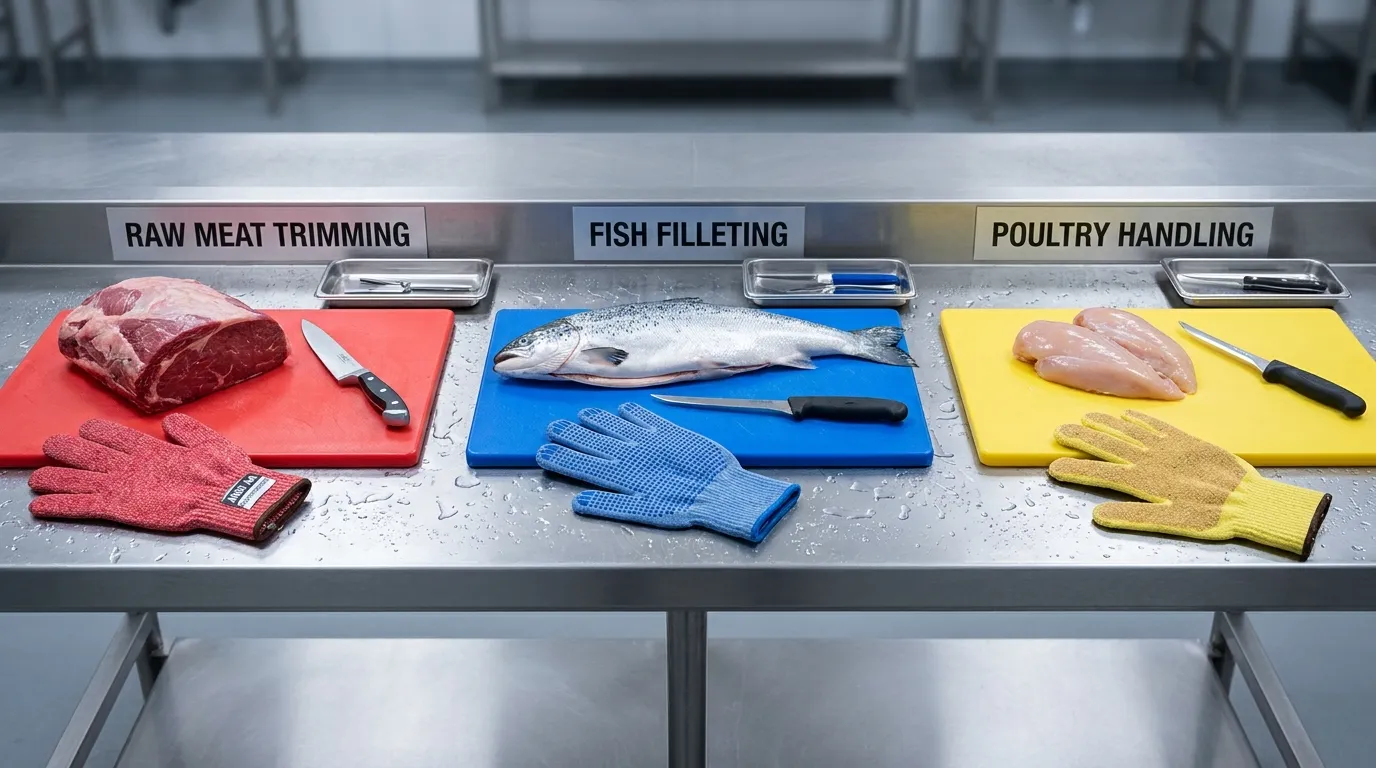
Meat, fish, and poultry lines do not need the same cut glove. Meat usually needs higher cut protection, fish needs wet-slip control and dexterity, and poultry needs washable grip with zone control for repetitive trimming.
Grip is not a small detail in food processing. A glove that passes a cut test can still be wrong if it slips on fish, drags on poultry trim, or feels bulky around a boning knife. Match the glove to the product surface and hand movement.
Line type
Main handling problem
Glove priority
Practical choice
Meat
Fat, bone edges, knife contact
Cut level plus firm control
Higher cut level for deboning, lighter style for trimming
Fish
Slime, water, fine blade control
Wet grip and dexterity
Thin cut liner with grip surface, tested during filleting
Poultry
Wet fat, speed, repeated trimming
Washability and color control
Reusable cut glove with clear raw-poultry zone color
Packaging
Sharp tray or carton edges
Dexterity and comfort
Lower-bulk cut glove that workers keep on
High-risk knife stations
Direct off-hand exposure
Maximum protection for exposed hand
Higher cut level or metal mesh after trial
For example, a fish filleting station may reject a thick glove even if it has a strong cut rating. Workers need control on wet product and small knife movements. A poultry trimming line may care more about washable grip, fit, and color discipline because workers repeat the same motion all shift.
How should you color-code cut gloves for HACCP zones?
Color-code reusable cut gloves by HACCP zone, then lock each color to storage, washing, and replacement rules. A color system only works if workers cannot casually move gloves between raw, cooked, allergen, and sanitation areas.
Color coding should be built around the HACCP map, not worker preference. A reusable glove can travel between stations if storage and laundry rules are loose. That creates a cross-contamination risk even when the glove itself is food-contact approved.
If the zone is...
Use color coding to control...
Practical rule
Raw meat
Raw protein movement
Store gloves only in raw-side racks
Fish
Odor, slime, and wet handling
Keep separate wash bins and drying area
Poultry
Raw poultry contamination
Use one color for raw poultry only
Cooked or ready-to-eat
Post-cook contamination risk
Do not share gloves with raw zones
Allergen handling
Allergen transfer
Assign a separate color and bin
Sanitation
Chemical and blade cleanup
Keep away from production gloves
Place color rules at the glove issue point, not only in the training manual. Workers should see the correct color before they enter the line. If custom colors are used, keep the same SKU and documentation linked to each color so QA can track what was approved.
How do reusable cut gloves survive washing, inspection, and replacement?
Reusable cut gloves need a written wash, dry, inspect, and replacement SOP. A glove that is food-contact safe when new can still become unsafe if it is damaged, poorly dried, mixed between zones, or kept too long.
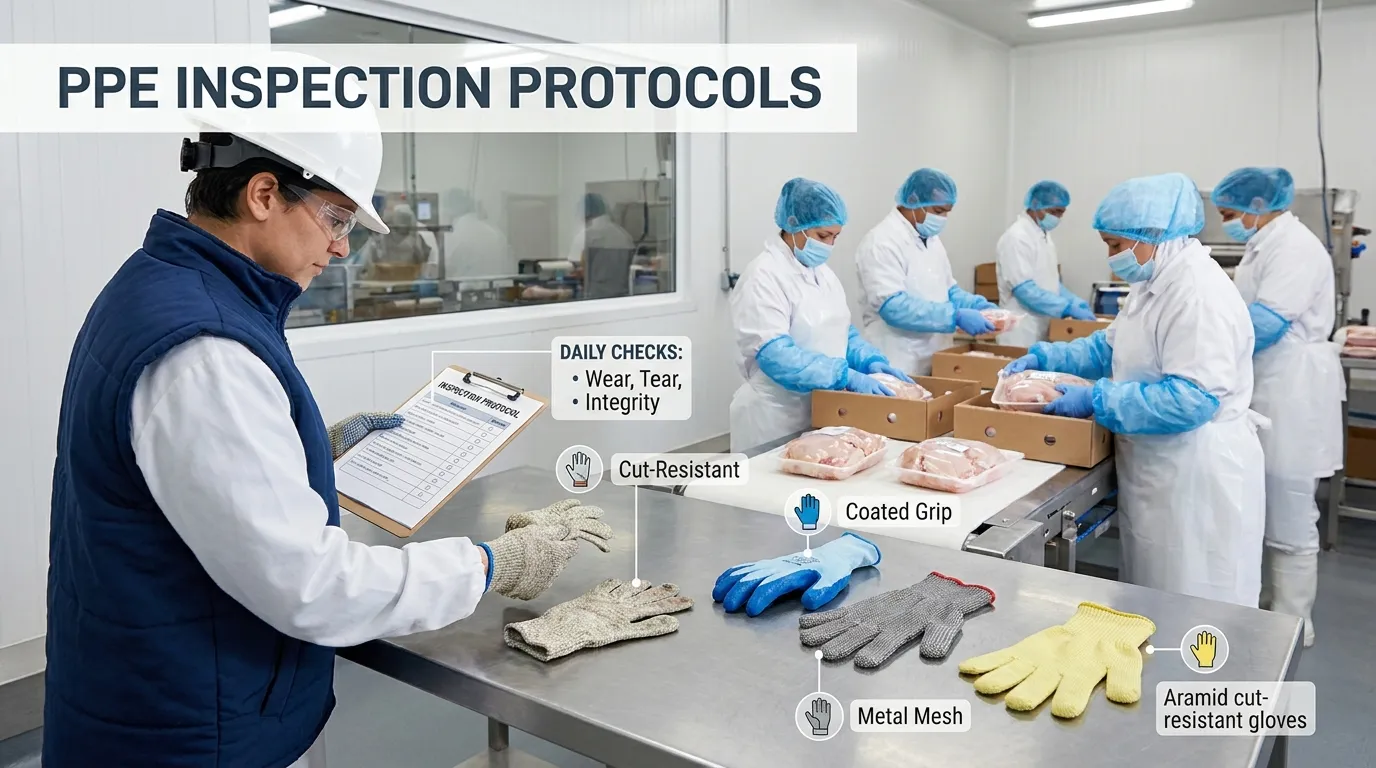
A reusable program needs more than a washing note. Decide who collects gloves, who washes them, where they dry, who inspects them, and when they leave service. Follow supplier washing instructions because heat, detergent, and drying method can affect fit, coating, or fiber condition.
Use this basic process:
Collect gloves by HACCP zone and color.
Wash according to supplier instructions.
Dry fully before storage.
Inspect before the next issue.
Remove damaged or questionable pairs.
Track recurring damage by station.
Replacement triggers safety leads should document
Remove a glove from service if it has broken fibers, loose seams, coating damage, shrinkage, poor fit, odor, staining that cannot be cleaned, or lost elasticity. A glove that feels loose or stiff after washing can create a handling hazard, even if it still looks acceptable.
A deboning line trial can show this quickly. Give workers A6/F reusable gloves for the non-knife hand, then inspect them after one week of washing. Track grip feedback, hand fatigue, fiber damage, and shrinkage before buying plant-wide. Use this step before you choose cut gloves for every line.
Which launderable glove SKUs should a food plant shortlist?
Start with a small SKU shortlist that covers risk levels, food-contact proof, washing needs, and fit. Do not approve a glove only because it has a strong cut rating. A plant trial should confirm grip, dexterity, wash performance, and QA documentation.
Listed as ANSI A4, EN388 level 5, food-grade, machine washable
Is A4 enough for the target task?
Food-safe color-option glove range
Zone-coded food handling
Food-safe category includes color options for cross-contamination control
Which colors fit the HACCP map?
Metal mesh glove option
High-risk off-hand knife exposure
Commonly used for serious knife hazards
Is the task severe enough for mesh?
For packaging and inspection, a lower-bulk cut glove may be better than a heavy glove. If workers need to pick, check, seal, and move quickly, dexterity may drive real safety. The right glove is the one workers can use correctly for the whole task.
What should procurement ask suppliers before approving reusable cut gloves?
Procurement should ask for SKU-specific proof, not broad promises. Food-contact documents, cut-level reports, wash instructions, color options, sizing, MOQ, and lead time all affect whether the glove works inside a food plant.
Use this approval checklist before purchase:
Approval item
What to ask
Why it matters
Exact SKU
Is this the same item tested?
Prevents catalog-level confusion
Cut report
ANSI or EN test report
Confirms protection class
Food-contact proof
FDA or EU documentation
Helps QA approve food use
Wash instructions
Method, temperature, drying
Protects fit and lifespan
Color options
Standard or custom colors
Supports HACCP zones
Sizing
Full size range and samples
Reduces worker rejection
MOQ and lead time
Production and reorder timing
Prevents stock gaps
Replacement guidance
Damage and wear rules
Supports daily inspection
For a 40-worker line, plan inventory before the first purchase. If each worker needs 2 pairs per shift and the plant keeps a 5-day wash rotation, the starter inventory is 40 × 2 × 5 = 400 pairs before spares. Add extra pairs for damage, sizing gaps, and training.
Use cut glove selection as the next step when procurement, QA, and safety need one shared review list.
What rollout process reduces worker resistance and audit risk?
Start with one high-risk line, then scale after the glove passes fit, grip, wash, inspection, and QA review. A full plant switch without a trial can create worker pushback, sizing problems, and sanitation gaps.
Use this rollout process:
Choose one line, such as deboning, fish filleting, or poultry trimming.
Select 2-3 glove options by task risk.
Confirm food-contact and cut-level documents.
Run a one-week fit and wash trial.
Record worker feedback on grip, heat, bulk, and fatigue.
Inspect gloves after washing.
Approve one SKU per task or zone.
Train workers by color, task, and storage rule.
Do not mix food and non-food sharp hazards into the same decision. For example, maintenance work around sharp metal parts may need a separate review from food-line gloves. If your team handles those hazards, review sheet metal handling separately.
What to Do Next
The safest next step is a controlled trial, not a plant-wide order. Pick one high-risk station, request SKU-specific food-contact documents, confirm the cut rating, and test wash performance for one full work cycle. Then compare grip, comfort, damage, and worker feedback before scaling.
For cut resistant gloves for food processing, the winning option is rarely based on cut level alone. The right glove fits the task, passes QA review, survives washing, stays inside its HACCP zone, and gets used correctly every shift.
Frequently Asked Questions
Are cut-resistant gloves required in food service?
Cut-resistant gloves are required when the employer’s hazard assessment shows workers need hand protection from cuts or lacerations. OSHA focuses on the hazard and task, not a single universal glove rule for every food worker.
Are cut-resistant gloves cut-proof?
No, cut-resistant gloves are not cut-proof. They reduce cut risk when matched to the task, but sharp blades, high force, wrong sizing, damage, or poor technique can still cause injuries.
Which gloves are FDA compliant for food handling?
FDA-compliant food-handling gloves should have supplier documentation showing the material or coating is suitable for food-contact use. For reusable cut gloves, request the exact SKU’s food-contact statement, not only a catalog claim.
Can meat processing gloves be used in different meat handling tasks?
Yes, but the same glove may not fit every meat task. Deboning, trimming, slicing, and packing have different cut, grip, and dexterity needs, so plants should trial gloves by station.
How do you maintain cut-resistant gloves?
Maintain reusable cut-resistant gloves with supplier-approved washing, full drying, daily inspection, and clear replacement triggers. Remove gloves with broken fibers, coating damage, poor fit, odor, or signs of contamination.
What cut level is best for meat processing?
The best cut level depends on the task. Light trimming may use a moderate cut level, but deboning, oyster work, or repeated knife exposure may need higher ANSI protection or metal mesh on the exposed hand.