Home > Uncategorized > PU vs Nitrile Coating: Which Wins on Grip & Cost?
PU vs Nitrile Coating: Which Wins on Grip & Cost?
11 Apr, 2026
By arafatshuvo509
PU coated vs nitrile coated gloves comes down to task fit. PU usually wins for dry precision, fingertip control, and light assembly comfort. Nitrile usually wins for oil grip, wet handling, abrasion, and rougher industrial use. For procurement, compare cost per wear over 30 days, not just unit price. Final picker: PU for dry precision, nitrile for oil.
If you’re reducing glove SKUs, coating choice can look simple on a quote sheet and messy on the floor. Workers care about grip and feel. Buyers care about price, wear life, and complaints. The wrong coating can increase changeouts, slow assembly, or push workers to remove gloves during fine tasks. This comparison keeps the decision practical: dry precision, oil grip, abrasion life, and real monthly cost.
PU coated vs nitrile coated gloves: what is the real difference?
PU coated gloves usually win on dry precision and fingertip control, while nitrile coated gloves usually win on oil grip, abrasion, and rougher handling. The right choice depends on the task, not the coating name alone.
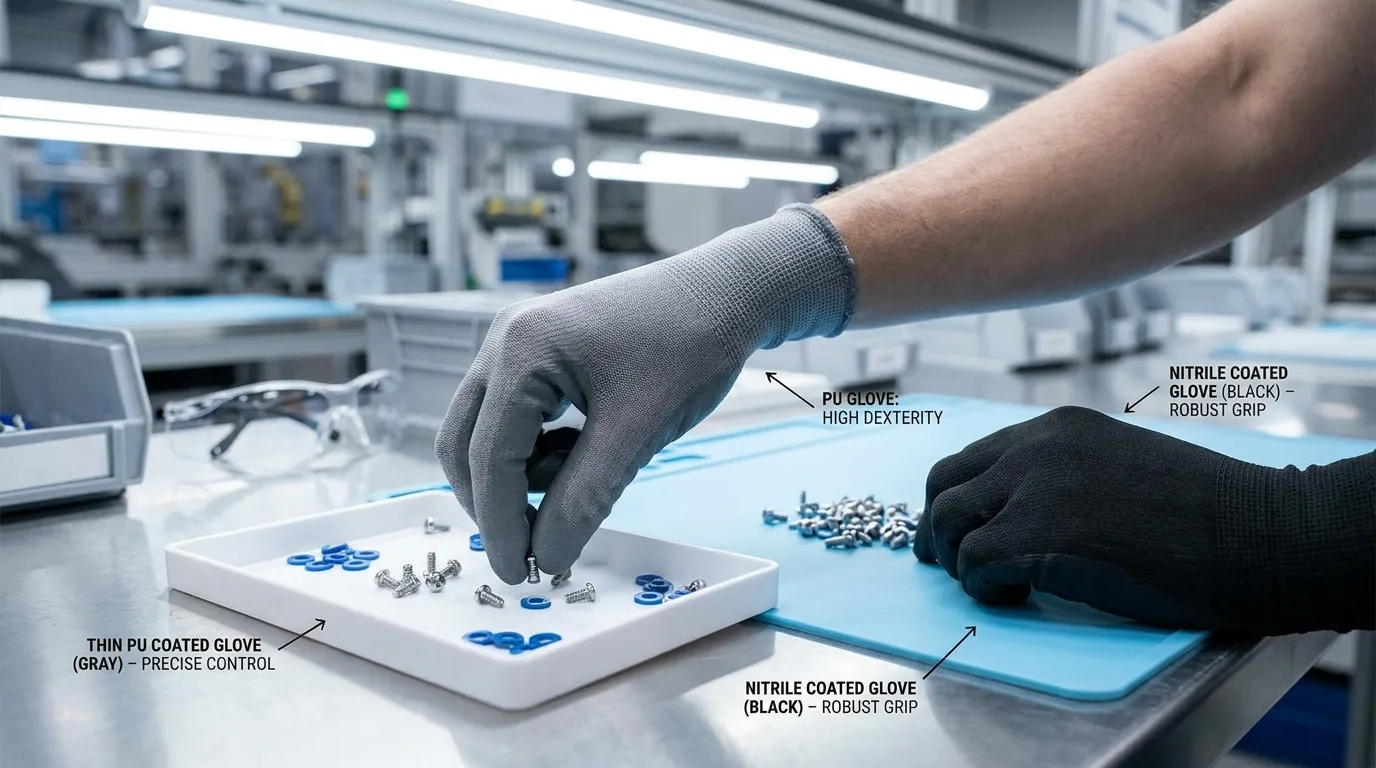
PU, short for polyurethane, is a thin and flexible palm coating. It gives workers a close feel on small parts, clean components, and dry surfaces. Nitrile coating is usually chosen when the job has oil, grease, wet parts, rough edges, or higher abrasion risk.
Coating is only one part of glove selection. The shell, gauge, cut level, and hazard exposure still matter. OSHA says hand protection should be selected based on the task, work conditions, use time, and hazards. For the broader safety match, use this cut glove selection guide.
Factor
PU coated gloves
Nitrile coated gloves
Best fit
Dry precision work
Oil, wet, and rough handling
Hand feel
Thin and tactile
Usually thicker, depends on coating
Grip strength
Strong on dry surfaces
Stronger in oil or grease
Wear life
Good in clean assembly
Better in abrasive jobs
Buyer risk
Poor fit for oily work
May reduce fingertip feel
Which coating gives better dry grip and dexterity?
PU is usually the better coating for dry grip and dexterity because it is thin, flexible, and tactile. Use it when workers handle small parts, dry components, packaging, electronics, or inspection tasks where fingertip control matters.
In dry assembly, the worker needs to feel the part. A thin PU coating helps with screws, clips, labels, small housings, and clean plastic parts. That’s why PU is common in electronics, inspection, finishing, packaging, and light assembly lines.
Nitrile can still work in dry jobs, but it often feels more protective than precise. That tradeoff matters. If workers start removing gloves to place small parts or read surface detail, the glove may be technically stronger but practically wrong.
Industry coating guides also place polyurethane around precision and touch-sensitive work. Delta Plus describes PU-coated gloves as a fit for precision tasks, and Pyramex links polyurethane with dexterity and tactile feel in dipped glove selection.
Choose PU when the surface is dry and clean.
Choose PU when fingertip control affects speed or quality.
Test worker acceptance before replacing PU with nitrile in small-part stations.
Which coating performs better around oil, grease, and wet parts?
Nitrile is usually the safer choice for oily, greasy, or wet handling. Foam and sandy nitrile textures are designed to improve grip when liquids interfere with contact, while PU is better kept for dry precision work.
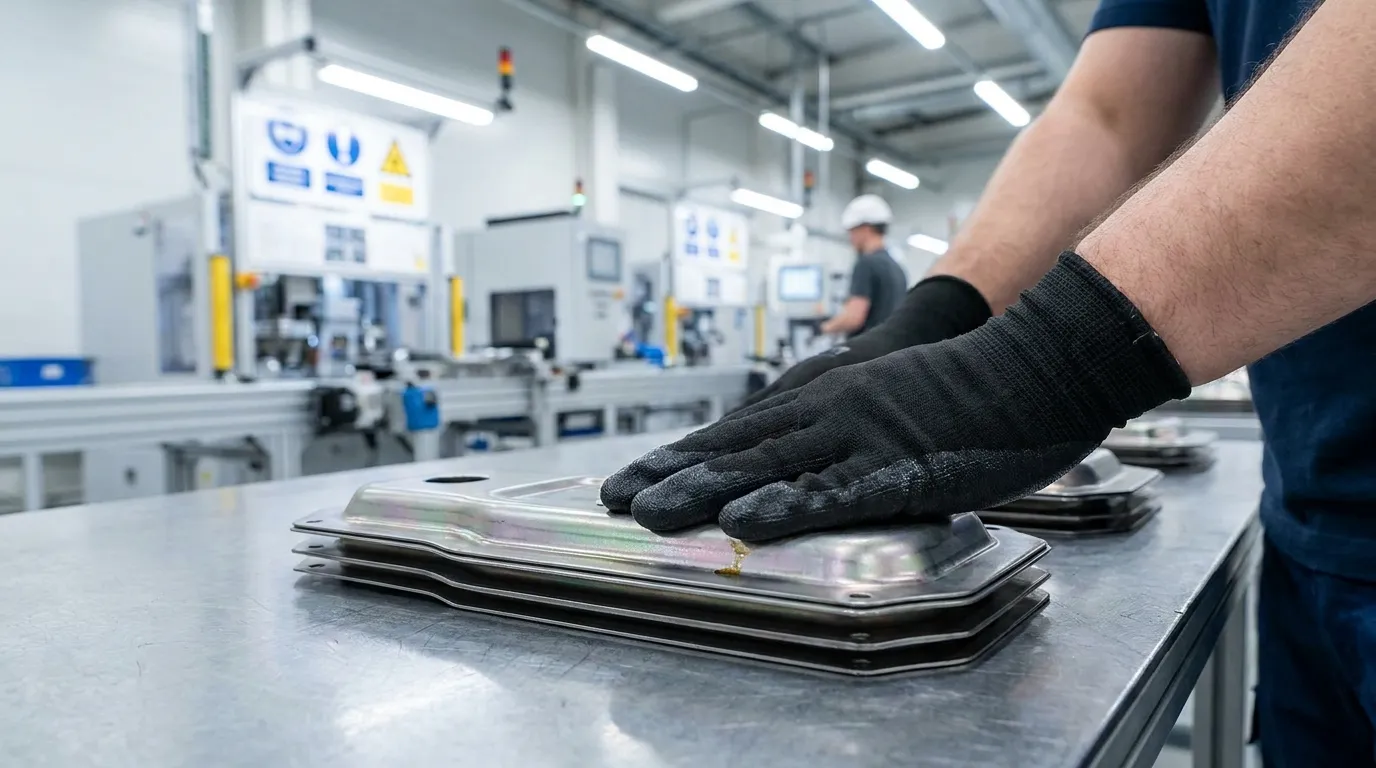
Oil changes the grip problem. A coating that feels great on dry parts can slip when light oil or grease sits between the glove and the workpiece. For oily stamped metal, machine parts, automotive work, or greasy maintenance, nitrile is the better starting point.
Foam nitrile and sandy nitrile give buyers more options inside the nitrile family. Foam nitrile can help with liquid contact because of its textured surface. Sandy nitrile is often used where wet, dry, and oily grip all matter. Pyramex explains these dipped glove texture differences in its guide to polyurethane, latex, and nitrile coatings.
Work condition
Better coating
Why it fits
Clean plastic parts
PU
Better dry feel and control
Dry carton handling
PU or nitrile
Choose based on wear life and comfort
Light oil on metal
Nitrile
Better grip when oil affects contact
Greasy machine parts
Nitrile
Safer grip and stronger coating choice
Wet parts handling
Nitrile
Better fit than PU for liquid contact
PU is not the smarter buy if the job has oil. It may feel better at first, but grip complaints and fast changeouts can erase the unit-price advantage. For deeper task matching, compare dedicated oil handling gloves.
Which lasts longer under abrasion and daily assembly wear?
Nitrile usually has the advantage in rougher, more abrasive work. PU can last well in clean assembly, but nitrile is the better candidate when parts have rough surfaces, oily edges, or repeated friction.
Abrasion life depends on more than coating material. A smooth plastic assembly task is not the same as handling stamped metal, cast parts, or oily tools. The same glove can last several shifts in one station and fail quickly in another.
Use a simple wear-life checklist before changing coating standards:
What surface touches the palm most often?
Are parts dry, oily, wet, or greasy?
Do workers handle sharp or rough edges?
How many shifts should one pair last?
Are gloves changed because of wear, grip loss, dirt, or comfort complaints?
Mechanical-risk standards can help buyers compare glove performance, but don’t treat a rating as the full decision. ANSI/ISEA 105 classifies performance properties such as cut, puncture, abrasion, heat, and chemical protection. EN 388 also covers abrasion, cutting, tearing, and puncture testing for protective gloves against mechanical risks.
If cut level is part of the buying decision, don’t turn this coating comparison into a full standards guide. Use the cut resistant glove guide for the wider rating and hazard match.
What is the 30-day per-wear cost for PU vs nitrile in assembly?
The cheaper glove is not always the lower-cost glove. Procurement should compare cost per wear by dividing pair cost by usable shifts, then test whether PU or nitrile survives the actual task without grip complaints or early changeouts.
Unit price is only the first number. A $1.20 PU glove that lasts three clean assembly shifts may be a good buy. The same glove used around oil may last one shift because workers change it early or complain about grip. That turns a cheap pair into an expensive system.
Example assumptions for a typical dry assembly job
This chart uses sample numbers for a 30-shift month. Treat it as a buying model, not a universal price claim. Your real cost should come from trial data, worker feedback, and actual changeout counts.
Coating
Example pair cost
Usable shifts per pair
Pairs for 30 shifts
30-day cost
Cost per wear
PU coated glove
$1.20
3
10
$12.00
$0.40
Nitrile coated glove
$1.50
5
6
$9.00
$0.30
PU in oily work
$1.20
1
30
$36.00
$1.20
Nitrile in clean dry assembly
$1.50
5
6
$9.00
$0.30, but may reduce fingertip feel
The table shows why cost needs context. In a clean dry station, PU may still be the better choice if it improves speed, control, and worker acceptance. In oily work, nitrile can win even when its unit price is higher.
For a real trial, give each station a 30-day test. Track pairs used per worker, reason for changeout, grip complaints, quality issues, and glove removal. That gives procurement a cleaner answer than price per pair alone.
Should procurement consolidate to one coating or keep both?
Do not consolidate by coating alone. Consolidate by task family: PU for dry precision stations, nitrile for oily or abrasive stations, and both when one plant has clean assembly plus maintenance, metal, or grease exposure.
The safest consolidation is one coating per task family, not one coating for the whole plant. A dry electronics assembly team and a maintenance team don’t need the same palm coating. Forcing one glove across both groups can create hidden cost.
Nitrile is not automatically the best standard glove. It works well in oil and abrasion, but for clean small-part assembly, the extra coating feel can reduce worker acceptance. If workers remove gloves to complete fine tasks, the standard has failed.
Work group or task
Best standard
Consolidation risk
Test before rollout
Dry small-part assembly
PU
Nitrile may reduce touch
Check speed and glove removal
Oily stamped metal
Nitrile
PU may slip or wear fast
Track grip complaints
Packaging and carton handling
PU or nitrile
Wrong choice may raise changeouts
Compare cost per wear
Maintenance and repair
Nitrile
PU may lack oil grip
Test grease and tool handling
Mixed assembly plant
Keep both
One coating may fail one group
Split by task family
For mechanics and repair teams, nitrile often deserves its own review. Use mechanics nitrile gloves when the next question is tool grip, grease, maintenance, and everyday mechanic use.
When should you choose waterproof, chemical, or oil-specific gloves instead?
PU vs nitrile coating is not enough when the hazard changes. Light oil contact is one thing. Liquid immersion, chemical splash, or waterproof protection needs a different glove conversation.
Use this section as a stop sign. If the worker’s hand is exposed to soaked parts, liquids, chemical contact, or full wet handling, don’t decide by palm coating alone. Check coating coverage, glove construction, chemical compatibility, and the actual exposure time.
Choose a different guide when the job looks like this:
For repeated oil and grease contact, treat the job as oil handling, not dry assembly.
For cut hazards, check the glove’s cut level and shell before deciding on coating.
This prevents overbuying and underbuying. A palm coating can improve grip, but it doesn’t automatically make a glove waterproof, chemical-safe, or cut-resistant.
Final picker: PU or nitrile?
Pick PU for dry precision and nitrile for oil. If your assembly line is clean and detail-heavy, PU usually feels better. If parts are oily, wet, abrasive, or greasy, nitrile is usually the safer standard.
Here’s the quick buying rule:
If the job is mostly
Choose
Reason
Dry, clean, small-part handling
PU
Better fingertip feel
Oily or greasy handling
Nitrile
Better grip in liquid contact
Rough or abrasive work
Nitrile
Better wear-life potential
Mixed clean assembly and maintenance
Keep both
One coating won’t fit all stations
PU wins when precision controls quality. Nitrile wins when grip failure creates risk. For procurement, the best answer comes from a 30-day trial, not a catalog-only comparison.
What to Do Next
For PU coated vs nitrile coated gloves, start with the station that creates the most complaints or changeouts. Test PU on dry precision work and nitrile on oil, grease, wet parts, or abrasive handling. Track pair use, grip feedback, worker comfort, and glove removal over 30 shifts.
Then set the standard by task family. Use PU where workers need clean fingertip control. Use nitrile where oil or rough handling changes the grip problem. That gives you lower waste, fewer complaints, and a cleaner buying rule: PU for dry precision, nitrile for oil.
Frequently Asked Questions
Are PU coated gloves better than nitrile coated gloves?
PU coated gloves are better for dry precision, but not better for every job. Nitrile coated gloves are usually stronger for oil, grease, wet parts, and abrasive handling.
Why are nitrile gloves recommended?
Nitrile coated gloves are recommended when workers need oil grip, abrasion resistance, puncture resistance, or tougher handling performance. They are a practical choice for automotive, metal, maintenance, and greasy assembly tasks.
Are polyurethane gloves heat resistant?
PU coated gloves are not the right choice for high-heat exposure. Competitor coating guidance cautions against using PU above about 175°F or 79 to 80°C, so heat work needs a heat-rated glove instead.
Which coating is better for oily parts?
Nitrile is usually better for oily parts, especially foam nitrile or sandy nitrile textures. These coatings are commonly used where liquids, grease, and wet surfaces reduce normal grip.
Which coating is better for small parts assembly?
PU is usually better for small parts assembly because it offers a thinner, more tactile feel. It helps workers handle dry components, packaging, inspection items, and electronics with better fingertip control.
Is the cheaper glove always the better procurement choice?
No, the cheaper glove is not always better if it wears out faster or causes more changeouts. Buyers should compare cost per wear, worker acceptance, grip complaints, and task failure rate.