Home > Uncategorized > ANSI Puncture Rating Explained for Safety Buyers
ANSI Puncture Rating Explained for Safety Buyers
19 May, 2026
By arafatshuvo509
ANSI puncture rating explained: ANSI/ISEA 105 puncture levels 1 to 5 measure resistance to blunt industrial puncture, not hypodermic needle sticks. Level 5 is the highest ANSI puncture level, but needle exposure needs a separate ASTM F2878 rating. Buyers should decode the glove label, confirm the test standard, and match the rating to the actual hazard.
A glove tag that says “puncture-resistant” can look clear at first. For safety buyers, it can also hide an important detail. Some puncture ratings apply to nails, wire, metal edges, and debris. Needle-stick protection is tested differently. If your workers face glass, sheet metal, recycling waste, or hidden needles, the rating name matters as much as the rating number.
What does an ANSI puncture rating actually tell you?
An ANSI puncture rating tells you how much force a glove material resists during a blunt-probe puncture test. It helps compare gloves for nails, metal edges, glass, and debris, but it does not prove hypodermic needle safety.
ANSI/ISEA 105 is a hand protection classification standard used to compare glove performance. OSHA also expects hand protection to be selected based on the task, working conditions, exposure time, and hazards involved. That means the rating should guide selection, not replace a job-hazard review.
For procurement, the main point is simple: ANSI puncture is useful for blunt industrial hazards. Think fasteners, wire ends, rough scrap, glass pieces, and sharp debris. If you are comparing cut puncture gloves, check the cut rating and puncture rating separately because they measure different risks.
What are ANSI/ISEA 105 puncture levels 1 to 5?
ANSI/ISEA 105 puncture levels rank blunt puncture resistance from level 1 to level 5. Level 5 means the material resisted at least 150 N in the test, but that still does not equal needle-stick protection.
The ANSI puncture scale uses Newtons, written as N, to show how much force the glove material resisted during testing. Higher numbers mean stronger blunt-puncture resistance. The exact glove choice still depends on the object, force, task, coating, fit, and worker movement.
ANSI puncture level
Force range
Simple buyer meaning
Typical fit
Level 1
10 to 19 N
Light puncture resistance
Light handling, packaging, minor debris
Level 2
20 to 59 N
Low to moderate resistance
General maintenance, warehouse tasks
Level 3
60 to 99 N
Moderate resistance
Glass handling, rough materials, light metal work
Level 4
100 to 149 N
High resistance
Heavier scrap, wire, sharp industrial debris
Level 5
150 N or higher
Highest ANSI blunt-puncture level
Heavy metal, demolition debris, high puncture exposure
A sheet metal buyer may compare an ANSI puncture 3 glove with an ANSI puncture 5 glove. The level 5 glove gives stronger blunt-puncture resistance, but the buyer still needs to check cut level, coating grip, and comfort. A glove workers refuse to wear will not protect them on the floor.
Why does “puncture-resistant” not always mean needle-safe?
“Puncture-resistant” usually refers to industrial puncture unless the glove also shows ASTM F2878 needle-puncture data. For sanitation, police searches, medical waste, and recycling needles, ask for the separate hypodermic needle rating.
This is the biggest procurement trap. A glove can perform well against a blunt probe and still have no verified hypodermic needle rating. The two tests are not the same because a needle is much thinner and behaves differently than a nail, probe, or metal point.
A recycling line is a good example. Workers may handle cans, broken glass, wire, and hidden syringes in the same shift. ANSI puncture helps with blunt debris, but syringe risk needs a glove tested for needle puncture. For a deeper explanation, review the needle test method.
ASTM F2878 is the separate needle test
ASTM F2878 measures resistance to hypodermic needle puncture. The ASTM page describes the method as a way to determine the force needed for a hypodermic needle to penetrate protective material. That is why a needle claim should name ASTM F2878 clearly.
For police or security searches, this detail matters fast. Officers may face hidden needles in bags, pockets, vehicles, or rough search areas. A generic “puncture-resistant” tag is not enough. Buyers should require the ASTM F2878 level and match it to the actual search risk.
How should buyers read the ANSI/ISEA 105-2024 glove label?
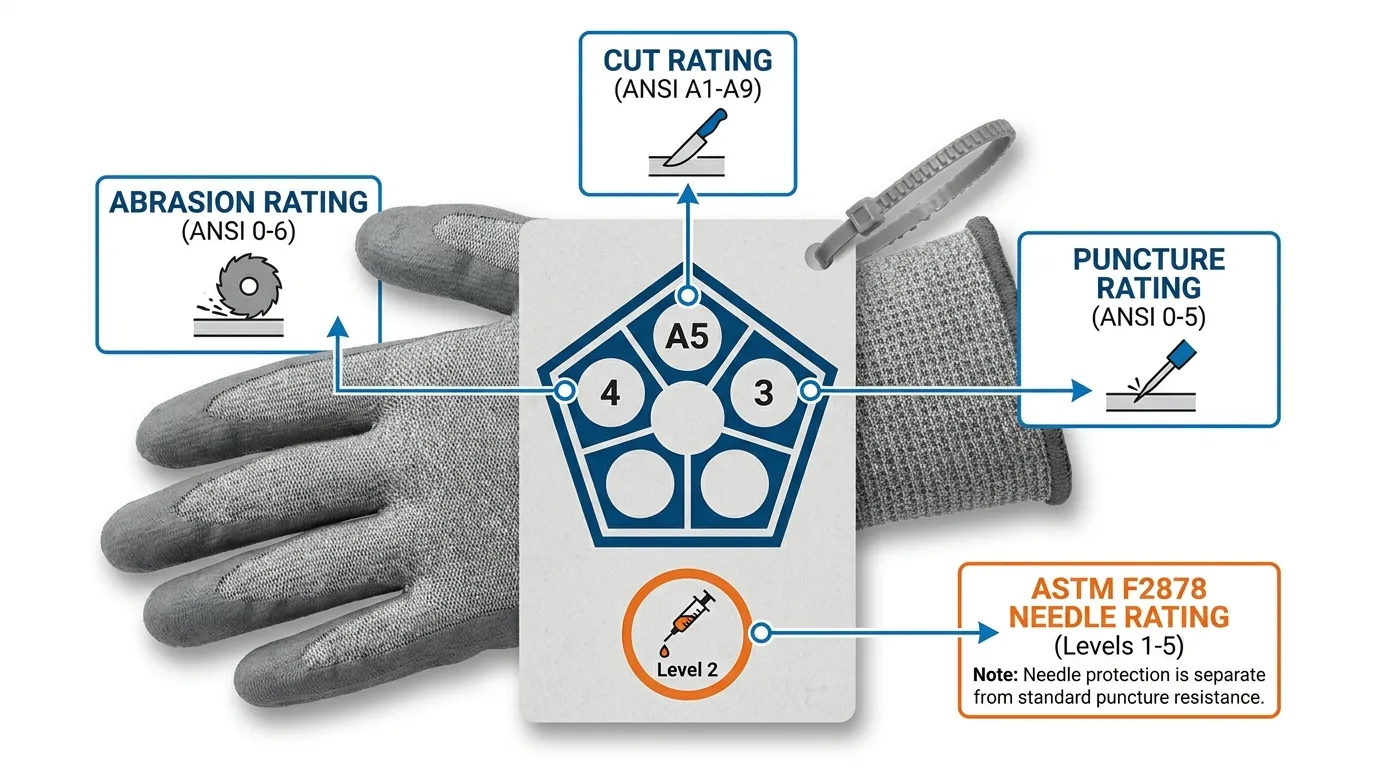
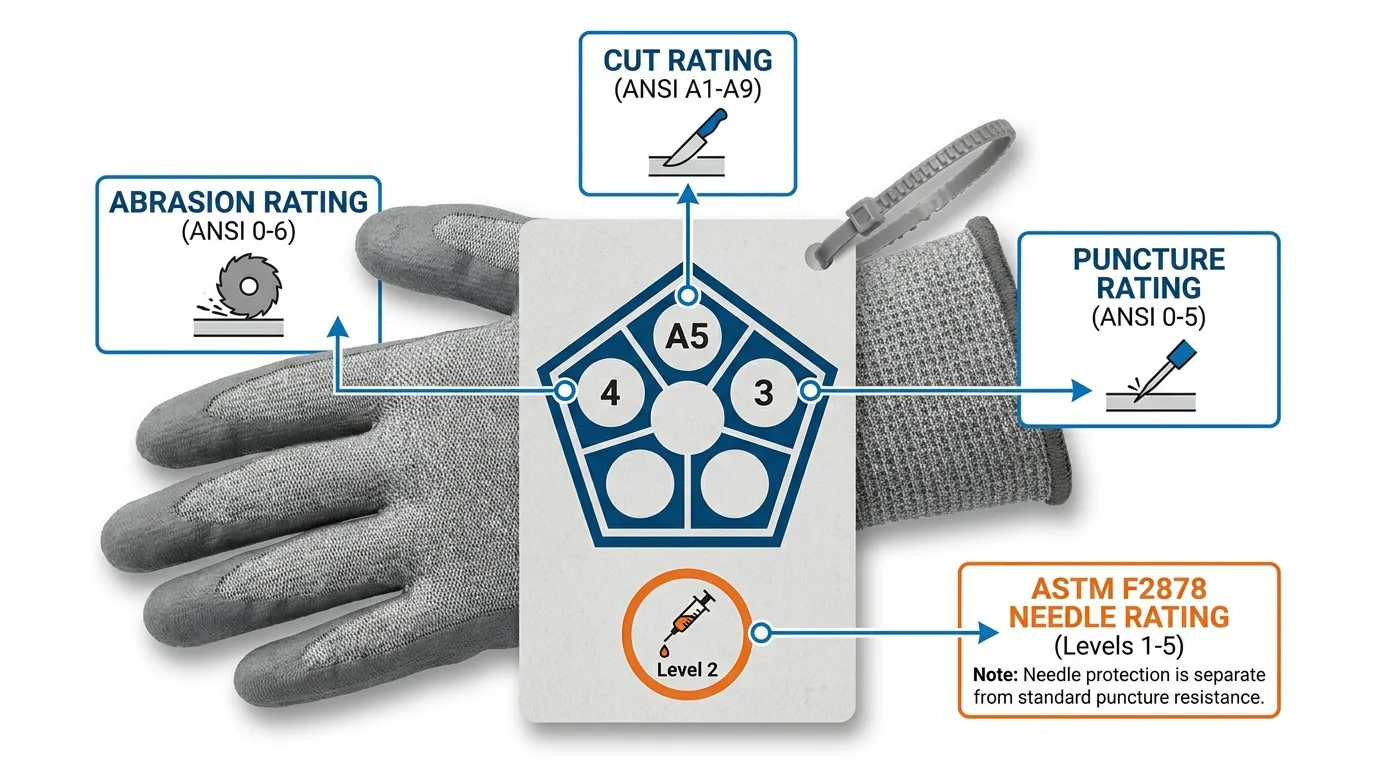
On the ANSI/ISEA 105-2024 pentagon label, the puncture rating appears on the right side. The cut rating sits at the top center, abrasion appears on the left, and an X means the property was not tested or not applicable.
The 2024 ANSI/ISEA 105 update made glove labels easier to compare by using a standardized pentagon badge. ISEA explains that the new badge places the cut rating at the top center, abrasion on the left, and puncture on the right. This gives buyers a faster way to check claims across competing tags.
Look for the standard year, the pictogram, and the exact rating position. If the puncture area shows X, do not treat the glove as puncture-rated. If a needle claim appears elsewhere on the tag, ask whether it is backed by ASTM F2878 data.
Quick label check
Find the ANSI/ISEA 105 badge.
Read the right-side puncture value.
Check whether any value is marked X.
Look for a separate ASTM F2878 needle rating.
Ask for the test report before approval.
What should a label decoder graphic show?
A useful label decoder graphic should show the ANSI/ISEA 105 pentagon badge and a separate needle-rating callout. The goal is to stop buyers from treating every puncture claim as the same type of protection.
Graphic element
What the label should show
Buyer meaning
Top center of pentagon
Cut rating
Cut protection is a separate performance claim
Left side
Abrasion rating
Abrasion resistance is not puncture resistance
Right side
Puncture rating
This is the ANSI blunt-puncture value
X marker
Not tested or not applicable
Do not treat that property as rated
Separate badge or callout
ASTM F2878 needle rating
Needed when hypodermic needles are a realistic hazard
Buyer note
Request the test report
Confirms the claim before procurement approval
This graphic should sit close to the label-reading section. Keep it simple enough for a purchasing manager, safety officer, or distributor sales team to use during product comparison.
Which rating should you choose for the hazard in front of your workers?
Choose ANSI puncture levels for blunt objects like nails, wire, glass, and metal edges. Choose ASTM F2878-rated gloves when hypodermic needles are a realistic exposure. Mixed-hazard work may require both claims.
Do not buy the highest puncture level blindly. It works when the hazard requires it, but over-specifying can reduce comfort and dexterity. If workers need grip, finger movement, or all-day wear, the best glove is the one that matches the hazard and still gets worn.
Worker task
Main hazard
Rating to verify
Extra claim to request
Buyer warning
Sheet metal work
Burrs, sharp edges, rough panels
ANSI puncture and ANSI cut
Coating grip data
Do not treat puncture level as cut level
Glass handling
Broken glass and sharp fragments
ANSI puncture and ANSI cut
Grip and fit details
Poor grip can increase handling risk
Recycling line
Mixed waste, glass, wire, syringes
ANSI puncture
ASTM F2878 if needles appear
ANSI puncture alone is not enough
Waste sorting
Trash debris and possible sharps
ANSI puncture
Needle rating for syringe exposure
Match the glove to real waste streams
Police or security search
Hidden hypodermic needles
ASTM F2878
Cut and abrasion data if needed
Generic puncture wording is too vague
Warehouse handling
Staples, cartons, light fasteners
Lower ANSI puncture may fit
Comfort and dexterity
Level 5 may be unnecessary
Heavy demolition debris
Nails, wire, metal scrap
High ANSI puncture
Cut and impact protection if needed
Check the full glove spec, not one number
A waste-management buyer should also review waste sorting gloves when needles, glass, and rough materials appear in the same process.
What should procurement ask suppliers before approving a glove?
A glove tag that only says “puncture-resistant” is not enough for procurement approval. Ask which test, which level, which standard year, and whether needle resistance was tested. This keeps the buying decision tied to evidence instead of marketing language.
Use this checklist before approving samples or issuing a purchase order:
Which standard was used, ANSI/ISEA 105-2024 or an older version?
What is the ANSI puncture level?
Is the claim for blunt puncture, hypodermic needle puncture, or both?
Was ASTM F2878 tested?
Can the supplier provide the test report?
Which glove area was tested?
Does the glove also need cut, abrasion, impact, or coating performance?
Have workers tested the glove in the real task?
For police and security teams, this step is especially important. A search glove may need cut, grip, and needle protection in one product. Start with the actual exposure, then compare police needle gloves against that risk profile.
No puncture-resistant glove should be treated as puncture-proof. HexArmor notes that no material protects against every puncture hazard. Field testing still matters because real workplaces have angles, motion, worn materials, and force levels that labels cannot show fully.
Where should buyers go next after decoding puncture ratings?
After you understand the label, move to the broader glove-selection question. If cut hazards are part of the job, use the cut-resistant glove guide to compare cut levels, materials, coatings, and application fit.
If your main issue is needle exposure, go deeper into needle-resistant glove construction and testing. If your workers handle waste or recycling, compare mixed-hazard gloves by task. If grip, oil resistance, or dexterity drives the decision, review coated and nitrile glove options before final approval.
What to Do Next
ANSI puncture rating explained for buyers comes down to one rule: match the rating to the hazard, not the marketing phrase. ANSI/ISEA 105 puncture levels help compare blunt industrial puncture resistance. ASTM F2878 is the separate needle test to request when syringes or hypodermic needles are realistic.
Before approving a glove, read the label, confirm the test method, request the report, and test samples with the workers who will wear them. That process prevents both under-protection and over-specification.
Frequently Asked Questions
What does ANSI puncture rating mean?
ANSI puncture rating means the glove material was tested for resistance to blunt puncture under ANSI/ISEA 105. It helps compare protection against hazards like nails, wire, metal edges, and debris, but it does not automatically mean needle-stick protection.
Is ANSI puncture level 5 needle resistant?
ANSI puncture level 5 is not the same as needle resistant. It shows high blunt-puncture resistance, while hypodermic needle protection should be verified with a separate ASTM F2878 rating.
What is ASTM F2878?
ASTM F2878 is the test method for measuring resistance to puncture by hypodermic needles. ASTM describes it as a method for determining the force needed for a hypodermic needle to penetrate protective clothing material.
Where is puncture shown on the ANSI/ISEA 105-2024 label?
Puncture appears on the right side of the ANSI/ISEA 105-2024 pentagon label. ISEA says cut is shown at the top center, abrasion on the left, and puncture on the right.
Are nitrile gloves puncture resistant?
Some nitrile-coated gloves may offer limited puncture resistance, but buyers should not rely on coating material alone. The safer procurement step is to check the ANSI puncture rating and, if needles are present, the ASTM F2878 rating.
Are puncture-resistant gloves puncture-proof?
No puncture-resistant glove should be treated as puncture-proof. Ratings help buyers compare tested materials, but real hazards vary by object shape, angle, force, wear, and worker movement.