


Subscribe for NMSafety News
What ANSI A9 Means for Your Puncture Proof Glove Safety
12 Jan, 2026
By hqt

Safety on the line, in the yard, and out at the job site improves when terms on a spec sheet translate into performance in the hand. That's exactly where ANSI A9 matters. It's not a buzzword. It's a measurable ceiling of cut resistance that gives safety managers a consistent yardstick for risk, cost exposure, and gear selection. When a Puncture Proof Glove carries an ANSI A9 cut rating, you're looking at a glove built to tolerate punishing contact with sharp, continuous edges - think trimmed steel, sheet metal, or raw glass - without surrendering to a catastrophic slice.
Why ANSI A9 Deserves Your Attention
Cut injuries don't just send people to the clinic; they ripple through schedules and budgets with lost-time incidents, overtime, scrapped work, and morale hits. ANSI A9 is the highest cut rating in widely used industrial standards, signaling a glove engineered to resist severe cutting forces. For decision-makers, that rating anchors procurement and training to a documented performance threshold rather than marketing language. In short, an ANSI A9 Puncture Proof Glove buys you margin - protection against the outlier event that does the most damage.
- Two Hazards, Two Stress Modes: Cuts vs. Needlesticks
Modern workflows rarely separate edge hazards from point hazards. A technician aligns a steel strip and then trims wire. A glass handler repositions a pane and brushes a hidden shard. These scenarios are common, and the physics behind them are different:
- A cut is a longer contact across a sharpened edge under load; the stress is distributed along that edge.
- A needlestick concentrates force into a pinpoint, driving a fine tip through the material.
ANSI A9 addresses the first problem - cutting by edges - using a standardized cut test method (e.g., TDM-100) under ANSI/ISEA 105. Needlestick resistance is typically assessed with hypodermic-needle testing, often referenced to ASTM F2878. NMSafety designs address both. Our Puncture Proof Glove solutions combine an ANSI A9 cut-rated liner with steel-fabric reinforcements positioned at the palm and fingertips - where force peaks during pushes, pinches, and controlled lifts - to achieve high needle puncture performance (up to level 5 per widely accepted needle test methods). The result is straightforward: one glove platform that standardizes protection across tasks where edges, points, and burrs overlap.
- Where Injuries Really Happen
Severe injuries often begin with small breakdowns: a momentary loss of grip, a rushed adjustment in a tight space, a glove that feels too bulky so the operator "cheats” by removing it. On glass lines, operators manage fresh-cut edges and awkward offcuts. Micro-slips during repositioning are the danger zone, because a new edge can act like a razor. In steel processing, trimmed strips shed unpredictable burrs while wire ends and pins turn up needle hazards. Manufacturing pulls it all together - fasteners, blades, and tooling points mixed with sheet edges and shims. This is the world we design for.
How NMSafety Builds a Better Puncture Proof Glove
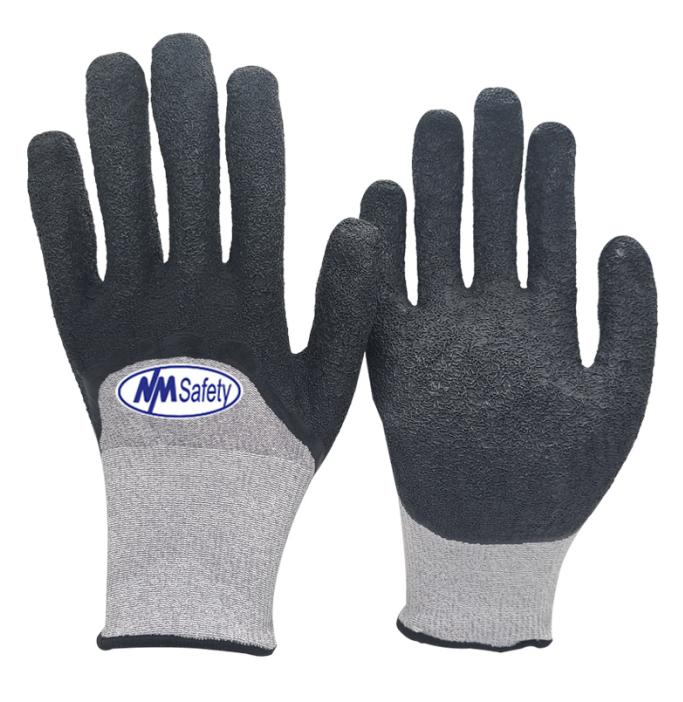
The foundation is a composite yarn liner designed for serious cut exposure without sacrificing feel. Our 18-gauge knitted liner blends nylon, HPPE, and steel fiber to create a thin yet robust barrier. The gauge choice is intentional: at 18-gauge, the glove maintains tactile feedback for aligning parts, feeding material, and making fine adjustments, rather than forcing a trade-off between safety and dexterity.
We layer targeted reinforcements where hands bear the brunt of point loads. Steel-fabric panels at the palm and fingertips diffuse pressure from fine points and slow needle penetration at the exact contact zones that fail first. To stabilize handling, a crinkle latex palm coating provides a dependable, dry-condition grip. That texture reduces grip variability - the tiny slips and regrips that compound into drops, misalignment, and accidental contact with sharp edges.
- What This Design Aims to Solve?
Across industries, the pain points are predictable:
- Bulky gloves erase fingertip sensitivity, so workers improvise by removing PPE for precision tasks.
- Inconsistent grip generates micro-errors that escalate into cuts.
- Variable quality between batches erodes trust and compliance.
- Misread standards cause mismatched specs and persistent exposure.
NMSafety counters these pitfalls with controlled manufacturing, documented ratings, and design choices grounded in field use. The objective is a Puncture Proof Glove that people actually wear because it protects without getting in the way.
From Spec Sheet to Daily Use: Make Deployment Count
The right glove on paper only delivers if fit, training, and replacement discipline are dialed in. NMSafety supports safety, operations, and procurement with a rollout framework tuned to how work really happens.
- Fit and sizing
- Fit affects everything from grip strength to fatigue. Too loose and the glove slips; too tight and fine control suffers.
- We offer sizes M through 3XL. Fit-test by task as well as by hand size, because the motions and force vectors at each station differ.
- Training and inspection
- Teach teams to connect ratings to real hazards: edge exposure versus point exposure, and what each feels like in hand.
- Focus inspection on high-pressure zones - the palm and fingertips - where reinforcement works hardest and wear shows first.
- Replace gloves proactively, before protection dips. Document pre-rollout incident baselines and track near misses and cut events after adoption. Use the data to refine glove allocation and coaching.
- Procurement and continuity
- Align order cycles to usage rates and the rollout schedule, and build buffer stock to cover lead times.
- Our minimum order quantity is 1,200 pairs, with typical lead times of 60 - 120 days - parameters that help multi-site operations plan replenishment without surprises.
- Use customization (logo, color accents, packing) to simplify field identification and reduce misallocation across tasks or shifts.
- Materials and features at a glance
- 18-gauge nylon/HPPE/steel fiber liner for ANSI A9 cut resistance with high dexterity.
- Steel-fabric reinforcements at palm and fingers to achieve high hypodermic needle puncture performance (up to level 5 per industry-accepted methods).
- Crinkle latex across the palm anchors tools and materials, reducing slip events.
Practical Steps to Standardize Protection with One Puncture Proof Glove:
•One-glove baseline: Use the standard glove for 80 - 90% of tasks with combined cut/needle risk.
•Exception list: Identify tasks where the glove is unsafe (rotating machinery) or insufficient (chemical exposure, high heat); specify alternative PPE or administrative controls.
•Engineering first: Reduce sharp/needle hazards via deburring, shields, better fixturing, and needle-safe containers.
•Temporary controls: Allow double-gloving or liners for extreme fine-point work until engineering changes are complete.
•Track near misses, cut events, and glove consumption; feed insights back into training and stocking.
•Plan procurement around consumption trends; incorporate MOQs, color-coding, and lead times into your schedule.
•Standardize models by task category to simplify training and inventory.
What Changes When the Glove is Right
An ANSI A9, needlestick-capable Puncture Proof Glove helps teams move from basic compliance to confident execution. Operators are less tempted to swap to thin liners for precision tasks because the 18-gauge build preserves feel. Grip stabilizes during repetitive lifts and feeds, reducing micro-slips and the errors they cause. And by unifying protection across departments, you cut confusion, speed up training, and keep inventory coherent.
The NMSafety formula is simple: remove the unhelpful trade-offs. The composite 18-gauge liner holds the line against severe cuts while keeping tactile control. Steel-fabric reinforcements defend the pressure points most exposed to needles and fine tips. A crinkle latex palm locks in reliable grip in dry conditions. The combination targets the real pain points - dexterity, consistency, and zone-specific defense - without turning the glove into a rigid shell.
Your next step: partner with NMSafety
Consolidate to a single, high-spec puncture-proof glove to improve compliance, cut incident rates, and simplify inventory. Engage NMSafety for hazard mapping, fit-testing across roles, sample kits, and a phased deployment plan that minimizes disruption to output. We will help map tasks to protection needs, tie ANSI A9 and needle puncture ratings to real exposures, confirm fit across sizes M to 3XL, and synchronize procurement with demand and lead times.
Safety improves when protection is built into everyday motions and maintained through consistent training and supply. Contact NMSafety to design a hand protection program that brings documented performance together with field-tested usability. With the right Puncture Proof Glove and a disciplined deployment, teams work with confidence, lines keep flowing, and injuries that derail schedules and budgets become the rare exception.
