Home > Uncategorized > HPPE vs Kevlar Gloves: Cut Level, Cost & Wear
HPPE vs Kevlar Gloves: Cut Level, Cost & Wear
04 May, 2026
By arafatshuvo509
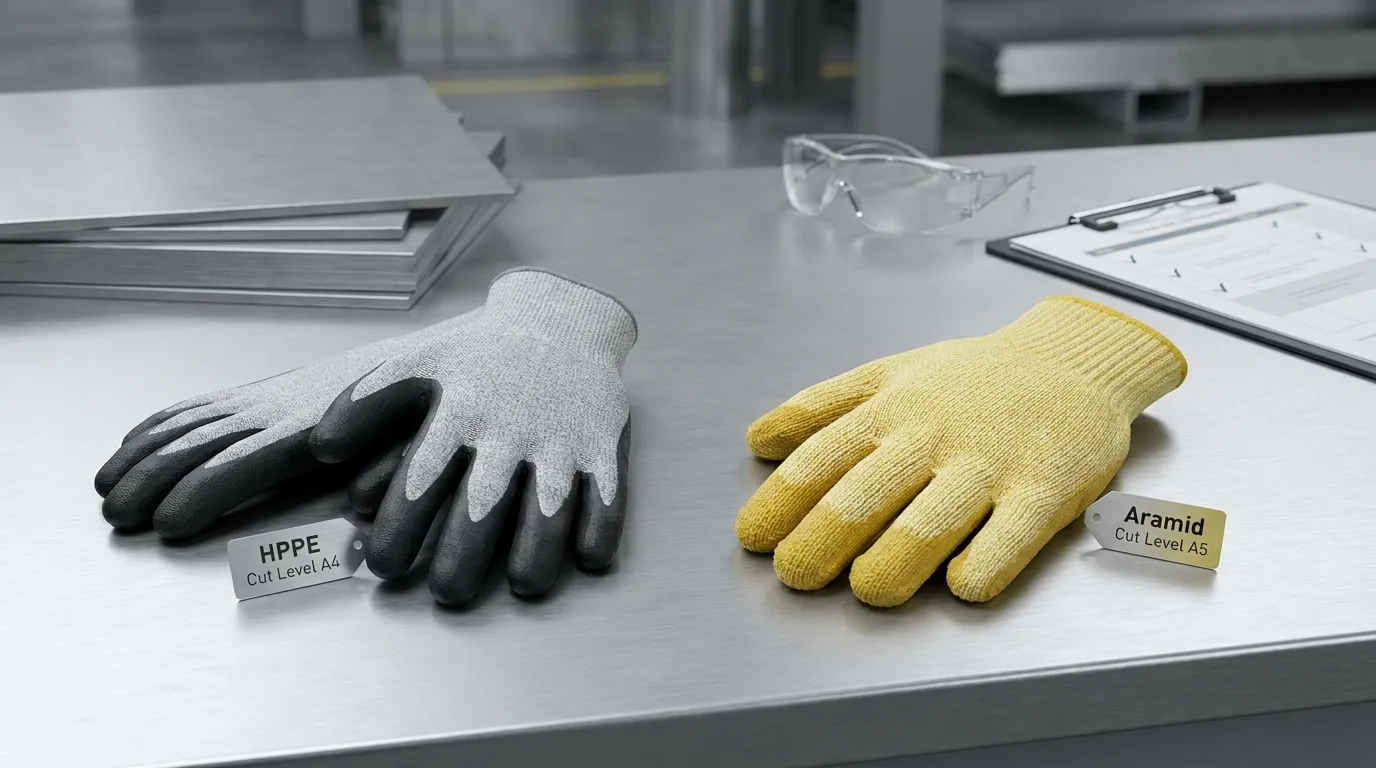
HPPE vs Kevlar gloves comes down to task conditions, not brand reputation. Compare ANSI cut grams first, then heat, wear life, washability, comfort, and cost-per-wear. HPPE usually fits general industry, food, assembly, and sheet metal handling. Kevlar is the safer choice when cut protection must overlap with heat, sparks, flame, or hot parts.
Procurement teams often hear one simple claim: Kevlar is better. That sounds easy, but it can lead to the wrong glove for the job. A glove that protects well near heat may feel too warm for long assembly shifts. A light HPPE glove may perform well in cool handling but fail the wrong heat test. The smarter question is not which material sounds stronger. It is which glove fits the hazard, cut level, wear pattern, and budget.
What is the real difference between HPPE and Kevlar gloves?
HPPE and Kevlar are different fibers, not two names for the same glove material. HPPE is high-performance polyethylene used for cool, flexible cut protection. Kevlar is a para-aramid fiber used when cut protection must overlap with heat risk.
HPPE is a lightweight synthetic fiber often used in cut-resistant gloves for assembly, metal handling, glass handling, food processing, and warehouse work. It is valued for flexibility, low weight, and comfort. Dyneema, a well-known HPPE-style fiber, highlights lightness, dexterity, abrasion resistance, washability, and cut protection in glove applications through its cut-resistant glove material guidance.
Kevlar is a para-aramid fiber. It is known for strength, cut resistance, and heat-resistant PPE uses. DuPont describes Kevlar as a lightweight material used in cut-and-heat-resistant protection, which is why many buyers connect it with tougher work environments and hot-part handling.
Point of comparison
HPPE gloves
Kevlar gloves
Fiber family
High-performance polyethylene
Para-aramid
Main strength
Comfort, dexterity, moisture resistance
Heat and cut protection overlap
Typical feel
Light, cool, flexible
Tougher, sometimes warmer
Best starting point
General cut-risk work
Cut risk plus heat risk
Buyer warning
Not for untested heat exposure
Not always the best comfort choice
For a broader view of cut levels, coatings, and glove selection, use NMSafety’s cut-resistant glove buyer’s guide. This article stays focused on the HPPE and Kevlar material decision.
Is Kevlar more cut resistant than HPPE?
Kevlar is not automatically more cut resistant than HPPE. For buying decisions, compare the certified ANSI cut level and gram range first, then compare comfort, heat, abrasion, and cost for the same cut rating.
The material name does not replace test data. A Kevlar glove and an HPPE glove can sit in the same ANSI cut level, depending on yarn, coating, gauge, and reinforcement. That is why buyers should ask for the glove’s tested ANSI rating before judging the fiber.
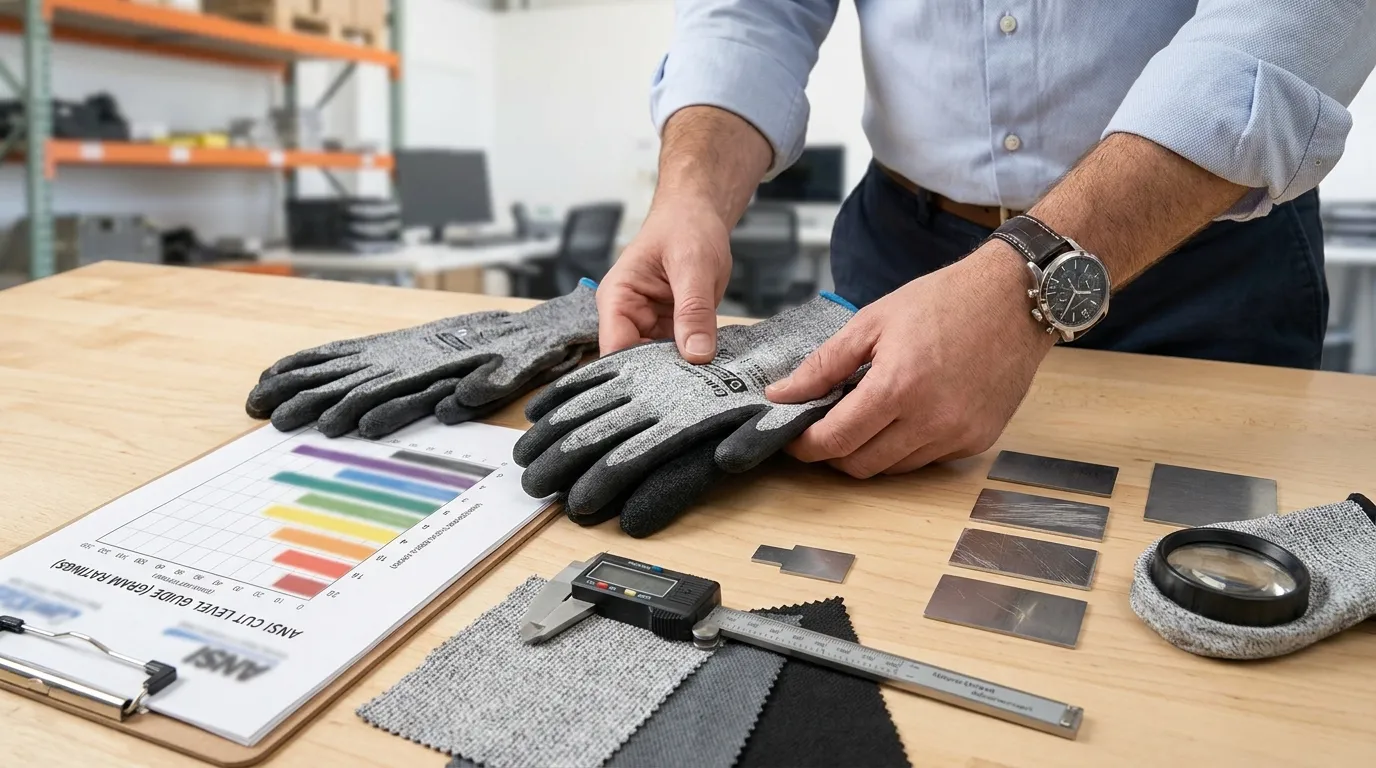
ANSI cut levels are measured by grams of force. The ANSI cut-level chart explains that ANSI A1 starts at 200 to 499 grams, and ANSI A9 reaches 6,000 grams or more. That gram range is more useful than a product page saying “high cut protection.”
ANSI cut grams buyers should compare
ANSI cut level
Gram range
Buyer meaning
A1
200 to 499 g
Light cut risk
A2
500 to 999 g
Light to moderate cut risk
A3
1,000 to 1,499 g
Moderate cut risk
A4
1,500 to 2,199 g
Common industrial cut risk
A5
2,200 to 2,999 g
Higher cut risk
A6
3,000 to 3,999 g
Heavy cut risk
A7
4,000 to 4,999 g
Severe cut risk
A8
5,000 to 5,999 g
Very severe cut risk
A9
6,000 g or more
Extreme cut risk
A useful rule is simple: compare A4 to A4, A5 to A5, and A6 to A6. Superior Glove’s cut-resistant glove guidance notes that 100% HPPE or 100% para-aramid may offer up to ANSI A3, but engineered yarns can reach higher levels. That means blends matter. If your team needs the full selection process beyond material choice, see choose cut gloves.
How do HPPE and Kevlar compare side by side?
HPPE usually wins for cool, flexible work. Kevlar wins when heat, sparks, or flame risk enters the job. The real answer changes once you add coating, yarn blend, glove gauge, and the exact ANSI cut rating.
Use this table as a first screen before requesting samples.
Buyer factor
HPPE gloves
Kevlar gloves
Practical buying note
Cut protection
Can perform well, especially in engineered blends
Can perform well, especially in aramid blends
Compare ANSI grams first
Abrasion life
Often strong in general handling
Can be strong, but construction matters
Coating wear may decide lifespan
Heat tolerance
Weak choice for untested heat exposure
Stronger starting point near heat
Ask for heat or FR test data
Flame risk
Many HPPE gloves are not flame resistant
Better fiber family for heat and flame
Full glove still needs testing
Comfort
Usually light and flexible
Can feel warmer or stiffer
Worker acceptance matters
Washability
Often good in washable programs
Check laundering limits
Avoid bleach unless approved
Moisture
Resists moisture well
May absorb moisture depending on build
Important for sweaty work
Unit cost
Often competitive
Often higher, but varies
Do not buy on unit price only
Best use
General industry, assembly, food, cool handling
Hot parts, sparks, thermal overlap
Match glove to hazard
This is where the “Kevlar is always better” idea breaks down. Kevlar is better when heat is part of the task. HPPE is often the smarter daily-use option when workers need comfort, dexterity, and steady cut protection during long shifts.
Which lasts longer after abrasion, sweat, washing, and UV?
HPPE often performs better in sweaty, wet, washable, or UV-exposed work because it resists moisture and stays cooler. Kevlar can still be durable, but buyers should check laundering instructions, bleach exposure, coating wear, and replacement frequency before assuming longer life.
Wear life is not only about the fiber. A glove can lose value because the coating wears smooth, workers reject the fit, or laundering damages the yarn. That is why procurement should compare field life, not only lab cut level.
Some competitor guidance notes that para-aramid fibers can be weakened by UV, moisture, or harsh washing. Dyneema’s glove guidance says its fiber-based gloves keep protection after washing, which makes HPPE-style materials attractive for washable programs. For a deeper laundry-focused article, send readers to washable cut gloves.
Work condition
HPPE buying note
Kevlar buying note
Sweaty shifts
Usually comfortable and moisture resistant
Can feel warmer in some builds
Wet handling
Often a strong starting point
Check drying and laundering limits
UV exposure
Often less affected
Check supplier guidance
Repeated washing
Ask for wash-cycle guidance
Avoid bleach unless approved
Abrasion-heavy work
Coating and yarn blend matter
Coating and yarn blend matter
A food processing wash program is a good example. If the glove needs repeated cleaning, comfort, and good dexterity, HPPE or Dyneema-style gloves deserve early testing. For oily metal or high-abrasion sheet work, the palm coating may decide glove life more than the fiber name.
Can HPPE gloves handle heat, sparks, or hot parts?
Do not choose HPPE for sparks, flash fire, hot metal, welding, or unpredictable heat unless the full glove is tested for that hazard. Kevlar or another rated heat-resistant construction is safer when cut protection must overlap with flame or heat exposure.
HPPE is thermoplastic. That means heat can be a serious problem if the glove is not designed and tested for the exposure. DuPont warns in its FR glove guidance that many HPPE and polyester fiber gloves are not flame resistant and may melt or burn during flash-fire testing.
Kevlar is the better starting point when the job includes sparks, hot surfaces, or flame risk. That does not mean any Kevlar glove is safe for every heat task. The full glove still needs the right construction, coating, liner, and tested rating.
Use this heat-risk checklist before choosing HPPE:
Are workers near sparks or welding spatter?
Do they touch hot metal, hot glass, or heated parts?
Could the glove face flash fire or flame exposure?
Is the heat contact brief, repeated, or unpredictable?
Does the supplier provide heat or FR test data for the full glove?
A welding-adjacent maintenance team should not choose standard HPPE only because the cut level looks right. For a sheet metal line without hot parts, HPPE may be a better comfort choice. For more task-specific selection, use NMSafety’s guide to sheet metal gloves.
Which glove is better for comfort, dexterity, and worker compliance?
HPPE is usually the better comfort choice for long shifts, small-part handling, food processing, electronics, and general assembly. Kevlar can still work, but only if the heat or abrasion benefit is worth the possible loss in coolness and dexterity.
Comfort affects safety because workers are more likely to remove gloves that feel hot, bulky, or hard to use. Dyneema connects glove comfort and dexterity with actual worker acceptance in cut-resistant applications. That matters in jobs where workers handle small parts, tools, cartons, metal edges, or food products for hours.
HPPE gloves often feel lighter and cooler. Kevlar gloves can be the right choice, but they should earn that place through heat risk, tested durability, or task-specific need. Do not pay for a tougher-sounding material if workers stop wearing it.
Buyer checks for comfort testing:
Can workers grip small parts without over-squeezing?
Does the glove stay comfortable after two to four hours?
Does the palm coating match dry, wet, or oily grip?
Is the cuff comfortable enough for repeated use?
Do workers remove the glove during detailed tasks?
For food lines, the comfort decision often sits beside hygiene, washing, and cut level. That makes food processing gloves a natural next step after the material comparison.
How should procurement compare unit cost and cost per wear?
Unit cost is only the first number. Cost-per-wear is the better buying metric because it includes replacement speed, laundering, worker acceptance, and whether the glove fits the real hazard.
A cheap glove can become expensive if workers replace it every few shifts. A higher-priced glove can be cheaper if it lasts longer and workers keep it on. The fair comparison is same cut level, same task, same shift length, and similar coating.
Simple cost-per-wear formula
Use this basic formula:
Cost per wear = glove unit cost ÷ expected number of safe wears
Option
Unit price
Expected safe wears
Cost per wear
Buyer note
HPPE glove
$6
10 shifts
$0.60
Better if no heat risk exists
Kevlar glove
$8
8 shifts
$1.00
Worth it if heat risk requires it
Engineered yarn glove
$10
15 shifts
$0.67
Strong option if cut level and comfort fit
This calculation is simple, but it changes the buying conversation. If the task has no heat risk, the $6 HPPE glove may be the better general industry choice. If the task includes sparks or hot parts, the $8 Kevlar glove may still be the correct buy because the lower-cost glove does not match the hazard.
Procurement should also track rejection rate. If workers remove a glove because it is too hot or stiff, its paper cost no longer matters. The lowest cost glove is the one that protects, lasts, and gets worn.
HPPE or Kevlar: what should you buy?
Buy HPPE for most general cut-risk jobs where comfort, dexterity, washability, and cost-per-wear matter. Buy Kevlar when heat, sparks, flame, or hot surfaces are part of the task. For severe cut hazards, compare engineered yarn test ratings, not material names.
This is the one-page recommendation: HPPE for general industry, Kevlar where heat is in the mix. That rule is simple enough for first screening, but final approval should still follow the glove’s certified cut rating and the full task hazard.
OSHA’s PPE guidance says protective equipment should meet relevant accepted standards, including ANSI, ISEA, ASTM, NIOSH, and NFPA where applicable. ISEA also explains that ANSI/ISEA 105 covers hand and arm protection classifications for hazards such as cut, puncture, abrasion, and chemicals.
Buyer scenario
Main hazard
Better starting material
Required proof
Watch-out
Recommendation
General assembly
Moderate cuts, long wear time
HPPE
ANSI cut rating
Poor fit reduces use
Start with HPPE A3 to A4
Food processing
Cut risk, washing, comfort
HPPE
Cut rating and wash guidance
Hygiene and laundering
Test HPPE washable gloves
Sheet metal without heat
Sharp edges, abrasion
HPPE blend
ANSI A4 to A6 data
Coating wear
Test HPPE with proper palm coating
Glass handling
Cuts, grip, abrasion
Engineered HPPE blend
Cut and grip data
Wet grip needs testing
Sample coated HPPE blends
Welding-adjacent work
Cuts plus sparks
Kevlar or rated heat glove
Heat and cut test data
Standard HPPE can melt
Start with Kevlar-style heat protection
Hot metal handling
Cut plus hot surfaces
Kevlar or heat-rated glove
Heat contact rating
Fiber alone is not enough
Choose tested heat construction
Wet washable program
Cuts, moisture, laundering
HPPE
Wash-cycle guidance
Bleach may damage some fibers
Test HPPE for repeated wash use
High abrasion plus heat
Abrasion and thermal risk
Kevlar blend or engineered glove
Abrasion, cut, heat data
Coating must match task
Run field trials before bulk order
A general assembly buyer needing A3 to A4 protection should start with HPPE because comfort and dexterity drive daily use. A sheet metal buyer needing A4 to A6 protection should test HPPE blends with the right palm coating unless hot parts are present. A welding-adjacent buyer should move toward Kevlar or another heat-rated glove, even if HPPE has a tempting unit price.
What to Do Next
The safest HPPE vs Kevlar gloves decision starts with the hazard, then the certified cut level, then field testing. Ask suppliers for ANSI cut data, heat or FR test data when needed, laundering guidance, and samples for worker trials. If the job is cool, dry, and comfort-sensitive, HPPE should be the first sample. If heat, sparks, flame, or hot parts are present, start with Kevlar or another tested heat-resistant construction. Do not let material branding replace test data.
Frequently Asked Questions
Are Kevlar Gloves Heat Resistant?
Yes, Kevlar gloves are heat resistant when the glove construction is designed and tested for that hazard. Kevlar fiber has a heat and flame advantage over HPPE, but buyers still need to confirm the full glove’s heat or FR rating.
Can HPPE Gloves Be Used in High-Heat Environments?
No, HPPE should not be the default choice for high-heat environments. HPPE is thermoplastic and may melt or burn under heat or flame exposure, so use a tested heat-resistant glove when sparks, welding, or hot parts are present.
Which Material Offers Better Dexterity, Kevlar or HPPE?
HPPE usually offers better dexterity because it is lighter, cooler, and more flexible in many glove designs. Kevlar can still be comfortable, but it is often chosen for heat or tougher-duty conditions rather than fine handling alone.
Are Kevlar Gloves More Durable Than HPPE Gloves?
Not always. Kevlar can be durable in harsh work, but HPPE may hold up better in wet, sweaty, washable, or UV-exposed environments depending on the yarn, coating, and laundering method.
How Do I Choose Between Kevlar and HPPE Gloves?
Choose by hazard first, then by certified cut level. HPPE fits general cut protection where comfort and cost-per-wear matter, while Kevlar fits jobs where cut risk overlaps with heat, flame, sparks, or hot surfaces.
Is Kevlar more cut resistant than HPPE?
Kevlar is not automatically more cut resistant than HPPE. An ANSI A4 glove should be compared against another ANSI A4 glove by certified gram range, then judged by heat, comfort, washability, and wear life.